Anthropic
A ten-minute note on what you have to believe at $70 to $78 a share, then the full deep dive.
To us, Anthropic is the most exciting institution yet built. We grew up in the Effective Altruism community, and its public-benefit structure and its work on bringing AI into the world safely resonate with us.
The most important company of our generation now needs public-market money to fund its next stage and to honour about $900B of compute commitments. You, the retail or fund investor, have to decide whether that is worth backing. This report answers the questions we find most pressing for that decision.
One admission. On each foundation-model investment or job Romil has weighed, he has made the classic mistake of being wrong in the short term, above all on how fast this layer turns into a commodity. Anthropic stands out today on model performance. The question we dig into is whether that advantage lasts or whether the extra benefit of a better model shrinks.
Whether or not Anthropic succeeds in the long run, expect to feel foolish at many points while its shares trade. Keep in mind the line usually attributed to Keynes: “The market can remain irrational longer than you can remain solvent.”
The note
The call and the argument behind it. Each section links to the deep dive that backs it.
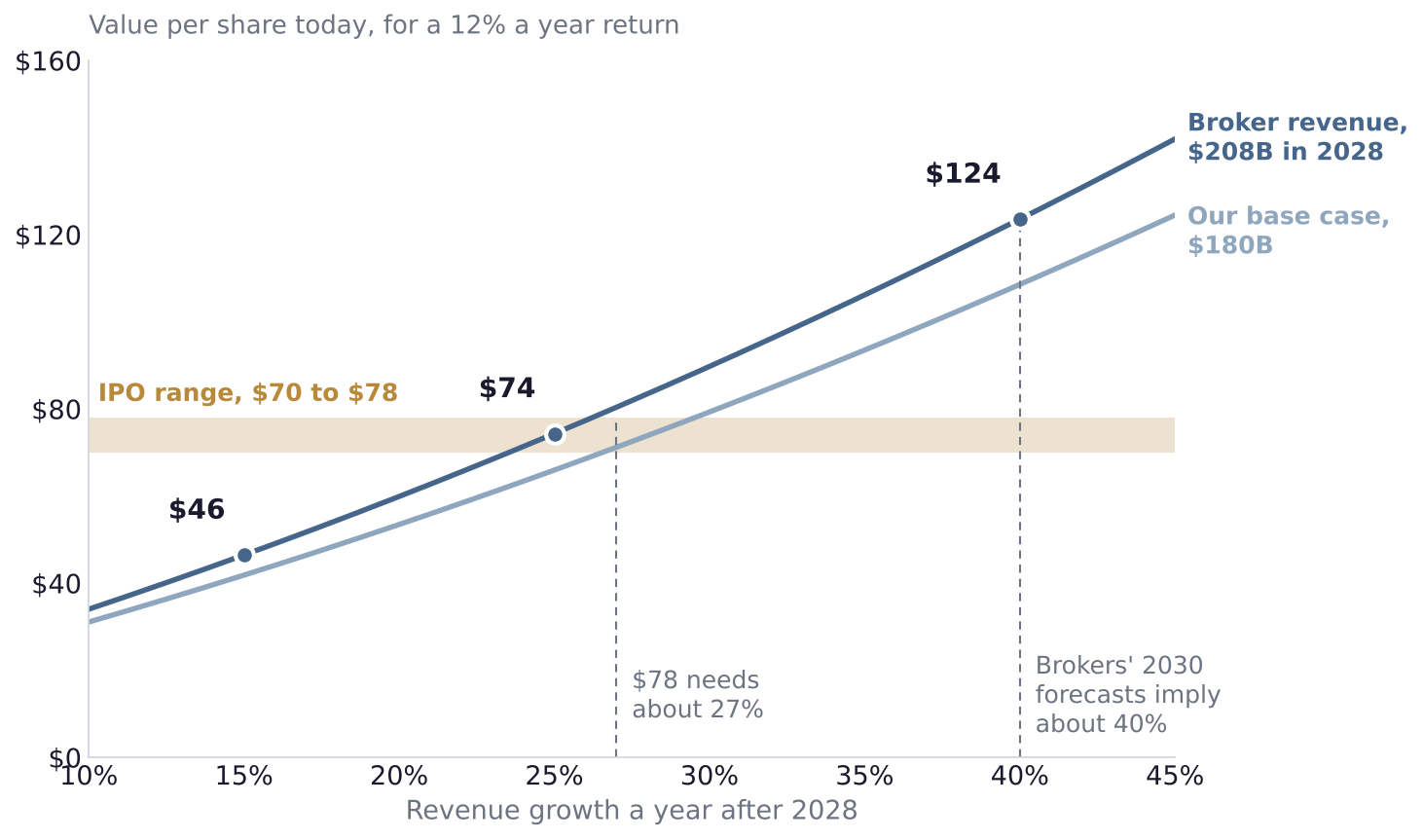
- Our view: at $70 to $78 a buyer pays for less growth than brokers forecast. The range needs revenue near $208B in 2028 and about 27% growth a year after it. Brokers' 2030 forecasts imply about 40%.
- What that growth is worth: priced the way investors price listed peers today, 40% growth makes the shares worth $109 to $124. Greenwich puts fair value at $80 to $104, and Morningstar at $1.7T against $1.36T at $78.
- Where it gets harder: $100 needs about 34% growth after 2028. Above about $110 a buyer pays for broker forecasts in full and takes nothing off for the $900.9B compute bill.
- What would make us wrong: if growth falls to 15% after 2028 the shares are worth $42 to $46. Two of the six beliefs below run against the buyer today.
- The first trade: our view covers the range. Anyone without an allocation pays the market price on 19 November, and with orders at about seven times the shares on offer that price may sit well above $78.
- Conflict: Claude, a model made by Anthropic, helped write this note and is no licensed adviser. The call is chokepoints.ai's own.
| Belief and our read | Evidence today |
|---|---|
| 1. Companies' spending on AI models triples by 2028, from about $122B a year to about $390B Supportive | Anthropic's revenue is 13 times last year's, and in Q3 usage added ten dollars for each dollar of price cuts. US business spending on AI still rose in October, by 1.65% on Ramp's card data (1.2, 1.3) |
| 2. Anthropic takes about 48% of that spending, against about 44% today Mixed | Menlo's survey has Anthropic at 55% of enterprise model spending, up from 40%. Ramp's weekly data has it at 49.3%, down from 53.2% four weeks earlier. OpenAI's models finish the same tests for less money (2.2, 2.7) |
| 3. Companies keep paying top prices for Opus and Fable while cheap models take routine work Mixed | Frontier models took 69.5% of business model spending in October, up from 67.7%. Open models carry 19% of enterprise tokens for 4% of the money. Fable's slow start, and savings of 50% to 90% at firms that switched, show the limits (1.6, 2.7) |
| 4. Revenue grows faster than the compute bill, so training and research fall from 44% of revenue towards 30% Concern | In Q3 the compute bill grew 77% on the quarter and revenue 47%. Anthropic owes $70.7B for compute in the next twelve months and has $10.4B of revenue under contract for the same period (1.7, 2.4) |
| 5. Anthropic still grows about 27% a year after 2028, and investors pay for growth as they do today Mixed | Broker forecasts imply about 40% a year from 2028 to 2030. Listed AI companies trade at 9 to 97 times sales, and the two listed Chinese model labs lost about 90% of their value in five months. Insiders can sell 1.6 billion shares within 76 days (3.1, 3.3) |
| 6. No court or government order removes a large block of revenue Concern | An appeals court upheld the Department of War's label. US export rules switched two Claude models off in June. The revenue exposed runs from under 2% to a mid-single-digit share (2.6) |
- The count: one belief has clear support, three are open and two run against the buyer today. A buyer at $78 needs all six.
1At $78 you pay for 27% growth after 2028
Work back from $78 and you reach one number: the rate Anthropic still grows at after 2028. The range needs about 27% a year. Brokers forecast about 40%, so at the range you pay for two-thirds of what they expect.
- From price to value: $78 times 17.5 billion shares, counting options and awards, is $1.36T. For a 12% return a year the business has to be worth $1.50T in 2028, after taking off $213B of cash.
- Why 2028: it is the first year in which brokers expect Anthropic to grow at a rate listed companies show today. They forecast 175% for 2027 and 38% for 2028, and no listed peer grows 175%.
- How investors pay for growth: 15 listed AI infrastructure, cloud and software companies trade at 6.8 times next year's sales for 31% growth. That is about 0.2 times sales for each point of growth.
- What $78 needs: $1.50T on $208B of 2028 revenue is 7.2 times sales, the rate those peers get for about 27% growth.
- AI companies get more than software: listed AI companies trade at 9 to 97 times sales, against 2.2 for the median software company. Z.ai and MiniMax, the two Chinese model labs listed in Hong Kong, show the risk: both traded above 600 times sales and lost about 90% of their value in five months.
- Why we take less than the peer rate: Anthropic owes $900.9B for compute whether revenue arrives or not. CoreWeave, which rents AI compute and carries $62B of net debt, trades at 9 times sales while growing 168%.
Go deeper: 3.1 the full valuation
2Growth can hold, and share is the weak point
The market is big enough. The average Fortune 500 customer spends under 0.1% of its costs on Claude, and usage is rising ten times faster than prices fall. Our worry is share: forecasts need Anthropic to take over half the market, and both weekly trackers turned down in late October.
- Revenue today: $17.0B in Q3, 12 times a year earlier. Quarterly growth slowed from 144% to 47%, and the pace at 31 October was $81B a year.
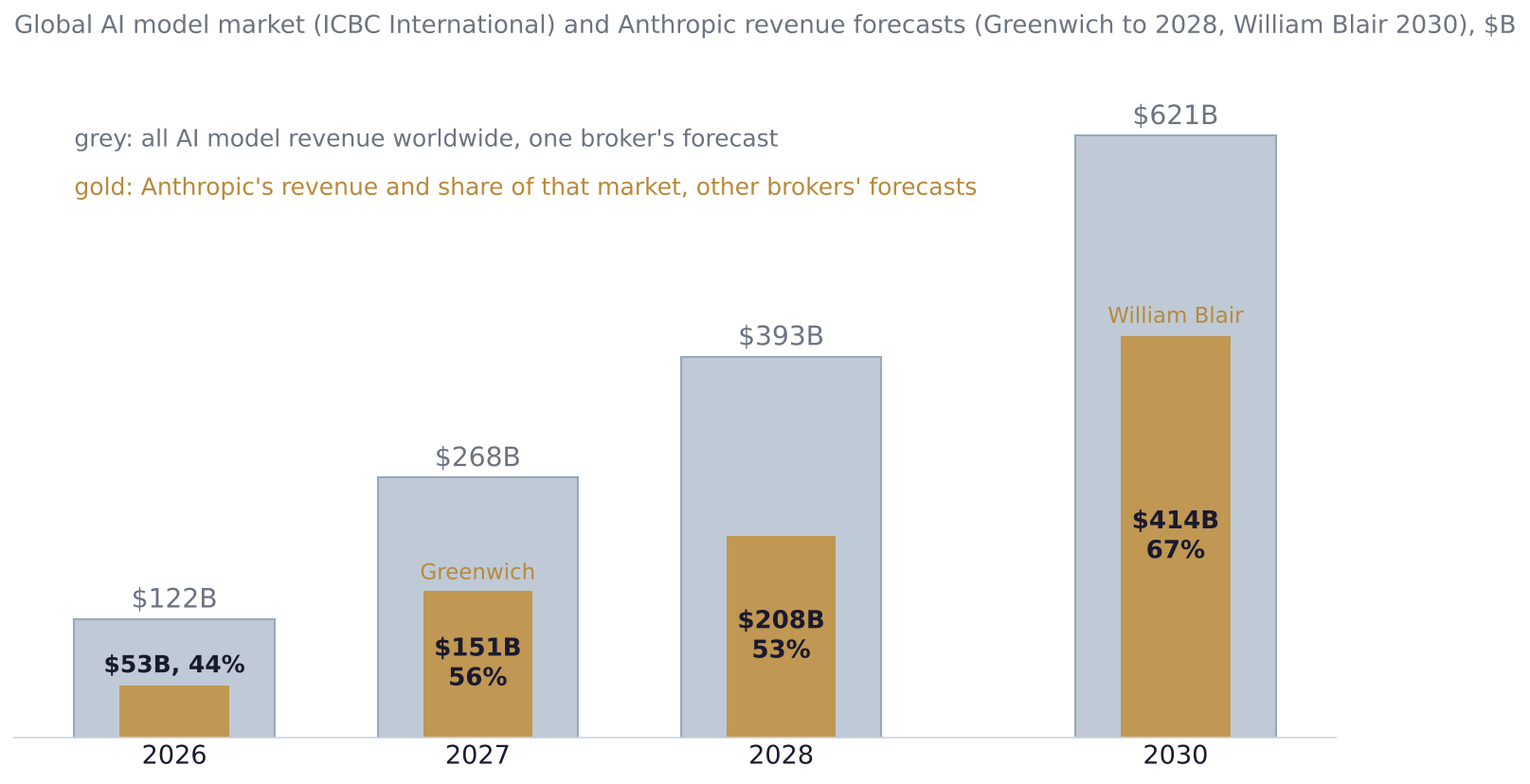
- Room to grow: ICBC International forecasts the market for AI models at $122B this year and $393B in 2028. Claude costs the ten largest Fortune 500 customers under 1% of their costs, about eight times the average.
- Price cuts have paid so far: in Q3 more usage added $6.0B of revenue and price cuts took off $0.6B.
- Customers spend more each year: business customers from a year ago now spend nine times as much. Only $10.4B of the next twelve months' revenue is under contract, about 13% of today's pace.
- Most of the money comes through other companies' software: we estimate a quarter to a third of revenue comes through Anthropic's own products, such as Claude Code, and the rest through the API. API customers can switch by changing a model name (1.1).
- Share is the open question: broker forecasts put Anthropic at 53% to 56% of the model market by 2028, up from about 44%. Ramp, a corporate-card company that tracks what US businesses pay AI suppliers, had Anthropic at 49.3% of token spending in the week to 1 November, down from 60.5% in the week to 23 October.
- Budgets are tightening: Uber, Tesla, Apple, Accenture and Microsoft have each capped what staff may spend on AI coding tools. On Ramp's panel token volume rose 37% in four weeks and spending rose 9%.
Go deeper: 1.1 revenue, 1.2 market and share, 1.3 prices, 2.1 retention, 2.2 competition
3Anthropic's lead lasts six months a release, and the money sits at the top
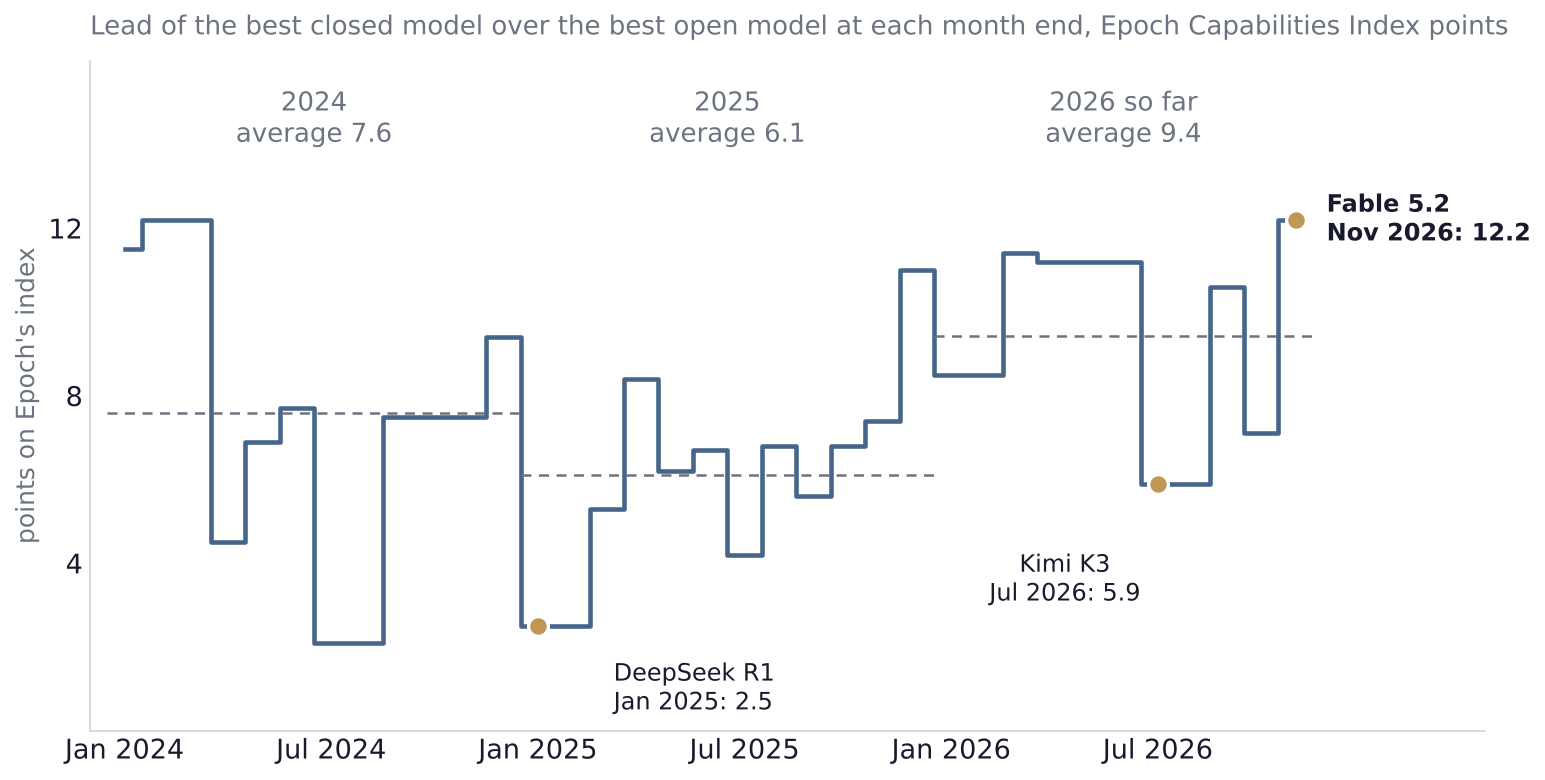
This is the question our preface says Romil has got wrong before, so we spent the most time on it. Open models from Chinese labs sit about six months behind Claude and cost a quarter to a fortieth as much per task. So far they have taken the tokens and left the money, and buyers have moved up to Opus faster than they have moved down.
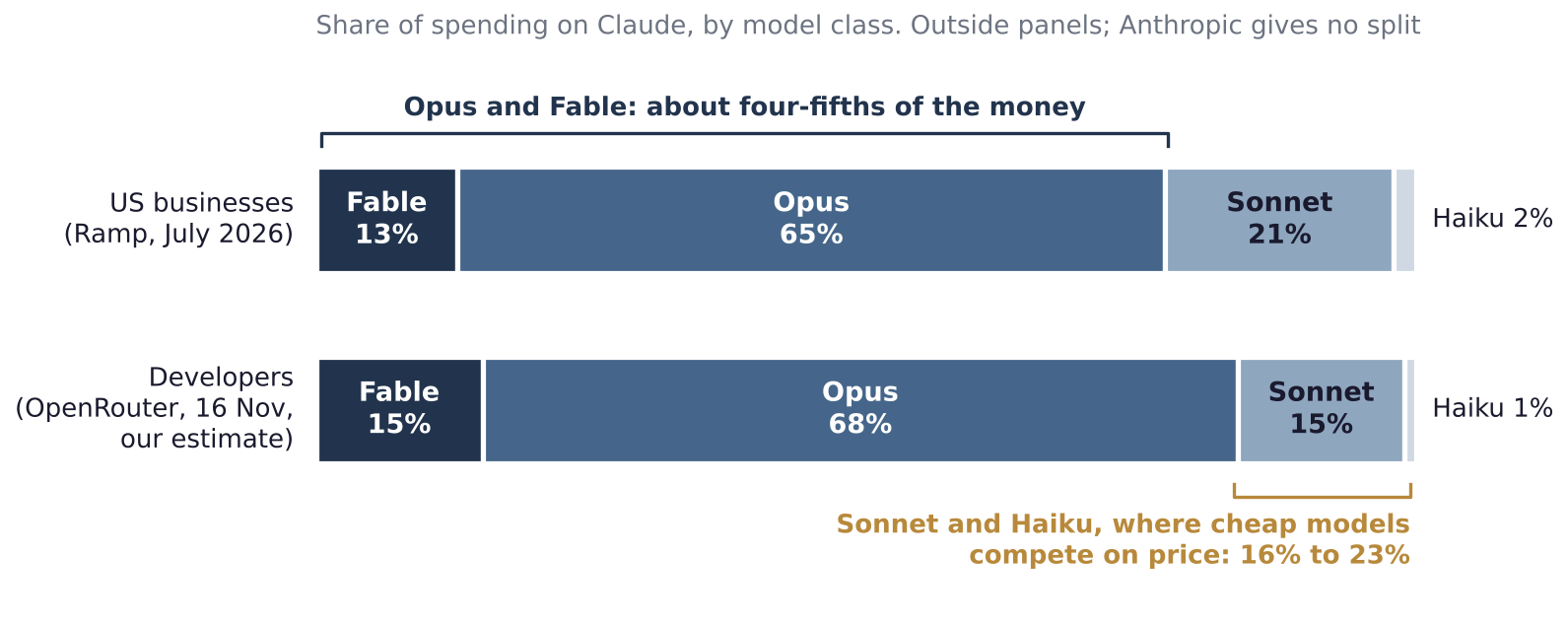
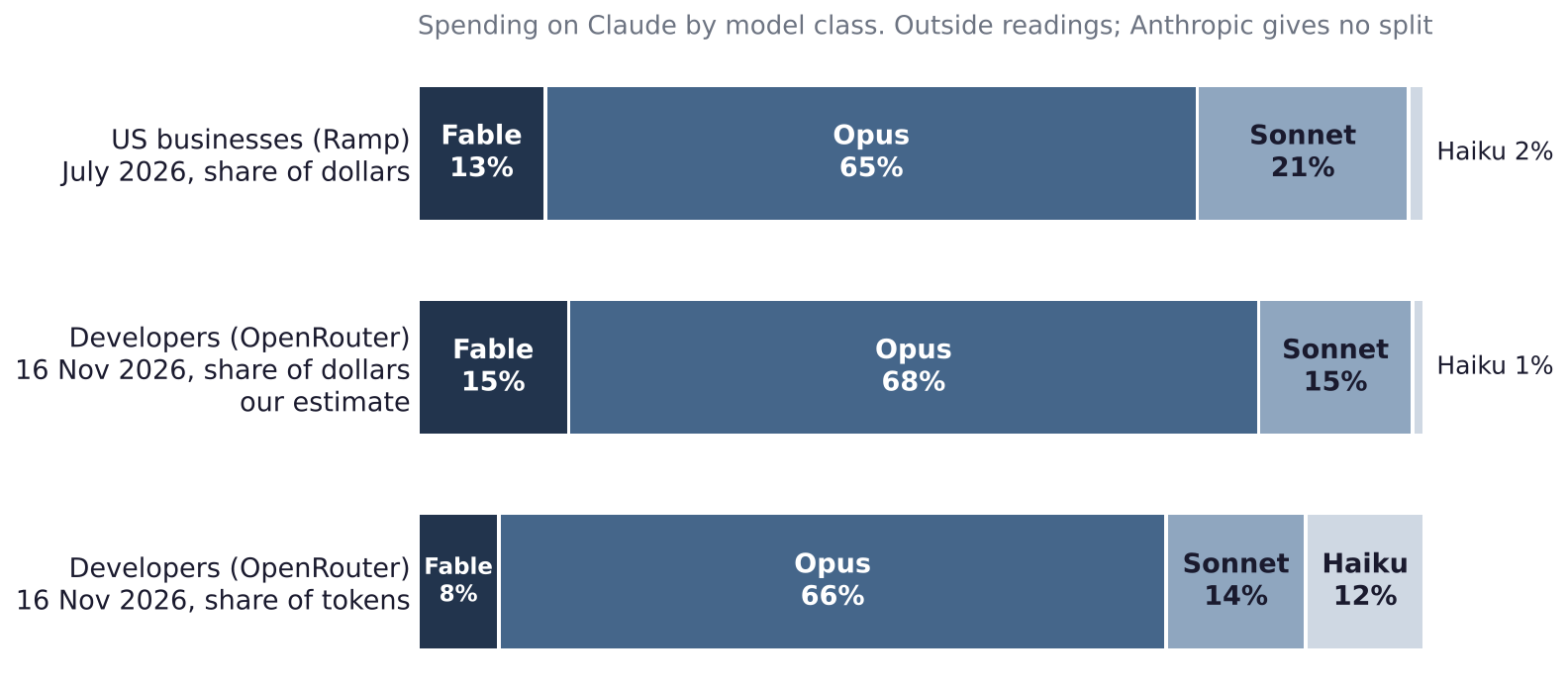
- Where the money is: Opus takes about two-thirds of Claude spending on two outside panels, and Fable an eighth to a sixth. Haiku, the class that competes with cheap models on price, brings in 1% to 2%.
- Open models take volume: they carry 19% of enterprise tokens and 4% of the money, on a survey by Menlo Ventures, a venture firm that owns Anthropic shares. Frontier models took 69.5% of business model spending in October, up from 67.7%.
- Switching works for routine tasks: Revolut, Coinbase, Lindy and Firetiger each cut 50% to 90% of the bill on the work they moved. Each kept a frontier model for hard tasks.
- Anthropic has to buy the lead again each release: on the index kept by Epoch AI, a research non-profit, the best open model matches what the best closed model scored six months earlier. William Blair estimates training cost $3.2B for Opus 5 and $6.9B for Fable 5.
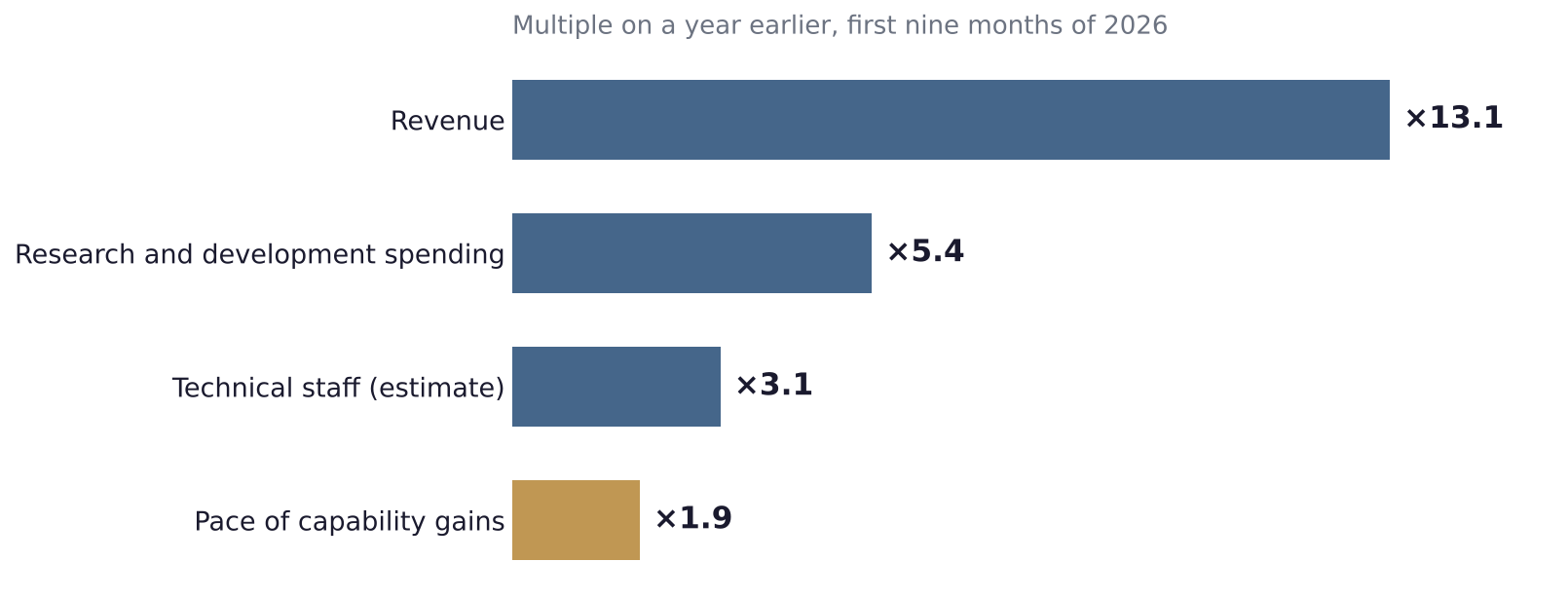
- Training still pays in dollars: revenue grew 13 times on 5.4 times the research spending. Each dollar buys less progress, and two economists put the fall at about 69% in a year.
- Buyers will pay only so much for capability: Fable 5 took 8% of business model spending in its second month at twice the price of Opus. Anthropic then cut Fable's price by 20%.
- OpenAI is the closer rival: GPT-6.2 Astra ties or beats Fable 5.2 on science and coding tests and finishes tasks for less money. Claude leads on finance, tax and office work.
- The cost to the price: if two-fifths of customers, measured by spending, halve their bills, our 2028 revenue falls from $180B to $144B and the value from $78 to $65 at eight times sales.
Go deeper: 1.6 models and prices, 1.7 training, 2.7 Chinese and open models
4Anthropic can pay the compute bill if revenue triples
The compute bill is the part of Anthropic we like least. It has signed for $900.9B, and in Q3 that bill grew faster than revenue. It holds enough cash to last about four years if growth stopped, so we see a risk to profit and to the multiple investors will pay, with solvency intact.
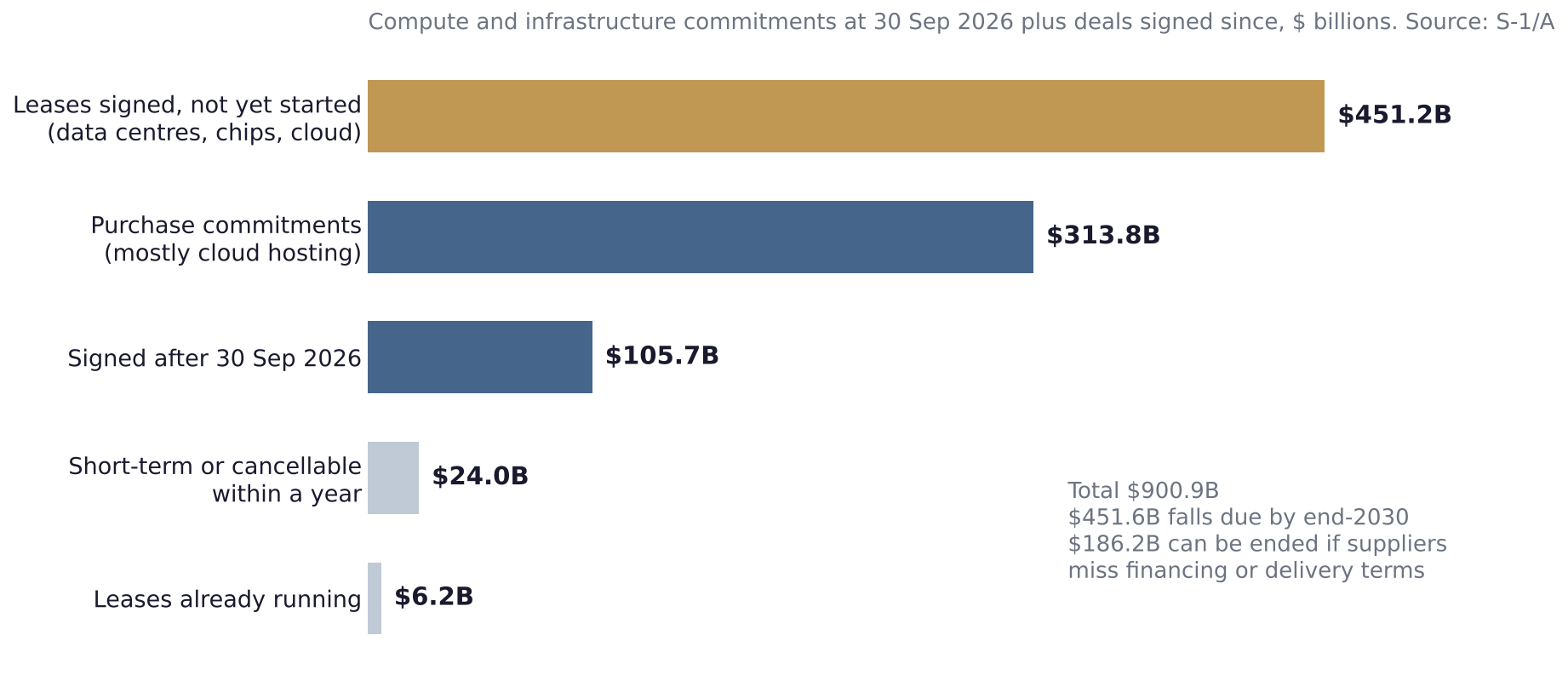
- The size of it: $900.9B in total, with $451.6B due by 2030 and $70.7B in the next twelve months.
- Where the compute goes: a quarter serves paying customers. Training, research and Anthropic's own use took $7.4B in Q3, or 44% of revenue, up from 40% in the first half.
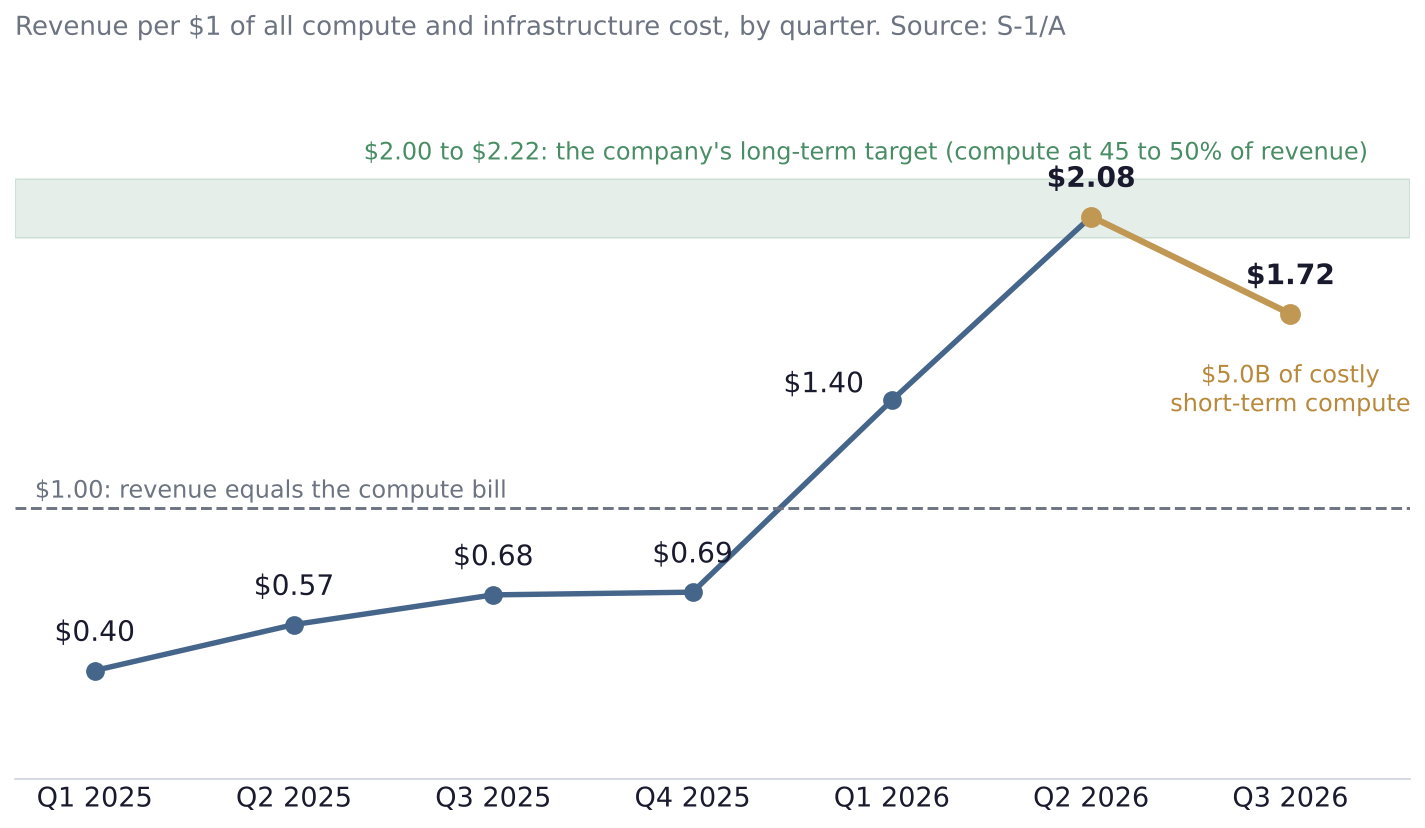
- The Q3 warning: the compute bill grew 77% on the quarter and revenue 47%. Revenue per dollar of compute fell from $2.08 to $1.72.
- What the margin target needs: a 35% margin needs compute near 45% of revenue. On the payments already signed, that takes about $150B of revenue in the next twelve months, close to the $151B brokers forecast for 2027.
- No broker gets there soon: Greenwich reaches a 30% margin in 2032 and William Blair in 2035. The adjusted margin leaves out stock pay of about $12B a year.
- The cushion: $212.7B of cash after the deal, and operations produced $6.6B of cash in nine months. With revenue flat at $81B, we estimate the cash lasts a little over four years.
- What Anthropic can cancel: $186.2B, if suppliers miss financing or site deadlines. Either side can end the SpaceXAI deal on 90 days' notice from early 2027.
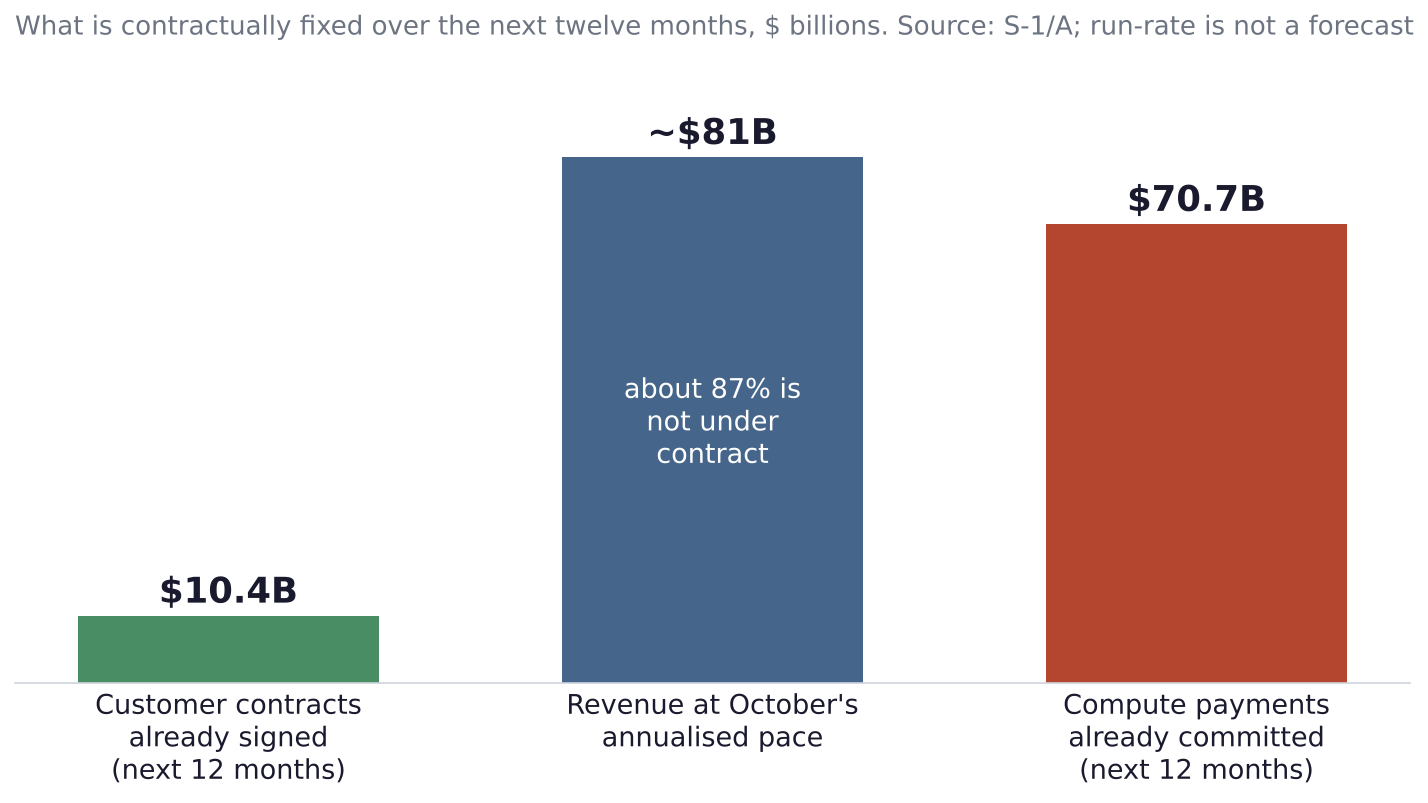
Go deeper: 1.4 unit economics, 1.5 path to profit, 2.4 the compute bill, 2.5 cash
5The terms favour sellers for the first six months
Anthropic built this deal to raise as much cash as it can. The new buyer gets a thin float, no vote and a lot of stock coming behind. The lock-up releases are the clearest known pressure on the shares before the first results.
- Float: 6.3% of shares outstanding. Index funds will need about 28% of the shares on offer once the stock joins their indices.
- Demand: orders cover the shares about seven times. Investors who expect to be cut back order more than they want.
- Stock coming: insiders can sell up to 315 million shares from day one and 1.63 billion within 76 days, twice the IPO. Up to 1.7 billion more are freed two trading days after the first results.
- Suppliers: seven suppliers buy $26.0B of shares with no lock-up. US resale rules hold those shares for six months.
- Control: the founders hold 50.1% of the votes through one special share, and a trust elects most of the board.
- Government: an appeals court upheld the Department of War's supply-chain label in September, and export rules switched two Claude models off in June. Anthropic's own court filings put the revenue at risk between under 2% and a mid-single-digit share.
- Precedent: SpaceX priced at $135 in June, closed its first day at $160.95 and traded at $123.62 on 5 November.
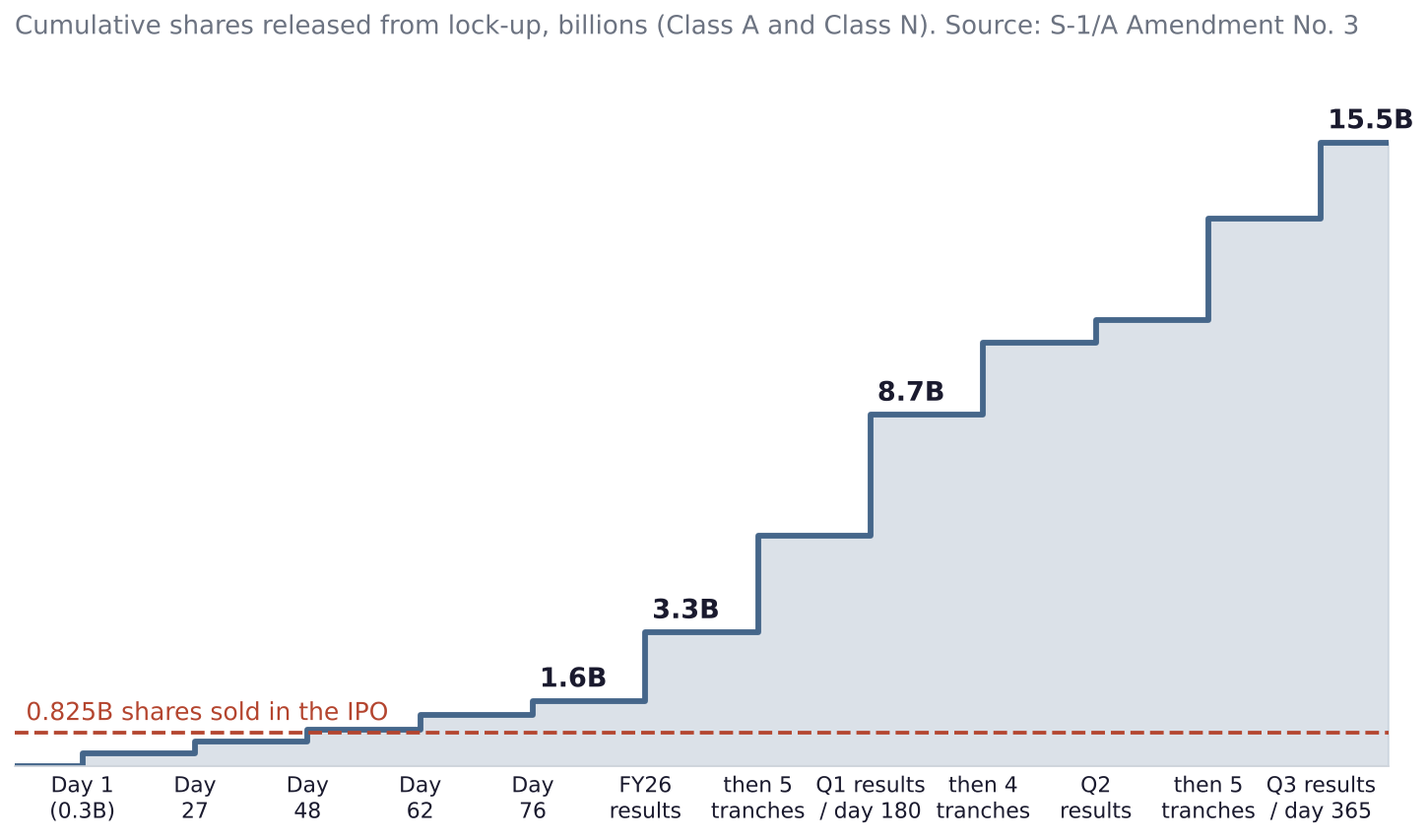
Go deeper: 2.6 control and rules, 3.2 deal structure, 3.3 lock-ups, 3.4 demand
6What would change our view
We hold this view with low conviction, because it rests on growth that nobody can check until 2028. These are the things we will watch, and the seven numbers we will track each quarter.
▲ Towards the bull case
- Run-rate revenue keeps rising faster than the compute bill.
- Revenue per $1 of compute climbs back above $2.00.
- The company discloses low churn or longer contracts.
- The top five and the clouds shrink as a share of revenue.
- The Department of War label is lifted on rehearing.
- Frontier models hold 70% or more of business model spending into 2027.
- Washington blacklists the Chinese labs caught copying US models.
▼ Towards the bear case
- A quarter where run-rate revenue stalls while new capacity arrives.
- Price cuts remove more than a third of what usage adds.
- SpaceX or another supplier ends a contract, forcing costly short-term buying.
- A top-five customer cuts spend or moves to a rival.
- Heavy insider selling at the early release dates.
- More large engineering teams make an open model their default, as Revolut and Coinbase did.
- Training and research stay above 44% of revenue.
- Run-rate revenue against compute due in the next twelve months: Today about $81B against $70.7B.
- Revenue per $1 of compute: $1.72 in Q3; the target is $2.00 to $2.22.
- Revenue under contract: $13.8B, about 13% of the run-rate for the year ahead.
- Price cuts against usage growth: $0.6B against $6.0B in Q3.
- Share of revenue from the top five customers and from the clouds: 21% in Q3 and 44% in the nine months.
- Frontier models' share of business model spending: 69.5% in October on Ramp's data.
- Compute that serves no paying customer, as a share of revenue: 44% in Q3; the 35% margin needs about 30%.
- The final price: Anthropic had set no price as we published. Pricing is expected on 18 November, and our view covers $70 to $78.
- New shares after the deal: our values use today's 17.5 billion shares. Stock pay of about $12B a year adds about 1% a year at $78, and suppliers' notes could add 4% to 5%. Over two years that takes about 6% off each value, and lifts the growth the range needs from about 27% to about 29%.
- Copyright suits: Anthropic settled the authors' class action for $1.5B. Suits from music publishers, Sony Music Publishing and BMG among them, and from Reddit are pending, and the filing says statutory damages add to the risk. We have put no number on them.
- People: the filing calls the chief executive and the president hard to replace. We have not assessed management, pay or staff retention.
- Odds: we give a bear case of $29, a base of $78 and a bull of $137, and attach no probabilities to them.
- Profit: we value Anthropic on sales and growth. We have built no cash-flow model, because the compute bill makes profit swing from quarter to quarter.
- The wider AI market: we have not tested the view against a fall in AI shares. Nvidia's chief executive resigned on 12 November, and the two listed Chinese model labs fell about 90% from their peaks.
- How to buy: we do not cover allocations, broker access outside the US or tax.
Eighteen questions, one by one
Every claim in the note comes from one of these sections. Each opens with our view, then the evidence, then what we still do not know.
◆The map
Each box is one section. The marks show how the evidence stands for that driver. Select a box to jump to it.
- Markers on what we found: AnsweredPartly answeredGap show how far the outside evidence goes.
- Sources: filing figures come from Amendment No. 3 to the S-1, filed on 17 November. We name broker notes and expert calls where we use them, and link public sources.
1Earnings power
1.1Revenue is broad and growing fast, at a slowing pace
Revenue is the strongest part of the case. It is spread across 11,900 large customers and still grew 47% in a quarter. Three features matter for the price: four-fifths of it is pay-as-you-go, a quarter comes from five customers, and coding brings in most of it on outside estimates.
Supportive Confidence: high on the filed splits, low on the product mix.
- Q3 2026 revenue was $17.0B. That is 47% up on Q2. Q2 had grown 144% on Q1.
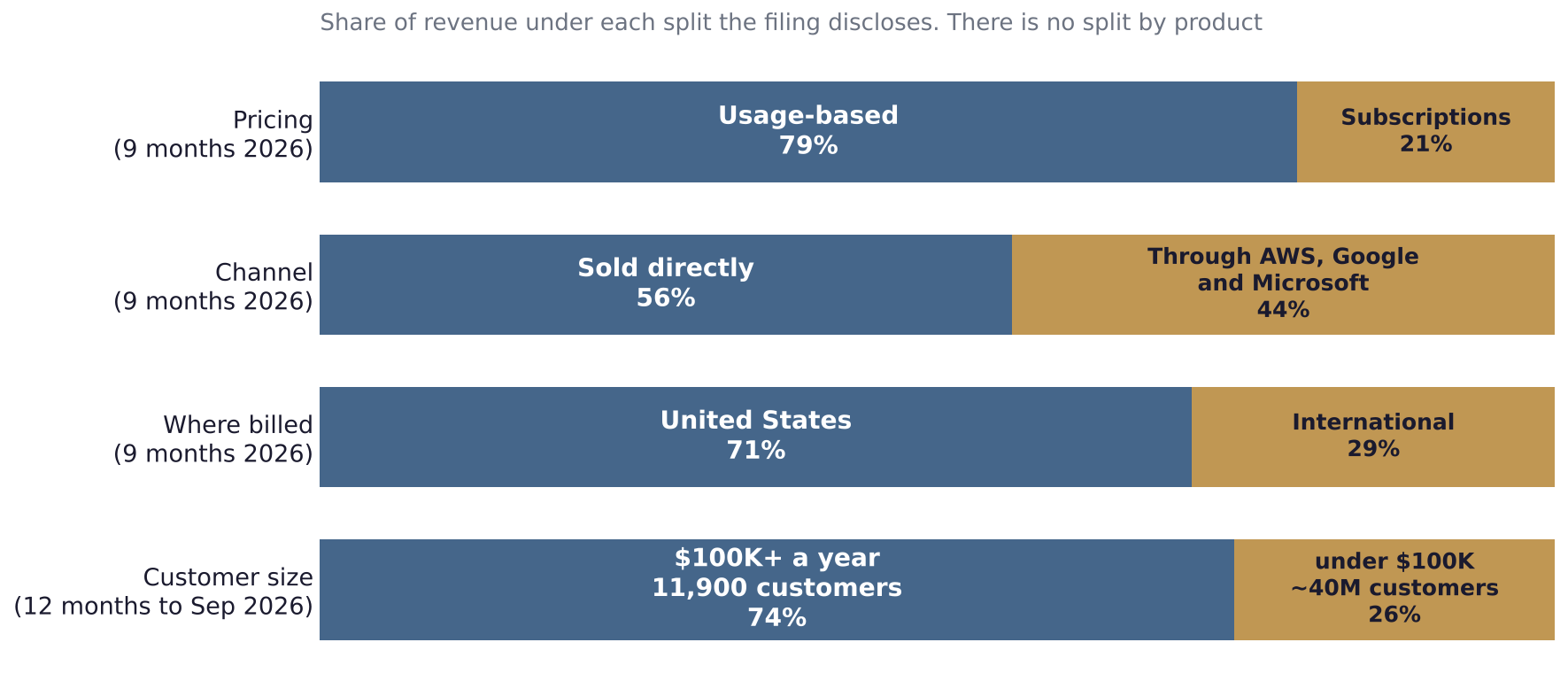
- Pricing: Usage-based revenue was $26.3B, 79% of the nine-month total. Subscriptions were $6.9B, 21%, and grew faster (16.5× a year earlier, against 12.4×).
- Channel: 44% was sold through the AWS, Google and Microsoft marketplaces, about $14.6B. That share was 11% in 2023 and 47% in 2025.
- Geography: 71% was billed in the United States. International rose from 27% in 2025 to 29%.
- Customer size: 11,900 customers spending $100K or more a year produced $26.1B, 74% of the last twelve months. About 40 million smaller customers produced the rest.
- The top: More than 1,900 customers spend $1M or more, and about 250 spend $10M or more. The top five were about 25% of nine-month revenue. Government agencies were under 2%.
- The filing gives no revenue by product.
- Huatai cites an outside tracker, TickerTrends, which had Claude Code at about $15.1B of annualised revenue on 10 August 2026 and modelled OpenAI's Codex at $8.8B. Neither company has confirmed either figure.
- Menlo Ventures sizes Claude Code plus Codex at $24.0B annualised, which is close to the two tracker figures added together. Menlo gives no split between the two.
- Roadshow deck: Claude Cowork, the newer product for office work, is growing faster than Claude Code did at the same age. Over half of $100K+ customers use the developer platform and at least one product. Both points are also in the filing. No dollar figures.
- Seaport: more than two-thirds of the AI revenue Amazon reports comes from Anthropic, on Seaport's own expert calls.
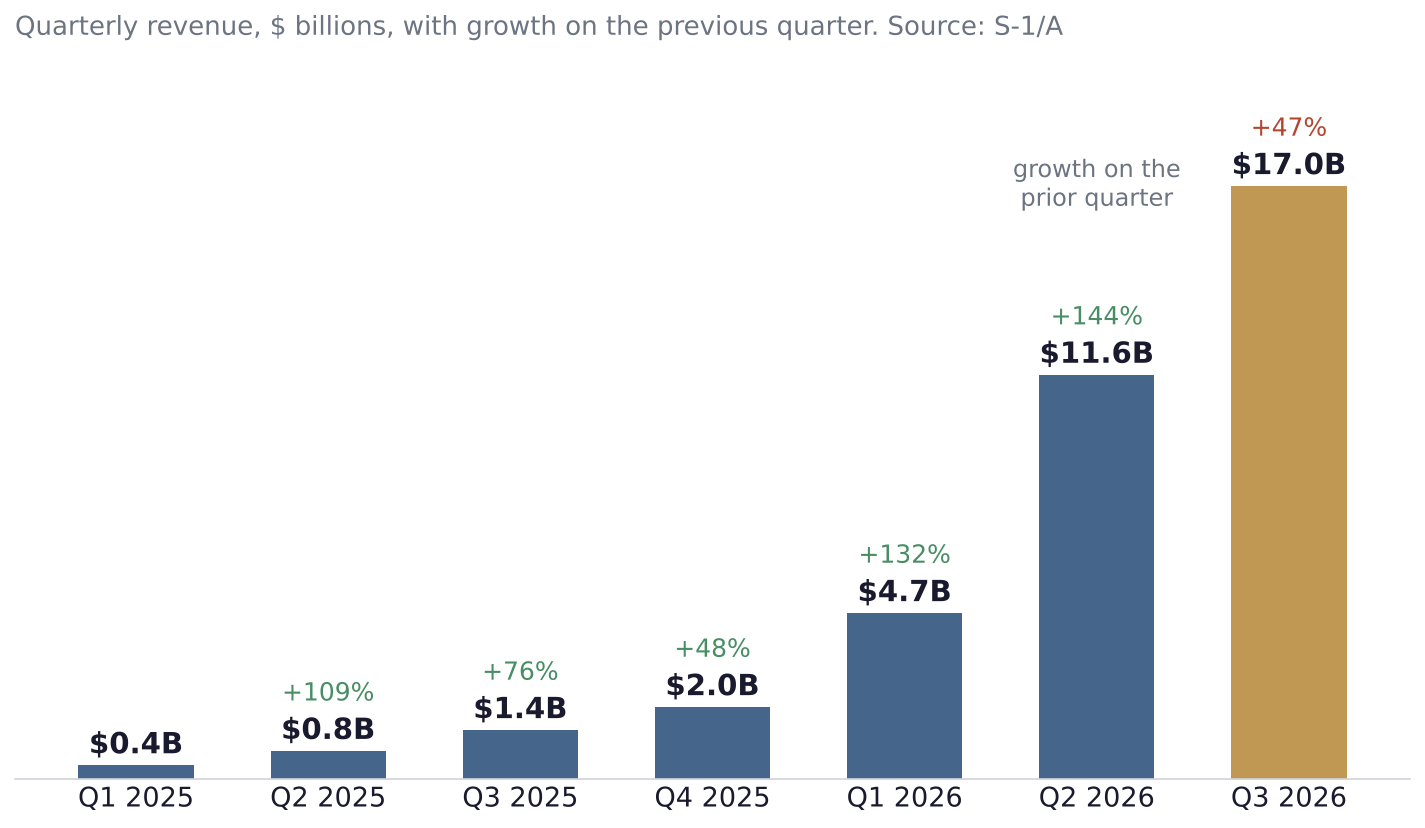
| Cut | What we can say | How sure |
|---|---|---|
| Average large customer | $2.2M a year ($26.1B across 11,900 customers) | Our maths on filing |
| Average small customer | About $230 a year ($9.2B across ~40M customers) | Our maths on filing |
| Top five customers | About $3.6B in Q3 between them, or about $2.8B a year each | Our maths on filing |
| Top five, trend | About 36% of revenue in Q1, 21% in Q3. Two customers were 12% each in 2025; none is above 10% now | Filing |
| Q4 so far | Brokers pencil in $19.8B to $21.8B for the quarter. Spend fell about 20% over last year's holidays | Broker estimates; filing for the holiday dip |
| Claude Code | Run-rate above $2.5B on 12 February, the company's last figure. Outside estimates today: $12B to $19B, about a fifth of revenue | Company statement; tracker estimates |
| Coding in all forms | Above 65% of revenue in July, on one research firm's estimate | SemiAnalysis estimate |
| Use of more than one product | Over half of $100K+ customers use the developer platform and at least one Anthropic app, up from about 30% at the end of 2025 | Filing |
| Claude Cowork, Team and Enterprise seats, API on its own | No figures anywhere | Gap |
| Consumer plans (Pro, Max, Ultra) | About 5% of revenue on one estimate. No subscriber count | SemiAnalysis estimate |
| Q2 to Q3 bridge | More usage added about $6.0B; price cuts took off about $0.6B; net +$5.4B | Filing |
| Where the customer uses Claude | Share of revenue, our estimate | What it rests on |
|---|---|---|
| Claude Code, Anthropic's coding tool | 15% to 23% | Outside trackers put it at $12B to $19B a year against an $81B pace. Anthropic's last figure was a run-rate above $2.5B in February, about 18% of revenue then |
| Consumer plans (Pro, Max, Ultra) | About 5% | One research firm's estimate |
| Cowork and Team or Enterprise seats | Not known | No figure from Anthropic or any outside source |
| Anthropic's own products, together | A quarter to a third | The three rows above, with a small allowance for Cowork and seats |
| The API: Claude inside other companies' applications and in-house systems | Two-thirds to three-quarters | What is left. Coding through tools such as Cursor and GitHub Copilot, and through customers' own agents, is about 40% to 50% of revenue on these numbers |
chokepoints.ai estimate. Anthropic gives no split. The inputs come from different dates and methods, so read the shares as a range. An Enterprise seat costs $20 and Anthropic bills each token on top at usage rates, so the filing's split of 79% usage and 21% subscriptions does not answer the question.
- Why it matters, in one line: the larger share of Anthropic's revenue sits where a customer can leave most cheaply.
- API revenue is easy to move: behind a routing layer a customer switches by changing the model name. Cursor, Replit and Microsoft each moved a default away from Claude this autumn, and Cursor built its own model on Kimi.
- Own-product revenue costs less to sell: Anthropic sells Claude Code and its seats directly. The clouds keep about a third of what they sell, and they carry 44% of revenue (1.4).
- Own-product revenue is harder to dislodge: a team that buys seats builds its habits, settings and connectors around the tool. Revolut still had to build its own coding tools before it could move 2,000 engineers to an open model.
- The mix is moving Anthropic's way: over half of $100K+ customers use the developer platform and at least one Anthropic app, up from about 30% at the end of 2025. Claude Code's share of revenue has held near a fifth while revenue grew many times over.
- Our view on the products: the tool around the model, which engineers call the harness, decides much of what a user gets. We think Anthropic's own products give the better experience for long, unattended work, and buyers are voting that way: Claude Code and OpenAI's Codex take 70% of coding spending on Menlo's survey.
- What the tests say: they confirm the harness matters and do not show Anthropic's is best. One model scored 42% on a bare harness and 78% inside Claude Code on one benchmark. On two others, Cursor scored higher than Claude Code with the same Claude model.
- What we would watch: a disclosed figure for Claude Code and Cowork revenue. If own products pass half of revenue, belief 3 gets easier to hold.
- Partly answeredRevenue by product: there is still no current split.
- The last product figure from the company was Claude Code at a run-rate above $2.5B on 12 February, about 18% of the total at the time.
- No broker models revenue by product.
- Outside estimates for today put Claude Code at $12B to $19B a year, about a fifth of revenue: TickerTrends tracked $15.1B in August and FutureSearch has $16B to $19B now.
- SemiAnalysis, which we could read only through others' summaries, put coding in all its forms above 65% of revenue in July, and consumer plans near 5%.
- One caution applies to all of these.
- An Enterprise seat costs $20 and every token is billed on top at usage rates, so Claude Code revenue sits in both the subscription line and the usage line, and any single figure is the estimator's own construction.
- Nothing exists for Cowork, seats or subscriber numbers.
- Section 1.6 adds the split by model class.
- Partly answeredThe top five customers: names are not disclosed, but press leaks point to the large buyers.
- Meta spent over $105M on Claude Code in one recent four-week period.
- One research firm calls it the largest single customer at 3% to 5% of revenue, which is hard to square with the filing, where two customers were 12% each in 2025.
- Microsoft had planned more than $1B a year for its own staff.
- Cursor and GitHub Copilot together drove about $1.2B of a $5B run-rate in 2025, and Accenture is reported as one of the three largest enterprise customers.
- Several of these compete with Claude Code or are cutting back: Microsoft cut its plan by over a third, Meta halved its Claude Code users, and Cursor, now owned by SpaceX, now bills Claude separately at list price.
- The filing shows the group's weight falling from about 36% of revenue in Q1 to 21% in Q3.
- The two customers at 12% each in 2025 are unnamed, and the names in circulation are guesses.
- Partly answeredNovember's revenue pace: the company has given nothing after 31 October.
- Greenwich holds November and December at the $81B pace and gets Q4 revenue of about $19.8B.
- William Blair's full-year figure implies about $21.8B.
- Two model-based trackers put the pace at $82B to $84B in early November.
- A widely repeated figure of $19.3B for Q4 has no primary source.
- It traces to second-hand accounts of a briefing by two analysts from the IPO banks, who also told investors not to extrapolate October.
- The filing warns of a holiday dip: spend fell about 20% in the two weeks to 2 January 2026.
1.2Forecasts need Anthropic to win over half of a market three times today's size
The market is large enough for the forecasts. Share is our concern. Brokers need Anthropic to rise from about 44% of model revenue to over half while cheaper models take more of the simple work, and the newest share data points down.
Mixed Confidence: medium on market size, low on share.
- Customers by yearly spend: more than 11,900 at $100K+, more than 1,900 at $1M+, about 250 at $10M+.
- Over 50% of the Fortune 500 and over 30% of the Global 2000 already spend $100K+. That is more than 250 and more than 600 companies.
- For those Fortune 500 customers, Claude spend averages under 0.1% of their total costs. For the ten largest it is under 1%, about eight times the average.
- A Claude Enterprise user who does not use Claude Code spends under $75 a month. The heaviest 5% of Claude Code users spend about 20 times that, about $1,500.
- The company's own frame: knowledge workers earned more than $40T in 2025, and there will be more than one billion of them by 2028.
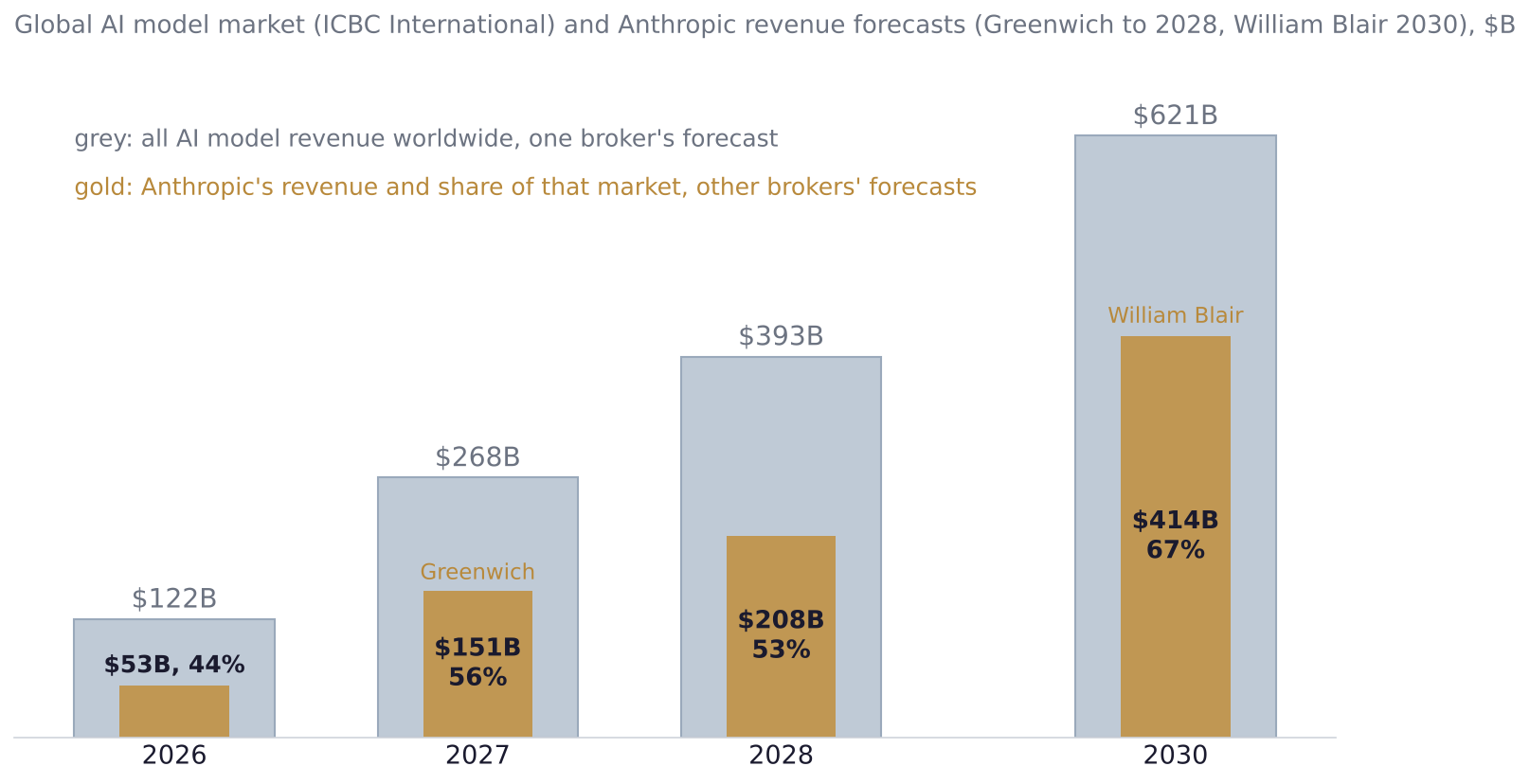
- Market size: Menlo Ventures puts enterprise AI spending at a $176.8B yearly pace in September 2026, up 5.4× in a year. ICBC International forecasts the market for AI models at $122B in 2026, $268B in 2027, $393B in 2028 and $621B in 2030.
- Longer range: UBS assumes 575 to 770 million paying workers at $150 to $250 a month by 2030. William Blair has Anthropic at about $414B of revenue in 2030.
- How many companies: Counts of companies with $1B+ of revenue range from about 5,000 (BIIA) to 9,987 (Crunchbase) to 38,746 (a registry count that includes subsidiaries). The EU has 53,000 enterprises with 250+ staff (Eurostat). The US has about 19,000 firms with 500+ staff (derived from SBA data).
- Spend per person: Expert calls: at Airwallex, a cap of $300 to $700 a month per API key and a soft alert at about $500 a month per developer. Press, via William Blair: Accenture cut its central Claude allowance to $29 per employee a month, and Apple cut some engineers' daily limits from $300 to $200.
- Share today: Menlo, which is an Anthropic investor, has Anthropic at 55% of enterprise spending on model access, up from 40%, with OpenAI at 31% and Google at 9%. Ramp's card data showed 60.5% in late October.
- Leakage: Open-source models carried 19% of tokens, up from 11%, but only 4% of dollars, down from 6% (Menlo). Cleveland Research's Q3 checks say Anthropic's share slipped, mainly as customers spread work across several models. Ramp's data for the week to 1 November shows OpenAI gaining share as its price fell 17.7%. ICBC expects Chinese vendors to rise from 10% to 30% of the model market by 2035.
| Yearly spend | Anthropic today | Companies that could spend this | Share reached, by count |
|---|---|---|---|
| $10M+ | ~250 | 2,000 in the Global 2000; 7,886 companies with 10,000+ staff | 3% to 13% |
| $1M+ | >1,900 | 5,000 to 38,700 companies with $1B+ of revenue | 5% to 38% |
| $100K+ | >11,900 | About 72,000 large firms in the US and EU alone | 16% at most |
Shares assume every Anthropic customer is one of the counted companies, so they overstate reach among large firms. Many $100K+ customers are start-ups. No source maps the spend bands to a population of companies; these pairings are ours.
- These bands are low bars.
- $100K a year is 111 office seats at $75 a month, or 33 developers at $250, the top of the typical range in Claude Code's own documentation, or six heavy Claude Code users.
- $1M a year is 333 developers at $250.
- Any company with a few hundred engineers can clear $1M at today's usage.
- So the count of possible customers is not the limit.
- The top of the market is already half signed: more than one in two Fortune 500 companies is a $100K+ customer.
- Growth has to come from spend per customer and from smaller and foreign firms.
| Lens | Today | Ceiling to test | What it implies |
|---|---|---|---|
| Share of a big customer's costs | Under 0.1% (average Fortune 500 customer) | Under 1% (the ten largest today) | About 8× from this group if the average reaches the leaders |
| Developers | $59 to $103 a month per developer worldwide, all vendors | $250 (top of the typical range in Claude Code's documentation) to $1,500 (heaviest 5%) | $145B to $871B a year across 48.4M developers |
| All knowledge workers | Under $75 a month for an enterprise seat | $75 for every knowledge worker | $900B a year across one billion workers |
| Share of knowledge-work pay | 0.44% ($176.8B of $40T) | 1% to 2% | $400B to $800B a year for all vendors |
Developer spend today is the coding market ($34B on Menlo's count; ICBC's $60B is a wider measure of coding within enterprise AI spending) divided by SlashData's 48.4 million developers. Ceilings are tests, not forecasts.
- Put the three steps together and 2028 revenue is a market size multiplied by a share.
- The grid shows the range.
| 2028 model market | 25% share | 35% share | 45% share | 55% share |
|---|---|---|---|---|
| $300B (below forecast) | $75B | $105B | $135B | $165B |
| $400B (ICBC: $393B) | $100B | $140B | $180B | $220B |
| $500B (above forecast) | $125B | $175B | $225B | $275B |
Today's share is about 44%. Green cells clear the $187B of 2028 revenue that a $78 price needs (section 3.1). The amber cell is our base case. Red cells are below $110B, not far above today's ~$81B pace. Greenwich forecasts $208B for 2028.
In people terms, $180B is 100 million workers paying $150 a month, with all of it going to Anthropic.
- Partly answeredShare data from neutral sources: there is, and the latest readings both point down.
- Ramp's index had Anthropic at 60.5% of token spend in the week to 23 October, then 49.3% in the week to 1 November.
- Wolfe's tracker, which is built on OpenRouter data, had it at 55.6% on 24 October and 41% on 7 November, after Moonshot's Kimi K3.1 Pro launched.
- Both are narrow samples.
- Ramp says its token sample does not represent its customers' total AI spend, and its weekly figures swing widely.
- OpenRouter is a routing service for developers and sees no direct enterprise or cloud-marketplace spend.
- Among larger buyers, a field technology chief at Dell put Anthropic at about 25% of Dell's model spend in August, behind OpenAI at 30% to 35%.
- Partly answeredSpend per developer: Caps are spreading, at very different levels.
- Reported since June, all in the press: Uber $1,500 a month per employee for each coding tool; Tesla $200 a week; Apple cutting some engineers' daily cap from $300 to $200; Accenture funding $29 a month centrally (it says this is budgeting, not a hard limit); Goldman Sachs keeping Claude Code for engineers only; Microsoft cutting monthly caps in its cloud division from $100,000 to about $10,000.
- There is no series showing spend per developer over time.
- Claude Code's own documentation is cited at $150 to $250 a month for a typical developer, well under the $1,500 ceiling.
- Partly answeredThe dollar market if prices keep falling: brokers are split, but spend data now leans one way.
- On Ramp's panel, token volume rose 37% in the four weeks to 23 October while spending rose 9%, and business token spending grew only 1.5% across August and September after 42% in July.
- YipitData puts the fall in price paid per token at about 50% in a year.
- So volume is growing far faster than dollars.
- William Blair still expects usage to more than offset lower prices over time, as it did for cloud computing.
- Canaccord expects open models that cost 80% to 95% less to slow the industry's dollar growth.
1.3Usage has grown ten times faster than prices have fallen
So far cheaper models have brought Anthropic more revenue. We would change our mind in a quarter where price cuts remove more than a third of what usage adds. In Q3 it was a tenth, though outside spend data is less comfortable than the filing: on YipitData's panel the price paid per token halved in a year.
Supportive Confidence: low to medium. The filing supports it; outside spend data is mixed.
- Price cuts and discounts took about $600M off revenue between Q2 and Q3 2026. Between Q3 and Q4 2025 the same effect was about $70M.
- Opus 5.5 cut the cost of a task by about 40% against Opus 5. The deck adds Fable 5.1 at about 25% and Haiku 5.5 at about 75%.
- The deck's main exhibit: Opus 4.5 cut costs 67%, and quarterly revenue growth went from 48% to 132% the next quarter.
- Channel checks: a consulting director said in an expert call like-for-like token prices fell 5% to 10% between Q2 and Q3, with 10% to 25% off for committed volume, and put the fall over a year at 30% to 50%. The same director saw commitments rise 30% to 50% at renewal with no customers lost.
- Budgets are biting: Uber's technology chief said in April that his AI budget for the year was already blown; later press reports say it was used up within four months. One Carlyle engineer says its Claude Code bill runs to hundreds of thousands of dollars a month for fewer than 30 engineers, and that it is testing open models.
- Seaport sees no price war with open models, and describes Anthropic and OpenAI as two dominant sellers lowering prices in an orderly way. Greenwich notes that the link between cheaper tasks and more usage has not been tested in a downturn.
- Latest prices: Fable 5.2 launched on 9 November at $8 and $40 per million tokens, 20% below Fable 5.1 (Anthropic). On Ramp's data the blended price paid for Anthropic fell 12.5% in the four weeks to 1 November, and OpenAI's fell 17.7%. YipitData puts the fall in price paid per token at about 50% in a year.
- Volume against dollars: Ramp's customers used 37% more tokens in the four weeks to 23 October and spent 9% more.
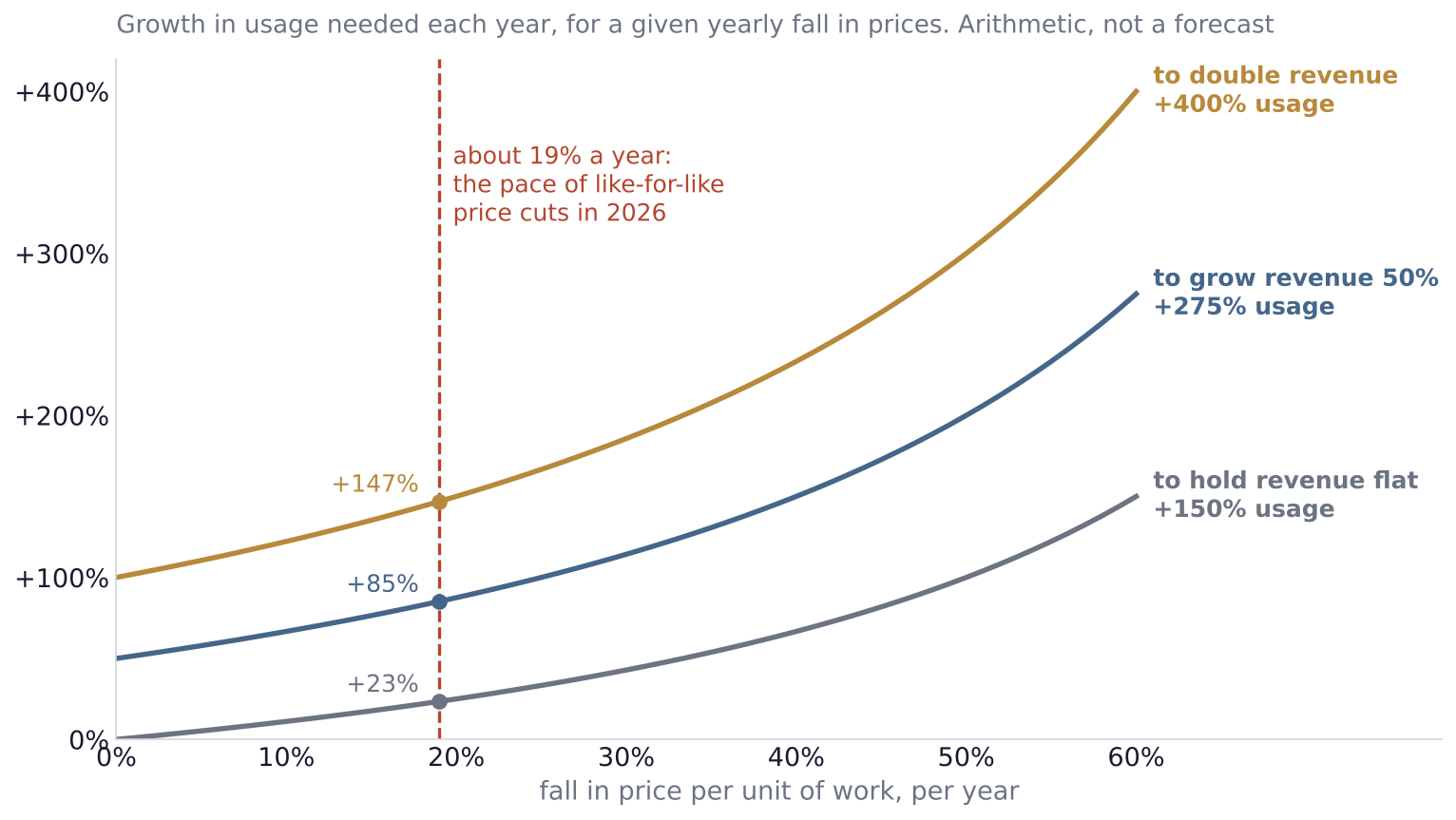
- The two disclosed price effects are the same size relative to revenue: about 5% of the prior quarter each time.
- Four quarters at that pace is about 19% a year.
- Against that, usage added about $6.0B in Q3, ten times what price cuts removed.
- Partly answeredUsage after the autumn price cuts: still not measured for these models specifically.
- Spend data gives the direction.
- Ramp's blended price paid for Anthropic fell 12.5% between the weeks ending 4 October and 1 November, and OpenAI's fell 17.7%.
- YipitData puts the fall in price paid per token at about 50% over a year.
- Both include customers choosing cheaper models and reusing cached work, as well as list-price cuts, which is why they are far steeper than the 19% a year in our chart.
- Fable 5.2 then launched on 9 November at $8 and $40 per million tokens, 20% below Fable 5.1.
- On the volume side, Ramp's customers used 37% more tokens in the four weeks to 23 October and spent 9% more.
- Partly answeredPrice response on routine work: no broker measures the two separately, but the evidence points to a split.
- On routine work, buyers switch to cheaper models readily.
- AT&T says about 40% of its employees' AI queries already run on open models and it aims for 60% to 70% in the coming years; routing to cheaper models cut the cost of coding and other advanced tasks by up to 56% for a 2% drop in quality.
- Revolut moved about 2,000 engineers from Claude Code to a self-hosted open model and says the bill fell to a tenth.
- On the hardest coding the gap holds: a senior engineering director at Rippling said the leading open model needed more tokens and up to twice as long, so it was not much cheaper.
- Partly answeredA price war with OpenAI or Google: discounting is reported, though thinly sourced.
- One senior engineering director at Rippling said buyers across the industry were moving to OpenAI because it offered 10% to 25% off while Anthropic had refused to discount.
- CFRA says OpenAI is discounting deeply.
- Google's Gemini 4 Carbon is half the price of Opus 5.5 until 30 November and matches it after that.
- List-price cuts in 2026 have been deepest on the cheapest models; top-model prices held or rose.
- No broker expects Anthropic to match a rival's cut outside a model launch.
- Its own cuts have so far come with new models.
1.4Anthropic keeps 85% after serving and 43% after all compute
The 85% margin covers serving customers only. After all compute Anthropic keeps 43%, and one quarter of buying short-term capacity cost ten points. The clouds keep about a third of what they sell, so we watch the channel mix as closely as the models.
Mixed Confidence: high on the totals, low on the channel split.
- Serving paying customers cost $4.8B in nine months, 14.5% of revenue. That leaves a gross margin of 85.5%, up from 29.4% a year earlier.
- All computing, including training new models, cost $18.8B, or 56.6% of revenue. That leaves 43.4%.
- Q3 included $5.0B of short-term compute, which the filing says costs significantly more than capacity bought on long contracts. The company expects to use more of it in the near term.
- Fees paid to channel partners rose by $4.8B in the nine months. They sit in sales and marketing, not in cost of revenue.
- Huatai: direct sales earn 60% to 70% gross margin; sales through clouds earn 44% to 50%. Huatai built these ranges from outside estimates, not disclosures.
- Greenwich: channel fees were about 16% to 18% of marketplace sales in 2025 and about 35% in the first half of 2026.
- Seaport: Anthropic is paying premium prices for compute, with SpaceX as its example.
| From $1.00 of revenue | Sold directly | Sold through a cloud |
|---|---|---|
| Cost of serving the customer | −$0.15 | −$0.15 |
| Fee kept by the cloud partner | none | about −$0.34 |
| Left before training and other costs | about $0.85 | about $0.51 |
Our estimate. Channel fees of $4.8B to $5.1B in nine months, set against about $14.6B sold through cloud marketplaces, come to 33% to 35%. The fee line may include other partners, and the filing says terms changed during 2026.
- Partly answeredThe clouds' fees: not disclosed by cloud.
- William Blair estimates the blended fee at 16% of marketplace revenue in 2025, 35% in the first half of 2026 and 34% for the nine months.
- That matches our 33% to 35%.
- So the clouds' cut about doubled in 2026 and has only edged down since.
- The filing says channel terms changed during 2026 but not which partner or by how much.
- Partly answeredThe premium for short-term compute: one estimate.
- Greenwich's note on SpaceX puts Anthropic's original deal at about $30 per watt a year (a range of $24 to $36), against $40 to $50 for short-term capacity now.
- That is a premium of about a third to two-thirds.
- SpaceX has told investors it prefers to rent near the going rate.
1.5The path from a 15% margin to 35% rests on the compute bill
Anthropic reaches a 35% margin only if revenue about triples, because it has fixed the compute bill years ahead. We give the target little weight. It comes from the roadshow, no broker models more than 30% before 2032, and it leaves out about $12B a year of stock pay.
Mixed Confidence: medium.
- Nine-month costs: compute $18.8B (57% of revenue), staff $4.9B (15%), sales, marketing and partners $5.5B (17%), other $5.3B (16%).
- Only about a quarter of compute serves paying customers. The other $14.0B, 42% of revenue, goes on training, research, internal use and free users.
- On the accounting measure the company lost $1.3B from operations in nine months. The adjusted measure shows a $4.1B profit, mainly by leaving out $3.3B of stock pay and $2.1B of non-cash donations.
- Stock pay is about to rise. Listing triggers $8.2B of share-award cost at once and $24.1B more over about two years.
- Long-term targets (deck): compute 45% to 50% of revenue, sales and marketing 7% to 10%, staff and other 7% to 10%. Q3 actuals were 58%, 14% and 13%.
- Greenwich forecasts an adjusted margin of 10.8% in 2027 and 20.0% in 2028, with compute at 58% and 50% of revenue.
- Seaport expects margins to narrow into next year as the cost of Anthropic's own directly run capacity builds.
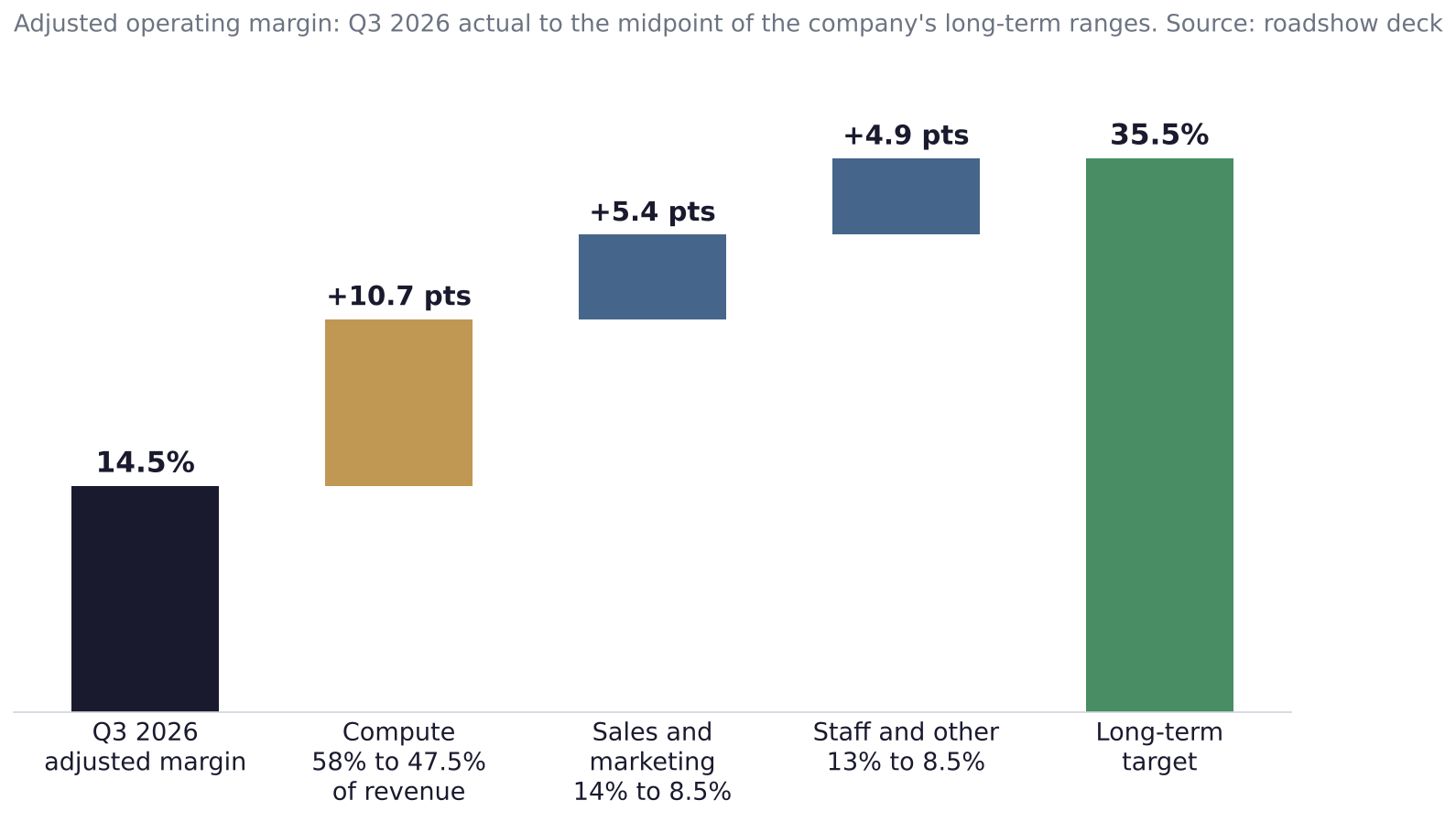
- Costs other than compute have already done most of their work.
- They fell from 70% of revenue in early 2025 to 27% in Q3.
- What remains depends on compute, and compute is bought years ahead.
- Section 2.4 shows that payments already signed average about $117B a year from late 2027 to 2030.
- For that to be 47.5% of revenue, revenue has to average about $247B a year.
- AnsweredMargin after stock pay: for the nine months it was −3.8%, which is the plain accounting operating margin.
- Looking ahead, Greenwich forecasts stock pay of $12.0B in 2027 and $13.6B in 2028.
- That takes its 2027 margin from 10.8% to 2.9%, and its 2028 margin from 20.0% to about 13.5%.
- Share awards not yet expensed stood at $32.3B on 30 September.
- GapTiming of the long-term targets: no date anywhere.
- The targets themselves hold up: they were given at the roadshow on 10 November and reported with the same ranges in the financial press.
- They are not in the filing, and no broker note repeats them.
- Published broker paths are slower: Greenwich reaches a 30% adjusted margin by 2032 (25% after stock pay), and William Blair 30% by 2035.
1.6Opus brings in about two-thirds of the money
Anthropic earns its money at the top of the range. Opus and Fable bring in about four-fifths of Claude spending, and Haiku, where Chinese models compete on price, brings in 1% to 2%. The money at risk sits in Sonnet and in the routine part of Opus work, and Fable's slow start at twice the price shows buyers will pay only so much for capability.
Mixed Confidence: high on prices, which are published; low on the model mix, which comes from two outside panels.
- Anthropic sells four model classes. Fable is the most capable. Opus is the workhorse for companies. Sonnet handles everyday tasks. Haiku is the cheapest and fastest. Mythos is Fable with looser limits, sold to vetted security and life-science teams.
- Customers pay by the token, which is a piece of a word, and the price depends on the model. The filing names the model chosen and the volume used as the two main drivers of a customer's spending.
- A subscription buys a fixed allowance. A subscriber who runs out moves up a tier or buys tokens.
- A growing number of large customers sign for a year or more with a minimum spend, in return for a fixed price list.
- Each new version has lowered the cost of a task. Fable 5.1 cut it by about 25% against Fable 5, and Opus 5.5 by about 40% against Opus 5. Anthropic says its margins held.
- Price cuts and contract discounts took about $600M off Q3 revenue, against about $6.0B added by usage.
- Models released in the six months to September brought in over 80% of Q3 revenue.
- The filing gives no revenue by model.
- Ramp, a corporate-card company that tracks what US businesses pay AI suppliers: in July, Opus models took 65% of what its customers paid for Claude, Sonnet 21%, Fable 13% and Haiku 2%.
- Ramp, October: Opus 5.5 alone was 34% of all business spending on AI models. Village, a research firm that tracks the same data, puts it at 57% of spending on Claude three weeks after launch, with spending on the older Opus 5 down 69%.
- Ramp on Fable: at twice the price of Opus, Fable 5 reached about 8% of model spending in its second month. Ramp's economist read that as a ceiling on what companies will pay. Anthropic priced Fable 5.2 20% lower in November.
- OpenRouter, a service developers use to reach many models through one account: on 16 November Opus 5.5 carried 65% of Claude tokens, Haiku 11%, Sonnet 5.5 11% and Fable 5.2 7%, on one tracker's count.
- Menlo Ventures, a venture firm that owns Anthropic shares: a year ago the most-used models were Sonnet 4.5 and GPT-5. Today they are Opus 5.5 and GPT-6 Astra. Buyers traded up.
- William Blair has no data on the mix and makes its own estimates: the Opus 4 family was just over half of revenue at its peak and about 2% by September, and the Opus 5 family earned over $5B in Q3. It thinks the latest Opus out-earns the latest Fable.
- Expert calls: a JPMorgan executive director says engineers default to Opus although Sonnet would do for 90% of tasks. A director at the software firm Harness plans and reviews with Opus, writes code with Sonnet, and expects to move 60% to 70% of simple work to Kimi or GLM.
- Both panels miss the largest contracts.
- Ramp covers smaller US firms and OpenRouter covers developers.
- The 250 customers that spend $10M or more a year may buy a different mix.
| Model class | Used for | Price per million tokens, read / written | A year ago | Change | Rivals at the same list price |
|---|---|---|---|---|---|
| Fable 5.2 | The hardest and longest tasks | $8 / $40 | Launched in June at $10 / $50 | −20% | OpenAI's GPT-6.2 Astra, launched on 17 November at 20% below its predecessor |
| Opus 5.5 | Daily work at companies | $4 / $20 | $15 / $75 | −73% | The fast tier of Kimi K3.1 Pro, from the Beijing lab Moonshot |
| Sonnet 5.5 | High-volume helper tasks | $2 / $10 | $3 / $15 | −33% | GPT-6.1 Sol, Kimi K3.1 Pro, and Google's Gemini 4 Carbon until its launch price ends on 1 December |
| Haiku 5.5 | Simple work in bulk | $0.10 / $0.50 | $1 / $5 | −90% | GPT-6 Luna |
Prices from Anthropic's published list on 17 November 2026. A year ago means the Opus 4.1, Sonnet 4.5 and Haiku 4.5 prices of mid-November 2025. Haiku 5.5 costs five times as much on requests longer than 100,000 tokens.
| Adjustment | Effect on the bill | Source |
|---|---|---|
| Re-reading saved text | Billed at 2.5% to 5% of the read price on the newest models. An agent re-reads the same files and instructions many times, so 95% of its tokens can be re-reads | Anthropic price list; Menlo |
| A typical Opus 5.5 agent session | About $0.70 per million tokens, against list prices of $4 and $20 | Menlo; our sum gives $0.71 |
| Work that can wait a day | 50% off | Anthropic price list |
| Faster answers | Twice the price for up to 2.5 times the speed | Anthropic price list |
| Processing kept inside the US | 10% more | Anthropic price list |
| Large customers | Discounts agreed case by case for a committed spend. Expert calls put them at 10% to 25% | Anthropic price list; filing; expert calls |
| Subscriptions | A flat fee with usage caps that reset. Pro costs $20 a month and Max $100 or $200. An Enterprise seat costs $20 and all usage is billed on top at list prices | Filing; Huatai |
| Governments | 40% off token usage with no minimum, under a US federal purchasing deal | Greenwich |
| Clouds | Bill at Anthropic's list price and keep about 35% of what they bill | Huatai; William Blair |
- Anthropic prices against rivals and against what buyers will pay.
- Cost plays a small part: serving took 14.5 cents of each revenue dollar in the nine months, so list prices sit at about seven times serving cost.
- Three things set them.
- Rivals' price lists. Each Claude class carries the same list price as the nearest model from OpenAI, Google or Moonshot.
- What a buyer will pay for a finished task. Opus 4.8 went from 2% to 31% of business model spending in one month. Fable 5, at twice the price, took two months to reach 8%. Anthropic then cut Fable's price.
- How much compute Anthropic has. The filing says demand has exceeded its capacity throughout. Usage caps on subscriptions and the premium for fast answers ration what it has.
| Model | List price, read / written | Tokens written per task | Cost per task | Tasks passed |
|---|---|---|---|---|
| Fable 5.2 | $8 / $40 | 198,000 | $17.94 | 71.3% |
| Opus 5.5 | $4 / $20 | 455,000 | $24.77 | 70.1% |
| Sonnet 5.5 | $2 / $10 | 595,000 | $16.18 | 70.8% |
| GPT-6.2 Astra | $8 / $40 | 91,000 | $10.68 | 67.7% |
| Kimi K3.1 Pro | $2 / $10 | 159,000 | $6.44 | 62.5% |
| DeepSeek V4.1 Flash | $0.30 / $1.20 at peak hours | 258,000 | $0.66 | 61.3% |
Vals AI, an independent testing firm, runs each model on finance, coding, legal and tax tasks and reports the cost. Read 16 November 2026. Vals ran Fable at its second-highest effort setting and the others at their highest.
- Sonnet costs a quarter of Fable's price per token and about the same per task, because it writes three times as many tokens.
- Opus costs more per task than Fable.
- Anthropic bills by the token, so a customer who moves to a cheaper Claude model can end up paying Anthropic as much as before.
- Partly answeredRevenue by model class: two outside panels agree on the shape.
- US businesses on Ramp paid 65% of their Claude spending to Opus, 21% to Sonnet, 13% to Fable and 2% to Haiku in July.
- On OpenRouter in November our estimate is 68%, 15%, 15% and 1%.
- Both panels lean towards smaller firms and developers.
- Nothing covers the 250 customers that spend $10M or more a year.
- Partly answeredSpeed of moves to new versions: fast, and so far they have spent more.
- Opus 4.8 went from 2% to 31% of business model spending in a month.
- Opus 5.5 reached 57% of Claude spending on Ramp in three weeks while spending on Opus 5 fell 69%, and Anthropic's total on that panel still grew 28%.
- In the filing, Q3 price cuts cost $0.6B against $6.0B added by usage.
- GapMargin by model class: the filing gives one figure for all models together: 85.5 cents of each revenue dollar in the nine months.
1.7Training and research take three-quarters of the compute bill
Serving customers is a high-margin business. The risk sits in the other three-quarters of the compute bill, which Anthropic has to spend to stay ahead and which grew faster than revenue in Q3. Training still earns its cost back within a year on broker estimates, and each dollar buys less progress than it did a year ago.
Mixed Confidence: high on the split, which is filed; low on returns to training, which rest on two outside studies and one year of data.
- All revenue comes from customers using finished models. Training earns nothing until the model ships.
- Anthropic reports one compute bill, $18.8B in the nine months. It runs its computers as one pool and moves them between jobs.
- A note to the accounts splits costs by purpose. Serving paying customers cost $4.8B, or 14.5% of revenue. Each revenue dollar left 85.5 cents after serving, against 29 cents a year earlier.
- Research and development cost $19.2B, 58% of revenue, against $3.6B a year earlier. Most of it is compute for training, research and Anthropic's own use of Claude.
- Sales and marketing, at $6.6B, holds the compute that serves free users, along with the clouds' fees.
- $6.5B of the compute bill was short-term capacity, which the filing says costs far more than capacity under long contracts.
- Anthropic's own use of Claude, valued at list prices, grew more than 250 times between January and September and passed its monthly cash pay bill in April.
- Anthropic says customers stay only while its models lead, so it treats training as a cost of earning revenue.
- It warns that the link between more compute and better models may weaken or stop, and that some training runs have failed or fallen short.
- Brad Gerstner of Altimeter, an investment firm: 26% of this year's compute served paying customers, on the same filing figures. Tom's Hardware estimates free users at no more than $0.6B of the first-half bill.
- Morningstar: Anthropic books training costs before the models they produce earn revenue, so compute will rise as a share of revenue in the near term and squeeze margins.
- William Blair estimates what each model family cost to train: $2.4B for Opus 4, $3.2B for Opus 5, and $6.9B for Fable and Mythos 5. It expects a new generation every 12 to 15 months and gives a model family a median life of 24 months.
- METR, a non-profit that tests AI models, worked inside Anthropic from August to October. It estimates Anthropic's models now improve at about twice the pace of March 2024 to October 2025, and credits most of the gain to staff using Claude for research. It saw no strong sign of returns falling.
- Luis Garicano and Alex Imas, two economists, set METR's finding against the filing. Research spending rose 6.2 times at an annual rate and technical staff 3.1 times, while the pace of progress rose 1.9 times. Progress per dollar fell about 69%. On their estimate, holding the 2026 pace takes four times the spending each year.
- Four MIT researchers find that the price of a fixed level of performance falls 5 to 10 times a year, while the cost of running the best model of the day rises 3 to 18 times a year.
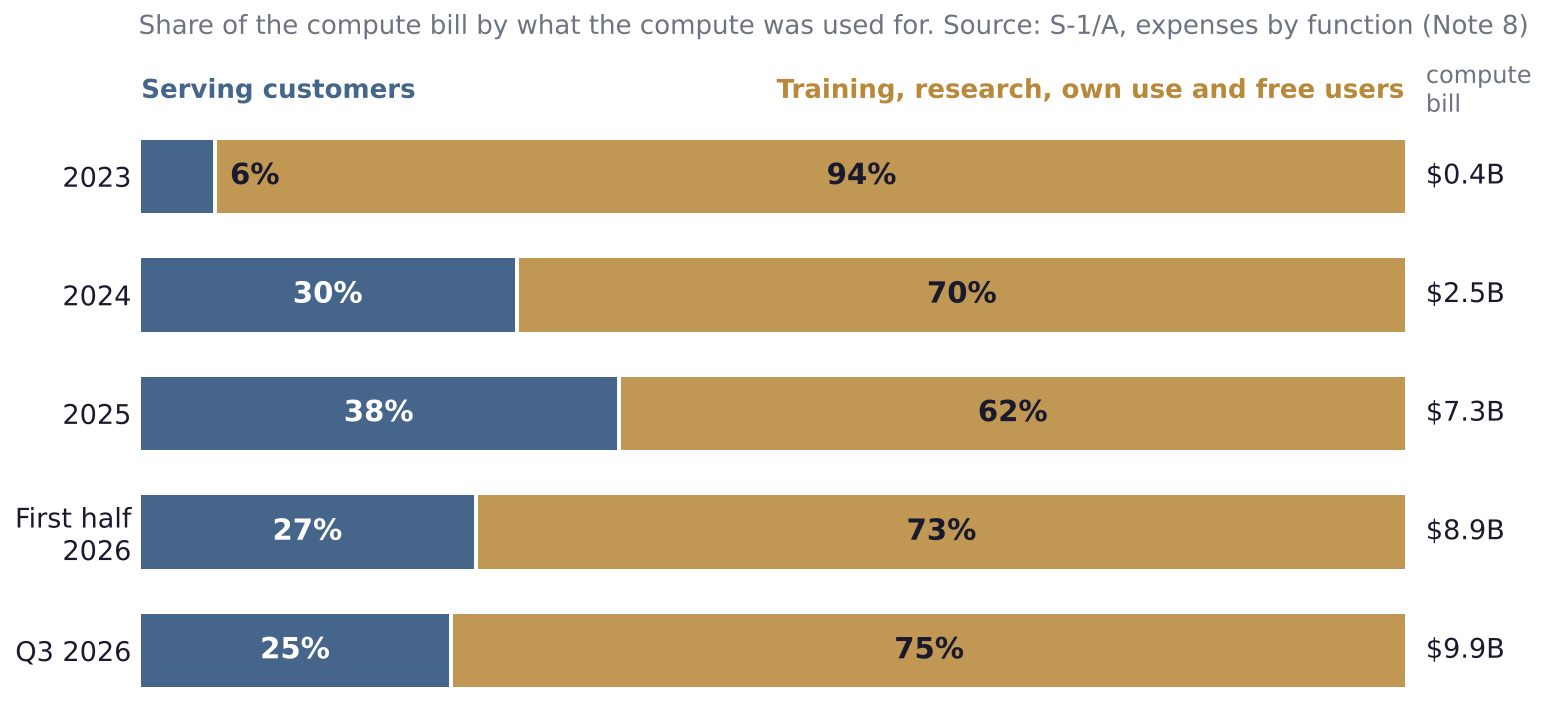
| Period | Revenue | Compute bill | Serving customers, at most | Everything else | Everything else, share of revenue |
|---|---|---|---|---|---|
| 2024 | $0.4B | $2.5B | $0.8B | $1.8B | 459% |
| 2025 | $4.6B | $7.3B | $2.8B | $4.6B | 99% |
| First half 2026 | $16.3B | $8.9B | $2.4B | $6.6B | 40% |
| Q3 2026 | $17.0B | $9.9B | $2.4B | $7.4B | 44% |
Everything else covers training, research, Anthropic's own use of Claude and free users. The filing gives no split between them.
- Serving has settled near 14 cents of each revenue dollar.
- Everything else moved against Anthropic in Q3.
- It spent $7.4B on compute that served no paying customer, more than in the whole first half, and that spending rose from 40% of revenue to 44%.
- The 35% margin target needs the whole compute bill near 45% of revenue (1.5).
- With serving at about 14.5%, training and research have to fall to about 30%.
- Anthropic has signed for $70.7B of compute in the next twelve months, and the table shows the revenue that takes.
| Revenue in the next twelve months | Serving, at 14.5% | Left for everything else | Everything else, share of revenue |
|---|---|---|---|
| $81B, flat at today's pace | $11.7B | $59.0B | 73% |
| $101B, up 25% | $14.6B | $56.1B | 55% |
| $151B, Greenwich's 2027 forecast | $21.9B | $48.8B | 32% |
| $180B | $26.1B | $44.6B | 25% |
Assumes Anthropic uses the capacity it has signed for and buys none on top. chokepoints.ai arithmetic on filing figures.
- In dollars, training still pays. Anthropic spent $6.3B on research and development in 2025. In the first nine months of 2026 it earned $28.4B after serving costs. The $19.2B spent in 2026 needs about $22.5B of revenue to earn back at today's margin, and Q3 revenue alone was $17.0B.
- In capability, each dollar buys less. Garicano and Imas put the fall at about 69% in a year.
- In what buyers pay, the top of the range sells less than the middle. Fable took 8% of spending at twice the price of Opus (1.6).
| Model family | Training cost | Revenue so far | Time to earn back the training cost |
|---|---|---|---|
| Sonnet 4 | $0.8B | Not given | Not given |
| Sonnet 5 | $1.4B | Not given | Not given |
| Opus 4 | $2.4B | $11.6B over its life | About seven months after launch |
| Opus 5 | $3.2B | Over $5B in its first quarter | Inside its first quarter |
| Fable and Mythos 5 | $6.9B | Not given | Eight to nine months, on our estimate |
Training costs and revenue are William Blair's estimates of 10 November. Anthropic discloses none of them. The Fable figure is ours: 13% to 15% of an $81B revenue pace, with 85.5% left after serving.
- Each generation has cost more to train and has earned more, on these estimates.
- Fable breaks the pattern: it cost twice as much as Opus 5 and sells about a fifth as much.
- William Blair expects a new generation every 12 to 15 months and puts the test ahead in plain terms: a $100B training run would need $145B of revenue from one model family.
- A new model pays for itself when the extra profit it brings exceeds its training cost.
- Two things decide that.
- One is how much more buyers pay for the better model.
- The other is how long it sells before an open model matches it, which is about six months today (2.7).
- On the economists' estimate, holding the 2026 pace of progress takes four times the research spending each year.
- Research and development ran at $38B a year in Q3.
- Four times that is $152B, and Greenwich expects Anthropic's whole compute bill to be $88B in 2027.
- Anthropic cannot keep raising research spending at the 2026 rate.
- Either Claude's own help with research makes up the difference, as METR's findings suggest it has begun to, or the pace of improvement slows.
- Partly answeredA model's earning life: One to four months at full pace, on Ramp's panel.
- Opus 5 launched on 24 July; three weeks after Opus 5.5 arrived in September, spending on Opus 5 had fallen 69%.
- Opus 4.8 held 28% to 31% of business model spending for two months before Opus 5 arrived.
- The filing says models released in the six months to September brought in over 80% of Q3 revenue.
- William Blair expects a new generation every 12 to 15 months.
- Anthropic gives no revenue by model.
- Partly answeredRoom to slow training spending: Only at the edges.
- It owes $70.7B for compute in the next twelve months and $451.6B by 2030 whether it trains or not (2.4).
- It can stop buying short-term capacity, which was $6.5B of the nine-month bill, and it can move signed capacity from training to serving if customers want it.
- Partly answeredClaude's help with research: in 2026 it did.
- METR attributes most of the doubling in pace to staff using Claude.
- Garicano and Imas read the same data as a one-off step of 1.4 to 2.3 times in research output, with no sign yet that the gain compounds.
- GapTraining, research and own use: the filing gives one line for all three. The only clue is that Anthropic's own use of Claude, valued at list prices, grew more than 250 times between January and September and passed its monthly cash pay bill in April.
2Durability
2.1Customers spend nine times more, and few are under contract
Customers are raising their spending at a rate few companies have seen, and almost none of it is under contract. The revenue recurs because customers have built Claude into daily work. That holds while Claude stays ahead, and a stumble would show in revenue within a quarter.
Mixed Confidence: medium. The 60% to 70% figure is our estimate.
- Net revenue retention was about 900%. Business customers from a year ago now spend nine times as much. The measure leaves out people on Pro, Max and Ultra plans.
- Revenue under signed, non-cancellable contracts was $13.8B at 30 September. About three-quarters, $10.4B, falls in the next twelve months.
- The filing says many of its top customers have no long-term contract and can cut or stop spending at any time.
- Churn and gross retention are not disclosed.
- The heaviest 5% of Claude Code users in enterprises raised their spend about 50% in Q3 alone (deck).
- Wolfe: in its scan of 129 companies' supplier lists, 93% of those using Anthropic also list OpenAI.
- Expert calls: behind a routing layer, switching model is as simple as changing the model name (Learnrithm). Nextdoor says Claude is tightly built in, yet it could still move if it can carry its agents and context. Airwallex splits its budget 50/50 with OpenAI.
- Greenwich: agent tools and connectors raise the cost of switching.
- YipitData: 87% of business customers in its spend panel were still paying after twelve months. The top 1% account for nearly half of the spend.
- Ramp: about 4% of its business customers, mostly smaller firms, cancelled Anthropic each month in February, the same rate as OpenAI.
- Consumer Edge: 52% of monthly subscribers still pay after twelve months, against 58% at OpenAI.
- Press, October and November: Microsoft, Meta, Cursor, Replit and Revolut each moved work away from Claude.
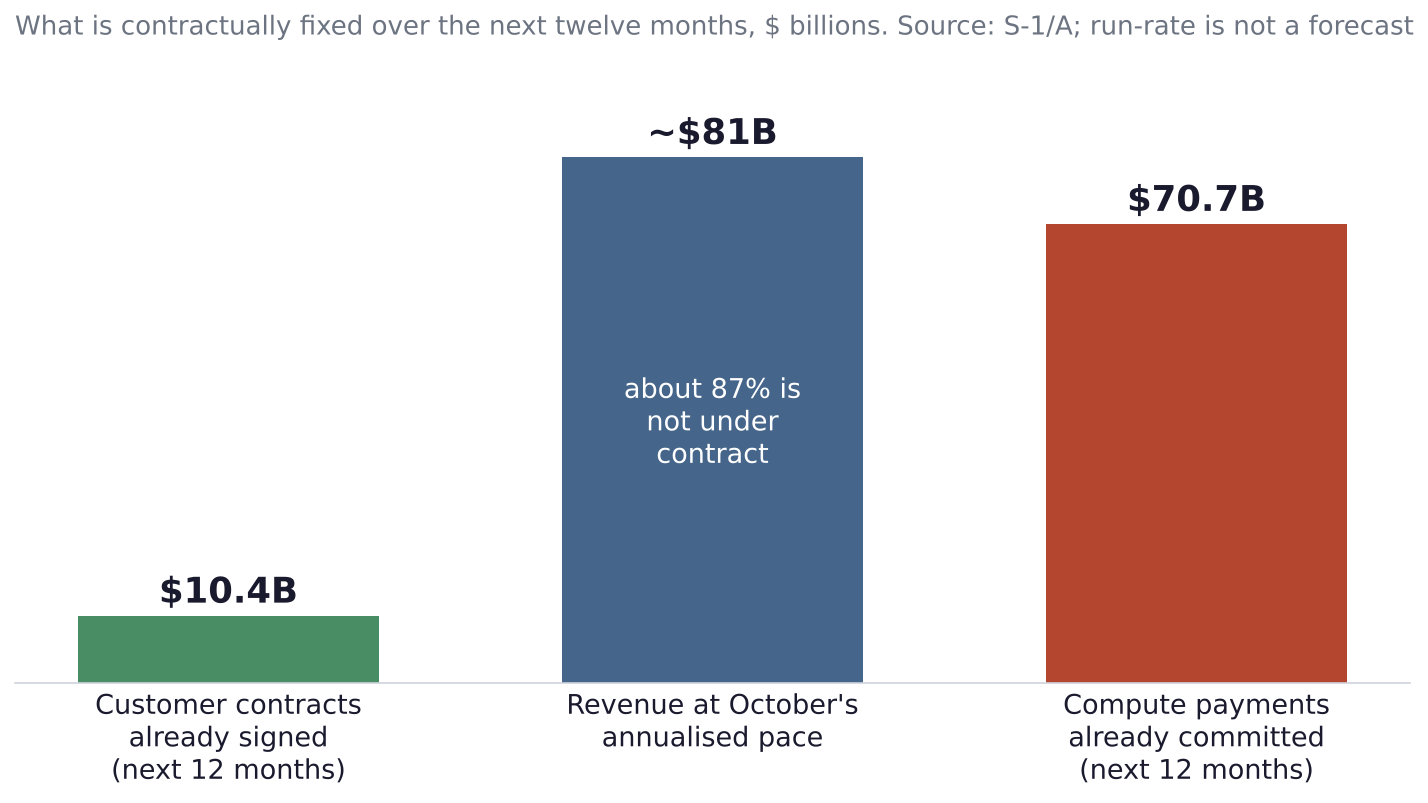
- Contracts cover about 13% of the current revenue pace.
- The rest is earned month by month.
- A second estimate follows from the retention figure: if last year's business customers now spend nine times as much, they account for about 60% to 70% of Q3 revenue.
- The other 30% to 40% came from customers won within the year.
- Partly answeredCustomers and revenue lost in a year: the company gives nothing, but outside data now does.
- Businesses: YipitData's spend panel of 1,500 small firms and 200 large ones shows 87% retained after twelve months.
- It does not say whether that counts customers or dollars.
- Ramp, whose customers are mostly smaller firms, found about 4% of businesses cancelling Anthropic each month in February, the same rate as OpenAI.
- Together they suggest between an eighth and two-fifths of business customers leave within a year, with large firms at the low end.
- Revenue lost is probably much smaller than customers lost, because the top 1% of customers account for about half of spend.
- Consumers: 52% of monthly subscribers were still paying after twelve months, against 58% at OpenAI.
- A September expert calls that reported no churn came from a consulting partner who resells Claude, not from a customer.
- Partly answeredContracts with the 250 largest customers: no average length is given.
- The filing says a growing number of enterprises sign one-year or multi-year contracts that cannot be cancelled, with a minimum spend, in return for a fixed price list.
- It also says many of the largest customers have no long-term contract and can stop at any time.
- Contracted revenue is $13.8B with three-quarters due within twelve months, which points to short commitments.
- A expert calls says buyers resist twelve-month contracts tied to one model.
- Partly answeredCost of switching to a rival: no source measures it, but this autumn's cases show large teams can move within weeks.
- Revolut moved about 2,000 engineers off Claude Code to a self-hosted open model.
- Meta halved its Claude Code users to about 30,000 by steering engineers to in-house tools.
- Microsoft switched its default internal coding model to OpenAI.
- Replit made OpenAI its default, while saying it still supports other models.
- In the other direction, a former Shopee engineering manager says his team moved to Opus 5.5, and an ETR survey in November found Anthropic the largest net gainer among firms that moved work in the previous month.
- GapRetention in earlier quarters: only the September reading of about 900% exists.
2.2Claude leads in coding, and the share data disagree
Claude leads where the revenue is, in coding and long tasks. Leads in this market last months, and the newest trackers show Anthropic's share dropping more than ten points in late October. Both samples are narrow and surveys of large firms still show gains, so we treat share as unproven in either direction.
Mixed Confidence: low to medium.
- On the coding test the company chose to show, Opus 5.5 matches OpenAI's GPT-6 Astra at about 40% of the cost (deck, data from 22 September).
- It shipped 250 models, products and features in the first nine months of 2026 (deck).
- Revenue moves with each release. Safety checks have delayed or limited releases before and may again.
- In June 2026 US export restrictions forced Anthropic to switch off two models for all customers until the restrictions were lifted.
- For the lead: Menlo: 55% of enterprise model spending, against 31% for OpenAI. Greenwich: the best open model scored 28% on a real-world coding test, against 46% for Opus 5.5. Dell and Nextdoor told experts they moved work from OpenAI to Anthropic.
- Against it: Cleveland Research: share worsened in Q3, mainly because customers spread work across several models to save money, with pockets of coding work moving to OpenAI, to SpaceX's models and to open models. D.A. Davidson: OpenAI seems to have caught up in Q3, and it was the breakout quarter for open models. Block adopted open models to cut cost.
- Scale: OpenAI's Q3 revenue was about $10B, up about 50% on Q2, by press reports of internal documents. Anthropic's was $17.0B.
| Measure of share | Reading | Direction | Weakness |
|---|---|---|---|
| Menlo survey, Sep 2026 | 55% of enterprise model spend | Up from 40% | Menlo is an Anthropic investor; about 400 US firms |
| Ramp spend data, weekly | 49.3% of token spend in the week to 1 Nov | Down from 60.5% in the week to 23 Oct; 51.3% in late Sep | Small sample that swings week to week; skews to smaller firms |
| Wolfe tracker (OpenRouter data) | 41% of spend on 7 Nov | Down from 55.6% on 24 Oct | Developers routing through one service; no enterprise or cloud spend |
| Dell, expert calls, Aug 2026 | About 25% of Dell's model spend | Rising on coding | One large buyer; OpenAI was 30% to 35% |
| Cleveland Research checks, Q3 | Share worse on the quarter | Down | Direction only, no number |
| Our cross-check | About 44% of 2026 model revenue | Brokers assume it rises | Mixes two brokers' numbers |
- Partly answeredCoding share in Q4: no coding-specific number for October or November.
- The general trackers both turned down at the end of October (see 1.2): Ramp from 60.5% to 49.3%, and the OpenRouter-based Wolfe tracker from 55.6% to 41%.
- Named moves in coding tools point the same way.
- From 12 October Cursor's entry plan includes only Grok, and Claude is billed separately at list price on its higher plans.
- Replit made OpenAI its default.
- Cleveland Research's October note describes the Q3 slippage as mainly customers spreading work across several models to save money, with only pockets of switching in coding.
- Against that, two October expert calls reported no move away from Claude.
- Partly answeredBuyers' view of GPT-6 on real work: two buyer calls since October.
- A senior engineering director at Rippling: GPT-6 Astra cost too much for the gain, and Opus 5.5 was a big step up.
- A former Shopee manager: the team now works on Opus 5.5.
- There is no buyer feedback yet on Gemini 4.
- On cost per task, Jefferies cites an independent index with Gemini 4 Argon at $1.99, Astra at $3.26 and Opus 5.5 at $5.98.
- That is the opposite of the deck's exhibit, which shows Opus 5.5 at about 40% of Astra's cost; the tests differ.
- All of it is already dated: Fable 5.2 shipped on 9 November and GPT-6.2 Astra on 17 November.
2.3Five customers bring in a quarter of revenue
The revenue base has three soft spots. Five buyers who are free to leave bring in a quarter of it, three clouds that sell rival models carry 44%, and up to 7% came from customers breaking Anthropic's rules. Microsoft, Meta and Cursor each cut their reliance on Claude this autumn.
Concern Confidence: high. All of it is in the filing.
- Customers: the top five were about 25% of nine-month revenue, about $8.3B. No single one was above 10%. Their share fell from about 36% in Q1 to 21% in Q3. Two customers were 12% of 2025 revenue each, and neither is above 10% now.
- Channels: Cloud marketplaces carried 44% of revenue and held 52% of the money owed to Anthropic at 30 September.
- The same firms on every side: After the deal Amazon will own 14.7% and Google 13.7%. Both are also suppliers and sales channels, and Google is a direct rival.
- Rule-breakers: About 5% to 7% of nine-month revenue, $1.7B to $2.3B, came from customers later found to be breaking Anthropic's usage rules. Enforcement was stepped up in August and September, and the company expects this revenue to shrink.
- William Blair: the top five average about $2.8B of annualised spend each.
- Cleveland Research: more enterprises are buying through the clouds, not directly, to avoid being tied to one model maker.
- The Information, September: Nvidia and Booz Allen limit their use of Fable because Anthropic does not guarantee that none of their data is kept.
- The Information, October: Microsoft cut planned spending on Claude for its own staff by more than a third, from over $1B a year. Meta halved its Claude Code users to about 30,000.
- YipitData: in its spend panel the top 1% of business customers account for nearly half of Anthropic spend.
- GapRule-breaking revenue lost in Q4: not quantified by the company.
- Two second-hand accounts of investor briefings say this revenue has fallen from about 10% of the total in July to under 2%, and is heading to zero in Q4.
- Neither is confirmed, and the July figure is above the filing's 5% to 7% for the nine months.
- The filing says enforcement was stepped up in August and September, and that the $81B October run-rate still includes rule-breakers not yet cut off.
- Brokers describe this revenue as mostly rival AI labs, largely based in China, copying Claude's answers to train their own models.
- Partly answeredClouds steering customers to their own models: there is evidence of steering but no measure of it.
- Google bundles Gemini with its office software and with existing cloud commitments, and discounts hard.
- Cleveland Research links OpenAI's improving share partly to its growing partnership with AWS.
- Seaport notes Claude has fewer features on the clouds than when bought direct.
- In the other direction, one channel expert says some Google clients add Claude instead of buying more Gemini.
- The filing itself warns that the clouds can see Anthropic's prices and set their own sales incentives.
2.4Anthropic has signed for $900.9B of compute against revenue of $81B a year
Anthropic has bet that revenue about triples by 2030. If it does, owning capacity that is in short supply is an advantage rivals cannot copy fast. If growth stalls, the cash covers the bill for about four years and profits turn into heavy losses within twelve months.
Concern Confidence: medium. The yearly timing beyond the next twelve months is our estimate.
- Total committed spend is about $900.9B. About $451.6B falls due before the end of 2030 and most of the rest between 2031 and 2045.
- $70.7B is due in the twelve months from October 2026.
- About $186.2B can be ended if a supplier fails to secure financing, sites or approvals. A further $150B to $175B sits in deals with no fixed amount and is not in the total.
- The SpaceXAI deal alone reaches about $3.1B a month from December. Either side can cancel it on 90 days' notice from early 2027.
- Lambda missed a deadline to secure a site, so a $34.9B agreement can now be ended by either side.
- Expert calls: one expert rates Fluidstack's delivery risk as high, and says Anthropic is about $50B of its contracts and over 90% of its revenue. Another expert disagrees, pointing to take-or-pay terms. Danske Bank notes that financing for one large Nscale site is not yet committed.
- Evercore: the right to cancel runs both ways, so SpaceX can also reprice or reclaim the capacity.
- Rosenblatt: the vehicle that buys Broadcom-built chips and leases them to Anthropic is funded by about $63B of debt and covers only part of 2027's needs.
- Greenwich: if about $290B of leases not yet started earned nothing, its 2028 margin forecast falls from 20% to between 6% and 9%.
| Supplier | Amount | Period | Can it be ended? |
|---|---|---|---|
| Broadcom-built chips, leased | $161.2B | Five-year leases from 2026 and 2027 | No |
| Google cloud | At least $121.3B | Apr 2026 to Jul 2033 | No; any shortfall is paid anyway |
| SpaceXAI (Nvidia chips) | Up to $120.5B | Into 2029 | Yes, by either side, from early 2027 |
| Amazon | At least $110.0B | May 2026 to Apr 2036 | No; any shortfall is paid anyway |
| Microsoft | $47.2B to $49.2B | Nov 2026 to Jun 2033 | Only for capacity not delivered |
| Nscale (Nvidia chips) | Up to about $44.6B | Into 2033 | Paid only as capacity arrives |
| Lambda (Nvidia chips) | About $41.3B | Into 2034 | $34.9B of it can be ended now |
| Google chips, further order | About $125B to $150B, not fixed | 2028 to 2031 | Depends on delivery; outside the total |
| AMD | Over $20B, not fixed | From 2027 | No; outside the total |
Amounts overlap and do not sum to $900.9B. Fluidstack runs data centres for Anthropic; the filing gives no amount.
- The next twelve months. Signed compute payments of $70.7B are 1.8 times the yearly pace of compute cost in Q3.
- The table sets them against four levels of revenue.
| Revenue over the next 12 months | Committed compute as a share of revenue | Adjusted margin if other costs stay at 27% |
|---|---|---|
| $81B: flat at October's pace | 87% | −15% |
| $101B: 25% higher | 70% | 3% |
| $154B: Seaport's 2027 forecast, raised on 12 November | 46% | 27% |
| $151B: Greenwich's 2027 forecast | 47% | 26% |
Committed payments are a floor on compute cost, and cash payments are not the same as the cost shown in the accounts. Greenwich expects Anthropic to spend $87.9B on compute in 2027, more than the amount already signed.
- From late 2027 to 2030. The remaining $380.9B due by 2030 averages about $117B a year.
- For compute to be 50% of revenue, revenue must average about $234B a year.
- At Q3's 58% it must average about $201B.
- If every contract that can be ended were ended, the bill falls to about $93B a year and the revenue needed to about $186B.
- If growth stopped. With revenue flat at $81B, we estimate Anthropic would use about $12B of cash in the first year and about $58B a year after that.
- Cash after the deal would last a little over four years before it cancelled anything or raised more.
- Partly answeredSchedule for the $580.9B outside the filing's table: the company gives two markers for the total: $70.7B due in the next twelve months and $451.6B before the end of 2030.
- Most of the amount outside the table, $451.2B, is leases that have not started.
- They begin between 2026 and 2028 and run about ten years on average.
- Brokers fill the gap with estimates.
- Greenwich gets about $88B for 2027 and $104B for 2028 by adding the fixed minimums ($51B and $67B) to about $37B a year of SpaceX capacity, which it assumes Anthropic keeps by choice.
- Evercore has about $114B for 2027.
- Partly answeredSpaceX supply after early 2027: no formal statement.
- Elon Musk said on 11 November that SpaceX would happily take the capacity back but expects Anthropic to want more.
- SpaceX told investors it prefers renting near the going rate to signing long contracts, which Evercore reads as room to raise the price.
- Dario Amodei said on 13 November that short-term capacity has always been available so far.
- Our read: supply probably continues, at a price that can move against Anthropic.
- GapReselling unused capacity: no data. The filing only warns that it may end up with capacity it cannot use.
- GapHow much of the $186.2B Anthropic would end: no forecast. One real case exists: a $34.9B agreement with Lambda became terminable when Lambda missed a deadline to secure its site.
2.5Anthropic holds $212.7B of cash and burns none today
Anthropic needs no new money for years. Cash after the deal covers about 47% of everything due by 2030 before a dollar of operating cash flow. The money does move in a circle: Amazon and Google will own 28% between them, supply the compute and sell 44% of the product.
Supportive Confidence: high.
- Cash and short-term investments were $131.9B at 30 September. The deal lifts that to about $212.7B.
- Operations produced $6.6B of cash in nine months, against a $2.0B outflow a year earlier. Spending on equipment was $0.9B, plus $2.0B paid ahead on leased gear.
- Unused funding lines: a $14.8B bank facility, $15B from Amazon, $10B from Google after the placement, and up to $42B from Broadcom to cover lease payments.
- The $104.0B net loss is mostly an accounting charge. $94.3B of it is the rising value of notes that convert into shares.
- Seven suppliers are buying $26.0B of shares at the IPO price.
- Financial Times, via press: backers say the priority is raising as much cash as possible, not the highest valuation. Bankers say a higher price could take the total raised beyond $100B.
- Greenwich forecasts free cash flow of $16.7B in 2027 and $34.7B in 2028. That is before stock pay. After stock pay, interest income and reinvestment, its own valuation model has 2027 at −$10.4B.
- Partly answeredAnother share sale in 2027: no broker expects one.
- New shares will come through agreements already signed: suppliers can be issued up to $77.0B more of notes that convert into shares, which Greenwich estimates would add 4% to 5% to the share count.
- The company has also agreed not to sell new shares until its Q1 2027 results or day 180, whichever is earlier.
- Partly answeredLandlord and lender financing: no total, but the structure is clearer.
- The Broadcom equipment leases are funded by lenders (Bank of America, Citi and Morgan Stanley arranging the senior loan, Blackstone leading the junior one), with Broadcom covering losses up to a peak near $43B.
- Anthropic guarantees its leasing subsidiaries and can pay the rent by issuing notes that convert into shares.
- If revenue targets are missed, those notes cost 13% a year and convert at a bigger discount.
- Google backstops about $5.9B of lease payments at three sites.
- The lenders behind Nscale and Lambda are not named.
2.6Founders hold 50.1% of the votes, and a court has upheld the Department of War's label
Public holders buy a share of the profits and no control. The US government has shown twice in a year that it can cut Anthropic off from customers, once by label and once by export rule. The revenue at stake is small today, between under 2% and a mid-single-digit share on Anthropic's own court filings.
Concern Confidence: high on the facts, low on how it ends.
- Votes: one special share held by the founders' vehicle carries 50.1% of votes on ordinary matters. It has no economic value.
- Board: a trust of five independent trustees, the Long-Term Benefit Trust, elects a majority of directors. The company is a public benefit corporation, so directors must weigh its mission alongside returns.
- Department of War: in March 2026 the department labelled Anthropic a supply-chain risk after Anthropic kept its limits on certain military and surveillance uses. A lower court sided with Anthropic in August. On 25 September an appeals court upheld the label by two votes to one. Anthropic has asked the full court to rehear the case.
- Direct sales to government agencies are under 2% of revenue. The filing warns the dispute could spread to customers who sell to the government.
- Export rules: in June 2026 the Commerce Department restricted exports of two models worldwide, and Anthropic switched them off until the rules were lifted.
- Copyright suits: Anthropic settled the authors' class action for $1.5B in September 2025, and the court approved it in July 2026. Suits by music publishers and by Reddit are pending. The filing gives no estimate and says statutory damages add to the risk.
- Key people: the filing says the chief executive and the president would be difficult to replace, and that many researchers stay for the mission.
- CBS, 11 October: Palantir's technology chief said Claude had already been replaced on the Pentagon's Maven platform, with no effect on operations. He was not talking about commercial customers.
- Anthropic's court filings, March: its finance chief put the cost at hundreds of millions of dollars in 2026 if only Department of War work is lost, and multiple billions if contractors drop Claude across their businesses.
- Law firms: the order covers work on Department of War contracts, and binds a contract only once written into it. Some contractors have still been asked to certify they do not use Claude at all.
- Defence officials, September: about 90% of the department's classified AI work had already moved off Claude.
- Partly answeredRevenue from US government contractors: there is still no disclosed figure, but Anthropic's own court filings in March give a range.
- Its finance chief said losing Department of War work directly could cost hundreds of millions of dollars in 2026, and that a broad reading of the label, with contractors dropping Claude everywhere, could cost multiple billions.
- Its public-sector head said more than $150M of run-rate in existing and expected Department of War contracts was lost at once, and that over $500M of expected public-sector run-rate for 2026 could shrink substantially or disappear.
- Its commercial chief said one partner switched models on a deployment for the Food and Drug Administration, ending a pipeline worth over $100M.
- For 2027, One outside estimate on stated assumptions is $1B to $4B, or 0.6% to 2.7% of revenue, if the label stays limited to Department of War contracts, and $2B to $7B if contractors remove Claude company-wide.
- The evidence so far favours the narrow case.
- Law firms say an order binds a contract only once it is written in, and covers that contract's work.
- Leidos and Northrop called their use limited.
- No large contractor has confirmed a company-wide ban, and Q3 revenue still grew 47%.
- Partly answeredThe court's rehearing decision: no decision date.
- The government's reply to the rehearing request was due in mid-November.
- Sources give either 13 or 18 November, and we could not check the court record.
- One law firm calls rehearing a long shot, made more likely here by the split vote and the conflicting California ruling.
- On spread: inside the department, an under-secretary said in September that about 90% of its classified AI work had moved off Claude, and Palantir's technology chief said on 11 October that Claude had been replaced on the Maven platform.
- Outside it, no cloud has removed Claude from its government regions, and civilian agencies can buy again under a government-wide agreement of 27 October, at 40% off.
- One warning sign: some contractors have been asked to certify that they do not use Claude at all, which goes beyond the order.
2.7Chinese and open models take routine work and 4% of the money
Cheap Chinese models threaten the routine part of Anthropic's revenue and have left the top tier alone so far. Large engineering teams have cut bills by half or more by making an open model the default and keeping Claude for hard tasks. The lead lasts about six months a release, so Anthropic has to keep paying for new models to hold its prices.
Mixed Confidence: medium on usage and prices, which several sources measure; low on how far the shift goes.
- Anthropic lists open models among its competitors, for the growing set of company tasks where cost matters more than capability.
- It warns that open models may take part of the market for some uses and push its prices down.
- It warns that rivals have tried to copy Claude by training their own models on its answers, and will keep trying. As AI helps to build AI, the know-how may spread until access to compute decides who competes.
- Customers breaking Anthropic's terms brought in 5% to 7% of nine-month revenue, $1.7B to $2.3B. Anthropic stepped up enforcement in August and September.
- Anthropic does not sell Claude in China.
- US enterprises: Menlo's September survey: open-source models carry 19% of tokens, up from 11%, and take 4% of spending, down from 6%. Chinese models take 89% of that open-source spending, led by Kimi, from the Beijing lab Moonshot, at 61%.
- US businesses' payments: Ramp: 0.2% of the businesses on its cards paid DeepSeek, a Hangzhou lab, in October. DeepSeek took 0.2% of token spending in the week to 1 November. Ramp counts payments to model makers, clouds and routing services. It misses a model a company runs on its own computers.
- Developers: on OpenRouter, Chinese models carried 119 trillion tokens in the week to 15 November against 15 trillion for US models. OpenRouter serves individual developers and start-ups, and its public counts leave out private traffic.
- Quality: Epoch AI, a research non-profit, combines many tests into one index. On its data the best open model, Kimi K3.1 Pro, matches a score the best closed model reached six months earlier. Stanford's AI Index has the top closed model 3.3% ahead of the top open one in March 2026, against 0.5% in August 2024.
- Copying: Anthropic's September report counts nearly 200 million exchanges in five campaigns by Chinese labs to train on Claude's answers, 151 million of them from Alibaba. A joint advisory from the NSA, the FBI and the cyber agency CISA says such copying is the core of six Chinese labs' development.
- Government: Federal agencies and their contractors must remove DeepSeek. The Congressional Research Service notes that no rule stops a private company from using it.
- Brokers: none sizes the revenue Anthropic could lose to open models. Greenwich ranks the risk sixth on its list and calls Anthropic's lead wide in coding and short-lived, renewed with each release and secured by no contract. Seaport sees no price war with open models. D.A. Davidson's bear case leaves the frontier labs with only the work where cost is no object.
- Expert calls: Dell's field technology chief expects open models to take the middle tier of work and to leave the hardest fifth, the long tasks. A Snowflake engineer says customers refuse Chinese-hosted services and accept the same models on their own machines or on US hosts. Carrier's data chief cut costs by 60% to 80% on selected internal uses and moved no customer-facing work.
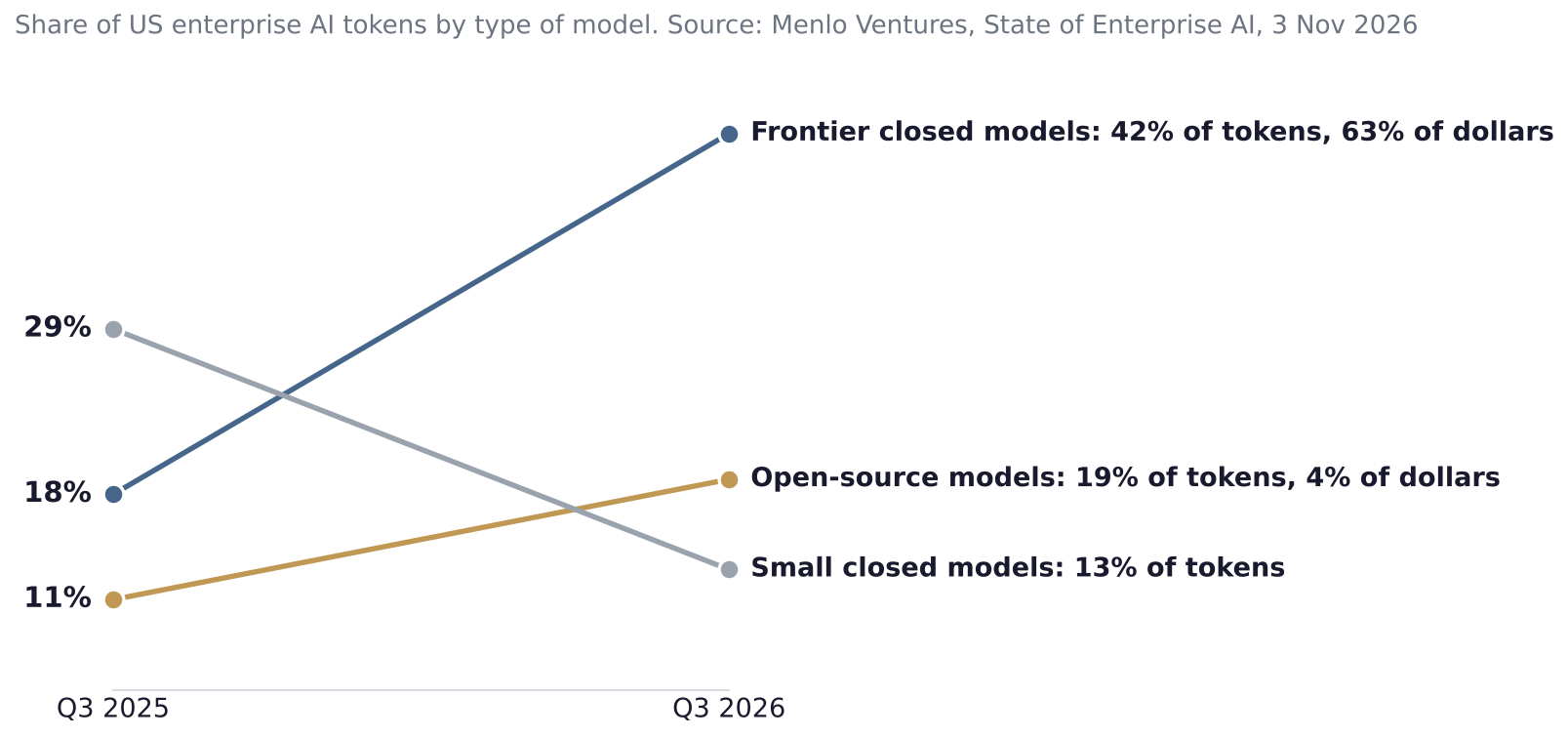
| Measure | Who it covers | Share of tokens | Share of money |
|---|---|---|---|
| Menlo survey, Sep 2026 | About 400 US enterprises | Open-source models 19% | 4% |
| Ramp, week to 1 Nov | Payments by US businesses | DeepSeek 0.6% | 0.2% |
| Vercel, Sep 2026 | Developers building apps | Open models 71.5% | 22.6% |
| OpenRouter, week to 9 Nov | Developers and start-ups | Open models 75% | Not published. Claude bought direct from Anthropic is 2% of tokens and an estimated 15% of the money |
The OpenRouter money figure is one analyst's estimate. Vercel's figures are from its own index.
- The two readings fit together.
- Developers who can pick any model send most of their tokens to Chinese models.
- Companies send them little of their money, because the tokens are cheap: the average open-source token cost $0.13 per million in September, against $0.70 for closed models (Menlo).
- A new release can move developers' money within weeks.
- Kimi K3.1 Pro launched on 23 October.
- Over the next two weeks Anthropic fell from 55.6% to 41% of spending on OpenRouter's fifty largest models and Moonshot rose to 15%, on Wolfe's tracker.
- Fable 5.2 brought Anthropic back to 45.5% by 14 November, on Shenton's.
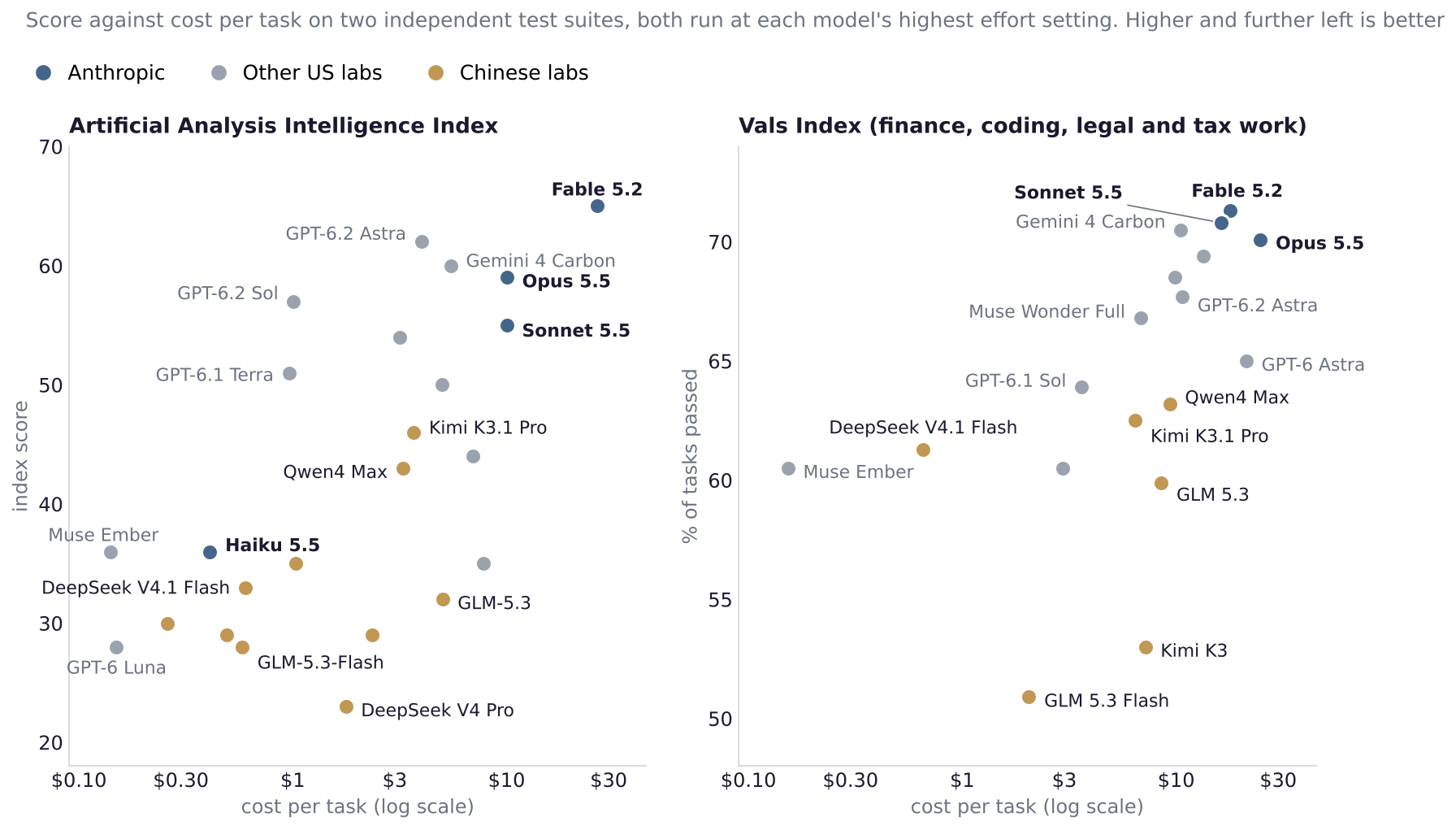
- Business tasks. On Vals's mix of finance, coding, legal and tax work, DeepSeek V4.1 Flash passes 61.3% of tasks at $0.66 each. Fable 5.2 passes 71.3% at $17.94.
- Legal work. GLM 5.3, from the Beijing lab Z.ai, passes 74.6% of Vals's legal tasks at $2.68 each. Opus 5.5 passes 72.4% at $19.94.
- Coding at the command line. Kimi K3.1 Pro passes 63.6% of Vals's tasks. Opus 5.5 and Fable 5.2 pass 65.2%.
- The cheaper rival at the top is OpenAI. GPT-6.2 Sol scores 57 on Artificial Analysis's index for $1.01 a task. Opus 5.5 scores 59 for $10.04.
- Effort settings change the ranking. Both boards run each model at its highest effort. At its lowest effort Opus 5.5 costs $0.98 a task on Artificial Analysis's index and still outscores GLM-5.3, which costs $5.01 because it writes six times as many tokens.
| Board | What it measures | Shows cost | Best Chinese model against the leader |
|---|---|---|---|
| Artificial Analysis Intelligence Index | Many test suites in one score. OpenRouter's benchmark tab draws on it | Yes, per task | 46 against 65 |
| Vals Index | Finance, coding, legal and tax tasks, weighted by each sector's share of US output | Yes, per task | 62.5% against 71.3% |
| Epoch Capabilities Index | Many benchmarks on one scale that compares models across years | No | 161 against 173, six months behind |
| Arena | People vote blind between two models' answers | No | Alibaba 1,449 against Anthropic 1,503 in March 2026 |
| METR time horizon | The length of task a model finishes half the time | No | Kimi K2 Thinking, tested in November 2025, matched a Claude model nine months older. METR stopped updating in September 2026 |
| FrontierCode | Hard coding tasks | No | 44 against 55 |
| BenchLeader | 285 public benchmarks combined | Token price only | 62 against 73 |
| OpenRouter model pages | Usage, the price buyers paid, and scores from Artificial Analysis, Vals and Design Arena | Token price only | One model per page, with no comparison |
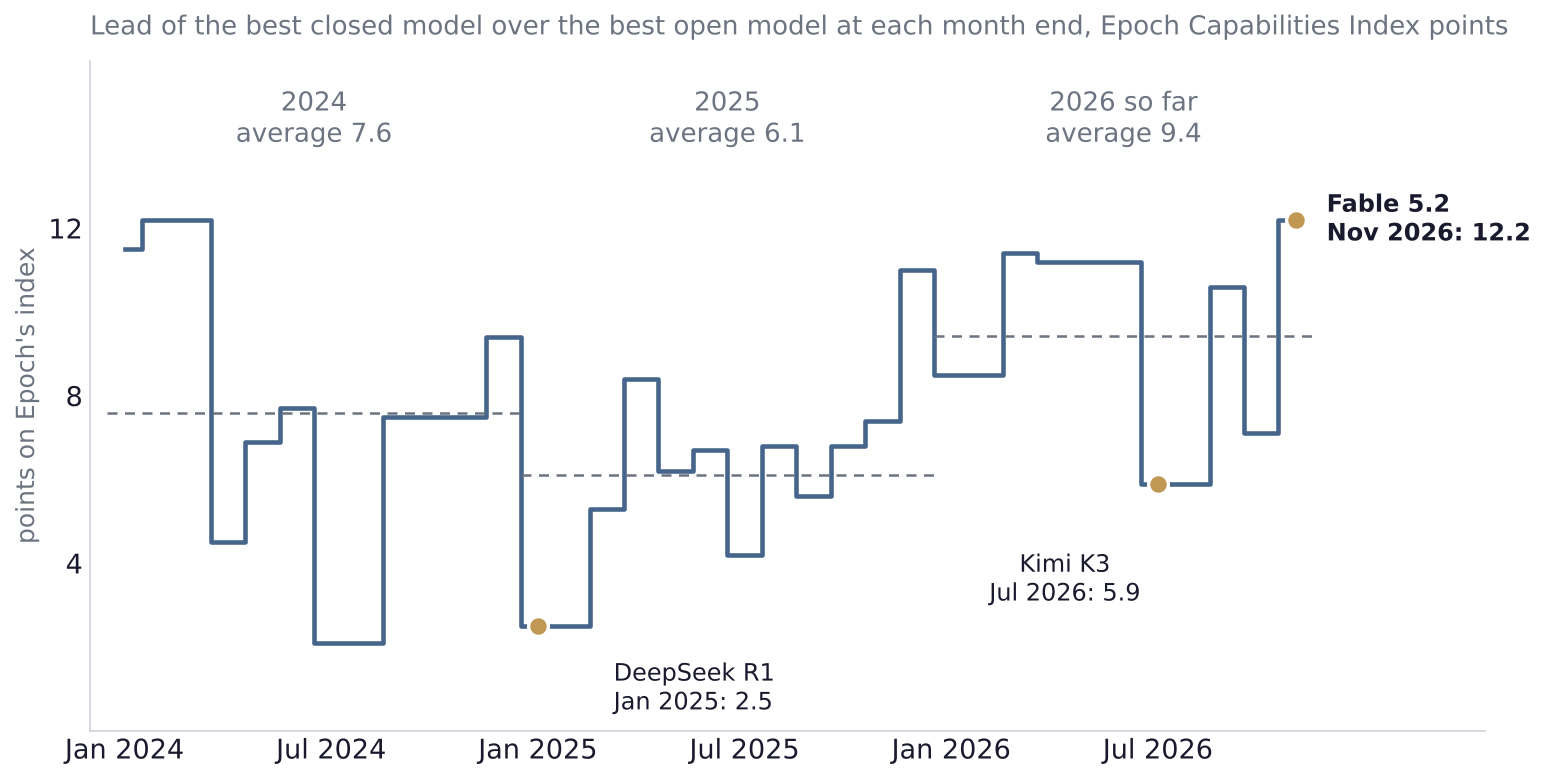
- Epoch's own notes put the lag at three to four months for open models, and at seven months for Chinese models since 2023.
- The newest data says six.
- Artificial Analysis rebuilt its index on 27 October: the old version had the best open model 3 points behind, the new one 12, and Fable 5.2 has since stretched that to 19.
- The followers keep pace by copying, on the US agencies' account, so the lead lasts while Anthropic and OpenAI keep releasing.
- For revenue the level matters as much as the lag.
- Today's best open model does what the best closed model did in April.
- On Vals's tasks Kimi K3.1 Pro costs about a quarter of what Opus 5.5 costs per task, and DeepSeek V4.1 Flash about a fortieth.
| Company | What moved | Saving reported | What stayed on frontier models | Caveat |
|---|---|---|---|---|
| Revolut, British fintech | Coding tools for about 2,000 engineers, from Claude Code and OpenAI's Codex to Z.ai's GLM on 56 Nvidia chips that Revolut runs itself, from April 2026 | Bill about a tenth of before, at about $0.30 per million tokens | Claude Code, Codex and Gemini for exceptions. Image tasks | Revolut's own figures. They leave out engineers' time and depend on keeping the chips busy. A slide in the talk says the system runs with Together, a US host |
| AT&T, US telecoms group | From 20% to 40% of its AI use, onto open models from Nvidia, Meta and Google | Not given | The rest of its AI use | US-made models only. No DeepSeek or Kimi |
| Pinterest, US social network | High-volume tasks, onto open models | Under 8% of the cost of closed models | Not given | From its August earnings call |
| Lindy, US assistant start-up | Most traffic, from Claude Sonnet and Gemini to DeepSeek V4 Flash hosted in the US, June 2026 | About 90% on the traffic moved | Sonnet when a user picks it or the task is hard | Kimi passed Lindy's tests and failed with real users |
| Firetiger, US monitoring start-up | Three kinds of agent, from Claude Sonnet 4.6 to DeepSeek V4 Pro hosted in the US, June 2026 | $606K a year to $231K, down 62% | Its other agents | DeepSeek passed 65% to 80% of tests before weeks of rework, then 92% against Claude's 94%. One task took four times as long |
| Coinbase, US crypto exchange | Routine engineering, to GLM and Kimi as defaults, June 2026 | AI spending about halved | Hard tasks, at the engineer's choice | Reported from the chief executive's post, which we could not open |
| Cursor, US coding tool | Built its own model on Kimi | Not given | Sells Claude at list price on its higher plans | Drew a House committee inquiry in April 2026 |
| DoorDash and Airbnb | Kimi for routine work at DoorDash. Alibaba's Qwen for customer service at Airbnb | Not given | Fable for the hardest tasks at DoorDash. Airbnb says most of its AI runs on US models | Both received House committee letters |
- Each company kept a frontier model for hard tasks and moved the volume.
- Savings run from 50% to 90% on the work moved.
- Each also reports weeks of engineering to make the cheaper model behave.
- Only start-ups have moved all their traffic.
- Running a model in-house pays once the chips are busy about 40% of the time, on one Snowflake engineer's rule of thumb.
- We found two small moves back to closed models, at Polyform and Semicon Alpha, and no large one.
- Section 2.2 covers Carrier, Dell and Block.
| Defence | Against cheap Chinese models | Evidence |
|---|---|---|
| The best model for the hardest work | Holds, for about six months per release | Six months on Epoch's index. 65 against 46 on Artificial Analysis. 46% against 28% on a real-world coding test |
| Price per finished task | Fails on routine work | $0.66 to $8.52 a task for Chinese models on Vals, against $16 to $25 for Claude. Switchers saved 50% to 90% |
| Claude Code and Cowork | Holds for teams that buy seats | Claude Code and Codex take 70% of coding spending (Menlo). Revolut runs its own tools on GLM |
| Trust and data rules | Holds for federal contractors | Amazon has hosted DeepSeek, Qwen, Kimi and GLM in the US since February. Revolut, a regulated bank, runs GLM in-house. A US standards body found DeepSeek's most secure model answered 94% of malicious requests under a common jailbreak, against 8% for US models |
| The clouds as a sales channel | Fails | The three clouds that carry 44% of Anthropic's revenue also sell the Chinese models |
| The work of switching | Holds for weeks | Firetiger rewrote prompts and added safety checks, then matched Claude within two points |
| Room to cut prices | Holds, at a cost to revenue | Serving takes 14.5% of revenue. Anthropic cut Haiku's price by 90% and the Opus class by 73% in a year |
| More compute than any follower | Holds the lead, and followers copy | The joint advisory from the NSA, the FBI and CISA. Anthropic's September report. UBS says Z.ai could serve about 10% of demand for GLM 5.2 itself for lack of chips |
| Independent test, November 2026 | Fable 5.2 | GPT-6.2 Astra | Ahead |
|---|---|---|---|
| Business tasks (Vals Index) | 71.3% | 67.7% | Claude |
| Finance agent (Vals) | 69.5% | 60.8% | Claude |
| Tax agent (Vals) | 32.1% | 21.8% | Claude |
| Epoch's own work tasks, marked by its staff | About 82% | 65% | Claude |
| Factual accuracy (SimpleQA) | 94% | 78.5% | Claude |
| Coding at the command line (Vals) | 65.2% | 63.1% | Close |
| Hard coding tasks (FrontierCode, run by Artificial Analysis) | 49.1% | 49.0% | Level |
| Epoch Capabilities Index | 173 | 174 | Level |
| Science tasks (Vals Science Index) | 63.7% | 68.4% | OpenAI |
| Science at the command line (Vals) | 55.7% | 71.4% | OpenAI |
| Legal agent (Harvey's test, run by Vals) | 5.0% | 16.3% | OpenAI |
| Cost per task, Artificial Analysis | $26.54 | $4.00 | OpenAI |
| Cost per task, Vals | $17.94 | $10.68 | OpenAI |
| List price per million tokens | $8 / $40 | $8 / $40 | Level |
Claude helped write this note. We took the scores from independent testers and list OpenAI's wins beside Claude's.
- We found no task that only Claude can do.
- Claude leads on finance, tax, factual accuracy and open-ended office work.
- OpenAI leads on science and finishes tasks for less money, because its models write fewer tokens.
- The lead in spending has changed hands twice since September: GPT-6 Astra drew level with Claude, and Opus 5.5 won the lead back within three weeks.
- In the week to 1 November Ramp had Anthropic at 49.3% of token spending and OpenAI at 46.1%.
- OpenAI launched GPT-6.2 Astra on 17 November.
- Two developers with weeks of early access posted the same day, and both prefer Claude for daily work.
- Their reports sit oddly with the test scores above, where Astra ties or leads on several measures.
| Who | What they praised | What they faulted | Verdict |
|---|---|---|---|
| Dan Shipper, chief executive of Every, a media and software firm | Good default design | Writing so terse it is hard to follow, a step back from Astra 6. Coding scores level with Astra 6, and it stops too early on full builds. Designs all look alike | A disappointing release next to Fable 5.2 |
| Theo Browne, developer and founder of T3 | Strong code review, 3D and game work, computer use and code quality. It found a fix that saves him $25K a month, which Opus missed | On long tasks it stops to ask questions the user cannot answer, or loops: 11 days on one project with no gain. He switches to Opus 5.5 to get a readable summary of its work. The same project cost over $300K in tokens on OpenAI models without success and about $20K on Opus | Would not choose it over Opus 5.5 |
Two users' opinions on launch day, posted on X. Neither is a controlled test, and one expects his view to be an overreaction. They bear on the long, unattended tasks that benchmarks measure least and that Anthropic's revenue depends on most.
| Date | Who acted | What it does | Who it binds |
|---|---|---|---|
| 18 Dec 2025, in force 17 Jan 2026 | Congress, in the defence act | Bars AI developed by DeepSeek or its parent, High-Flyer | The Pentagon's contractors |
| 26 Jan 2026 | Texas | Adds Alibaba, Moonshot, MiniMax and Zhipu to its banned list. About 14 states acted on DeepSeek in 2025 | State devices and networks |
| 23 Apr 2026 | White House science office | Memo calling Chinese copying of US models deliberate and industrial in scale | Nobody |
| 29 Apr and 31 Jul 2026 | Two House committees | Letters to Cursor's owner, Airbnb and DoorDash about their use of Chinese models | Requests for information |
| 20 and 24 Jul 2026 | The administration, as reported by Axios | Has weighed a Commerce blacklist of Chinese labs and liability for US hosts. The Treasury Secretary said sanctions and blacklisting are on the table for labs that copy | Nothing in force |
| 8 Sep 2026 | NSA, FBI and CISA | Advisory naming DeepSeek, Moonshot, Alibaba, MiniMax, StepFun and Z.ai for copying US models | Advice to companies |
| 8 Sep and 20 Oct 2026 | The Pentagon, Homeland Security and the intelligence director | Orders to remove DeepSeek products wherever they are hosted, and products built on DeepSeek | Federal agencies and their contractors |
| 2026 | Bank supervisors | Asking banks whether they run Chinese-developed technology | No rule yet |
| Pending | Congress | Four bills that would widen the bans | All in committee |
- A private US company may run a Chinese model on its own computers or through a US host today.
- Officials are moving towards restriction, and CFRA says that risk already deters large-scale use by US businesses.
- The step they have named is a Commerce blacklisting of labs caught copying, which would cut US firms off from those labs' models.
- Moonshot, whose Kimi takes 61% of enterprise open-source spending, is the lab the administration accused in July.
A ban would help Anthropic less than it first appears, for three reasons.
- US labs publish open models too. Meta, Reflection and Thinking Machines each released one in October or November, and Nvidia has its own. The best of them scored 39 out of 43 on one data-analysis test, against 42 for Kimi K3.1 Pro, and they would inherit the cheap work.
- 29% of Anthropic's revenue is billed outside the US. A US ban has no force there. Siemens and Renault already use DeepSeek, and the French telecoms group Orange says it can run any open model, Chinese ones included. Greenwich warns that US policy can push foreign buyers towards local models.
- The same powers have hit Anthropic. The Department of War's label and the June export rule both removed Claude from customers (2.6). Orange says it wants AI that nobody can switch off.
- Sonnet and Haiku bring in 16% to 23% of Claude spending, and cheap models compete for that work now.
- Opus brings in about two-thirds, and the companies that switched moved 50% to 90% of their bills.
- The table shows our base case for 2028 if a share of customers, measured by spending, halve their bills the way Coinbase did.
| Customers that move routine work, by spending | Revenue lost | 2028 revenue | Share of a $400B market | Value at 8× sales | Value at 6× sales |
|---|---|---|---|---|---|
| None, our base case | 0% | $180B | 45% | $78 | $61 |
| A fifth | 10% | $162B | 41% | $71 | $56 |
| Two-fifths | 20% | $144B | 36% | $65 | $52 |
| Three-fifths | 30% | $126B | 32% | $58 | $47 |
An illustration on our own assumptions. It treats the moved work as lost and puts nothing in its place. In 2026 the opposite happened: cheaper tokens brought more usage, and buyers moved up to Opus.
- GapRoutine work an open model could do: no panel sorts spending by how hard the task is.
- Two rough bounds: Sonnet and Haiku bring in 16% to 23% of Claude spending, and the companies that switched moved 50% to 90% of their bills.
- Dell's field technology chief expects open models to take the middle tier and leave the hardest fifth of work.
- Partly answeredLarge customers defaulting to open models: named so far: Revolut, Coinbase, Lindy, Firetiger, Cursor, AT&T and Pinterest here, with Carrier, Dell and Block in 2.2.
- Press reports add Shopify, Uber and Thomson Reuters as firms that send some work to open models.
- Only start-ups have moved all their traffic.
- Menlo finds 10% of companies building AI products now retrain open models for their own use, up from 6%.
- There is no count by spending.
- GapCompanies that forbid Chinese models: we found no survey with a number.
- Expert calls describe a working rule: companies refuse Chinese-hosted services and allow the same models in-house or on US hosts.
- AXA has approved Qwen for Asia only.
- Ramp finds 0.2% of US businesses pay DeepSeek.
- A security firm found 8% of employees used a Chinese AI tool in a month in 2025.
- In a survey of 1,940 firms paid for by Red Hat, 26% preferred open models they control for sensitive work, against 18% for closed frontier models.
- Partly answeredThe gap on long tasks: wider, on the little evidence there is.
- Mozilla puts the longest task the best closed model finishes at 1.7 times the best open model's: 12 hours against 7.
- METR's last reading of an open model, in November 2025, matched a Claude model nine months older.
- METR stopped publishing in September 2026.
3Price and terms
3.1At $78 a buyer needs 27% growth after 2028
At $78 a buyer pays for broker revenue in 2028 and about 27% growth a year after it. Brokers' forecasts imply about 40%, so the range leaves room. We hold this view with low confidence, because the multiple depends on growth that nobody can check yet.
Mixed Confidence: low. The multiple depends on growth after 2028, and that growth is a forecast.
- There will be 13.09 billion shares after the deal.
- Counting everything that can become a share, we get about 17.5 billion. That adds 1.77 billion options priced at $2.91 on average, 1.07 billion unvested share awards and 1.56 billion shares from Amazon's remaining notes.
- Cash after the deal is about $212.7B.
- Greenwich puts fair value at $80 to $104 a share after the offering in its 13 November note. Its 6 November note had a bear case of $29.20 and a bull case of $223.50.
- Aswath Damodaran valued the company at $1.475T after the offering on 28 October and trimmed that to $1.45T on 3 November. Seaport calls its own figure a test of its model, not a formal valuation.
- Peers trade on these multiples of next year's sales: Microsoft 9.9×, Nvidia 7.7×, ServiceNow 6.1×, Alphabet 5.6×, Oracle 4.8×, Amazon 3.3× (Greenwich, at the 4 November close).
- The last private round: Anthropic's Series H in May valued it at $965B. The top of the range is about 46% above that six months later. The run-rate has doubled since the round, on the All-In podcast's account of 17 November.
- A higher 2028 figure: the same podcast showed a 2028 revenue estimate of $250B, labelled as from a JPMorgan model session. We have not seen the source. On $250B, $78 needs about 23% growth after 2028, against 27% on Greenwich's $208B.
- Step 1, what you pay: $78 a share times 17.5 billion shares, counting options and awards, values Anthropic at $1.36T.
- Step 2, what you want back: a stock this risky should pay more than the 10% a year that shares have paid over the long run. We use 12%. After two years the company has to be worth $1.71T.
- Step 3, take off the cash: Anthropic will hold $213B after the deal. The business itself has to be worth $1.50T in 2028.
- Step 4, turn value into revenue: investors value a fast-growing company with thin profits as a multiple of its sales. At eight times sales, $1.50T needs $187B of revenue.
- Why sales and not profit: Anthropic's operating margin was 15% in Q3 before stock pay. A multiple of profit would swing with each quarter's compute bill.
- Why eight times: it is our cautious starting point. Investors set the multiple by how fast a company is still growing when you sell, and the next two tables work it out from growth.
- Why 2028: by then brokers expect growth to slow to a rate listed companies show today, so a buyer can compare prices. The next table sets this out.
| Revenue used | Revenue | Growth into that year | Value at $78, less cash, as a multiple |
|---|---|---|---|
| Today's pace (Q3 2026 × 4) | $81B | 12 times a year earlier | 14.2× |
| 2027, broker forecast | $151B | +175% | 7.6× |
| 2028, broker forecast | $208B | +38% | 5.5× |
| 2030, William Blair | $414B | About 40% a year from 2028 | 2.8× |
- Why we do not use today's revenue: listed peers grow about 31% a year. Investors have no going rate for a company whose sales grow 175% in a year, so a multiple of 2026 or 2027 sales has nothing to compare with.
- Why 2028: it is the first year in which brokers expect Anthropic to grow at a rate listed companies show today. They forecast 38%. Snowflake, the data software company, grows 30% and Palantir, the AI software company, 96%.
- What a 2028 view leaves out: growth after 2028. The multiple has to carry it, and the next table shows how.
- How investors pay for growth: a group of 15 listed AI infrastructure, cloud and software companies trades at 6.8 times next year's sales for 31% growth. That is about 0.2 times sales for each point of growth (Compound, on FactSet data of 9 November).
- Anthropic today: at $78 it costs about 10.6 times next year's sales, for growth of about 200%. For each point of growth that is a quarter of what the peers cost.
- The growth will slow: brokers have revenue growing 175% in 2027 and 38% in 2028. William Blair's 2030 forecast implies about 40% a year after that.
- So the multiple in 2028 is a growth forecast: the table prices Anthropic in 2028 the way peers are priced today, at three growth rates.
| Growth in the year after 2028 | Multiple of next year's sales | The same, as a multiple of 2028 sales | Value today on Greenwich's $208B | Value today on our $180B |
|---|---|---|---|---|
| 15% | 3.2× | 3.6× | $46 | $42 |
| 25% | 5.3× | 6.6× | $74 | $66 |
| 40% | 8.4× | 11.8× | $124 | $109 |
- What $78 assumes: revenue of $208B in 2028 and growth of about 27% a year after it. On our lower $180B, about 30%.
- Why eight times was our starting point: it is what a company growing about 30% earns at peers' prices. It is a floor if growth holds near 40%, and too high if growth falls to 15%.
- Why we do not pay peers' full rate: Anthropic owes $900.9B for compute whether revenue arrives or not, which works like debt. CoreWeave, which rents AI compute and carries $62B of net debt, trades at 9 times sales while growing 168%.
| Company | What it is | Sales growth | Value as a multiple of sales | Note |
|---|---|---|---|---|
| Anthropic at $78 | US model lab | 12 times a year earlier | 14 times today's pace; 10.6 times next year's sales | Small operating loss in Q3 |
| Palantir | AI software | +96% | 57 times the last year; 33 times next year | 47% operating margin |
| Nvidia | AI chips | +106% | 12 times the last year | $303B of sales in the last year |
| CoreWeave | AI compute for rent | +168% | 9 times | $62B of net debt |
| SpaceX, which owns xAI | Rockets, satellites and the Grok models | Not given | 97 times | Listed in June 2026 and worth $1.9T |
| Z.ai | Chinese model lab, listed in Hong Kong | +400% in the first half | About 80 times its first-half sales pace; over 1,000 times the last year's sales at its June peak | Shares down about 90% from the peak |
| MiniMax | Chinese model lab, listed in Hong Kong | +283% in the first half | About 22 times its first-half sales pace; over 600 times the last year's sales at its March peak | Shares down over 90%, below the issue price |
| Median software company | +11% | 2.2 times next year |
Prices of 3 to 17 November 2026. Sources: Trefis, Stoxa, Data Driven VC, Yahoo Finance, Invest With Attention, Multiples.vc, StockAnalysis and Tiger Brokers.
- Anthropic is the first US frontier lab to list, and the third model lab: Z.ai and MiniMax listed in Hong Kong in January 2026. Anthropic's revenue is several hundred times theirs.
- Investors pay far more than eight times for AI: each listed AI company in the table trades at 9 to 97 times sales.
- The premium can vanish: both Chinese labs traded above 600 times sales and lost about 90% of their value within five months.
- Morningstar values Anthropic above the top of the range: $1.7T, or 13 times 2027 sales, on growth of 47% a year for five years. Its bull case is $3T and its bear case $0.5T. At $78 Anthropic is valued at $1.36T.
| Sales multiple in 2028 | Equal to this multiple of profit, at a 35% margin | 2028 revenue a $78 buyer needs | Share of the 2028 market | Who uses it |
|---|---|---|---|---|
| 6× | 22× | $250B | 64% | The middle of Greenwich's peer group |
| 8× | 29× | $187B | 48% | Our base case |
| 10× | 36× | $150B | 38% | Microsoft today; our bull case |
| 12× | 43× | $125B | 32% | Close to the 11 times William Blair applies to 2027 revenue |
| 15× | 54× | $100B | 25% | Greenwich's bull case |
- Yes, the multiple can be higher: at 15 times sales a $78 buyer needs $100B of revenue in 2028, a little above our bear case. The whole answer turns on this one number.
- What earns a high multiple: growth that is still fast in 2028 and margins near the 35% target. If growth has slowed and compute still takes 57% of revenue, investors will pay less than eight.
- The dominant-company case: if Anthropic takes 55% of a $500B market and investors pay 15 times sales, the shares are worth about $200 today. Greenwich's bull case is $223.50.
- The other direction: each turn of the multiple is worth about $8 a share in our base case. At six times sales the base case is $61.
| View | Revenue assumed | Value today at 6× sales | Value today at 8× sales | Source of the revenue figure |
|---|---|---|---|---|
| 2028, two years out | $180B | $61 | $78 | Our base case |
| 2028, two years out | $208B | $69 | $88 | Greenwich's forecast |
| 2030, four years out | $414B | $102 | $132 | William Blair's forecast |
- Yes, growth can be higher: on William Blair's 2030 forecast the shares are worth $102 to $132 today, well above the range. A buyer at $78 then needs only 4.7 times sales in 2030.
- What that forecast asks: revenue of $414B is five times today's pace and about two-thirds of the whole model market ICBC International expects in 2030.
- What the four-year view leaves out: it holds cash flat and ignores new shares. Anthropic owes $451.6B for compute by 2030 and issues stock to staff each year.
- Our reading: eight times 2028 sales is the cautious lens. The price turns on how fast Anthropic is still growing after 2028.
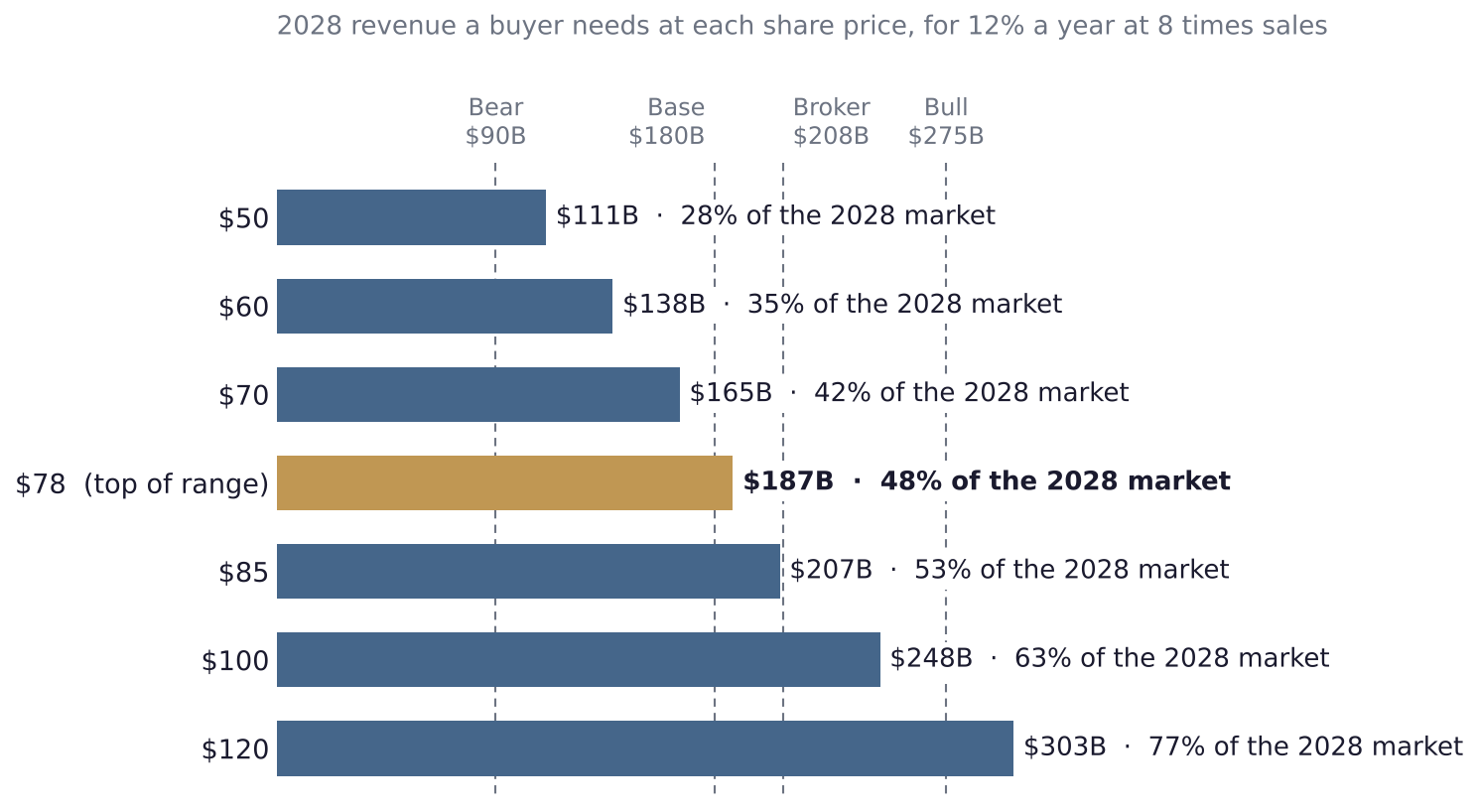
| Price paid | Value, fully diluted | 2028 revenue needed | Share of 2028 market | Gain to our bull case | Loss to our bear case | What a buyer is paying for |
|---|---|---|---|---|---|---|
| $50 | $0.87T | $111B | 28% | +175% | −43% | Anthropic loses a third of its share and the buyer still earns 12% a year |
| $60 | $1.05T | $138B | 35% | +129% | −52% | Two-fifths of customers move routine work to open models (2.7) |
| $70 | $1.22T | $165B | 42% | +96% | −59% | Anthropic holds a little less than today's share |
| $78 | $1.36T | $187B | 48% | +76% | −63% | Anthropic holds today's share and adds four points |
| $85 | $1.49T | $207B | 53% | +62% | −66% | Greenwich's 2028 forecast of $208B, the highest we hold, comes true |
| $100 | $1.75T | $248B | 63% | +37% | −71% | Anthropic takes almost two-thirds of the market |
| $120 | $2.10T | $303B | 77% | +15% | −76% | More revenue than our bull case |
Each $10 on the share price adds $27B at eight times sales and $18B at twelve. Revenue needed assumes a buyer wants 12% a year and Anthropic trades at eight times sales in 2028. The 2028 market is ICBC International's $393B forecast. The bull and bear cases are our own, at $137 and $29 a share (3.1). On Greenwich's higher share count each price needs about 3% more revenue.
| Share price | Value on shares out | Value fully diluted | Value less cash | ÷ run-rate ($81B) | ÷ 2028 forecast ($208B) |
|---|---|---|---|---|---|
| $70, bottom of range | $0.92T | $1.22T | $1,012B | 12.5× | 4.9× |
| $74, midpoint | $0.97T | $1.29T | $1,082B | 13.4× | 5.2× |
| $78, top of range | $1.02T | $1.36T | $1,152B | 14.2× | 5.5× |
| $85, if priced above | $1.11T | $1.49T | $1,275B | 15.7× | 6.1× |
$85 is an illustration of "above the range", not a reported price. Greenwich's published count is 18.0 billion diluted shares, about 3% above ours. On that count $78 is about $1.40T, and each per-share case value below is about 3% lower.
- Suppose a buyer wants 12% a year for two years, and that in 2028 the market values Anthropic at a multiple of that year's sales.
- The table shows the 2028 revenue required.
| Price paid | If valued at 6× sales | At 8× sales | At 10× sales |
|---|---|---|---|
| $70 | $221B | $165B | $132B |
| $78 | $250B | $187B | $150B |
| $85 | $276B | $207B | $165B |
For scale: brokers forecast $208B for 2028, and $187B would be 48% of ICBC's 2028 model market. Eight times sales equals about 29 times after-tax profit only once the margin reaches the 35% target. At peers' prices, six times sales goes with about 23% growth after 2028, eight with about 30% and ten with about 35%.
A $300B market and a 30% share give $90B of revenue. Compute is held at about $66.5B, the level Greenwich assumes in its bear case, so the margin is −4%. Valued at 4× sales, the rate peers get for about 16% growth.
A $400B market and a 45% share, about today's, give $180B. Compute of $100B is 56% of revenue and the margin is 22%. Valued at 8× sales, the rate peers get for about 30% growth.
A $500B market and a 55% share give $275B. Compute reaches the 45% target and the margin is 37%. Valued at 10× sales, the rate peers get for about 35% growth.
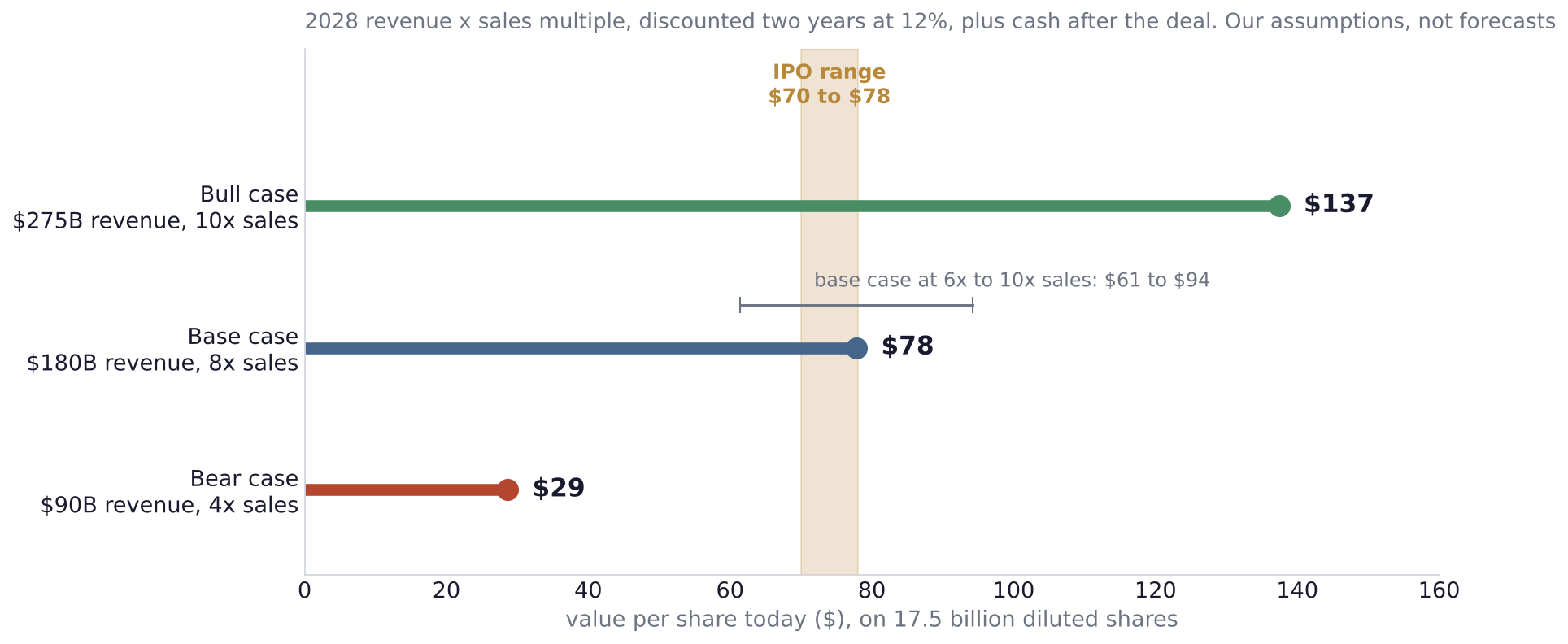
- Partly answeredThe diluted share count: Greenwich is the only broker with a published count: 18.01 billion shares at $74 (17.99 billion at $78), about 3% above our 17.5 billion.
- On its count the company is worth $1.33T at $74 and $1.40T at $78, and each of our per-share case values would be about 3% lower.
- The base case would be about $76, not $78.
- Partly answeredThe right sales multiple: every broker values Anthropic like a software or large internet company, on value to revenue.
- None compares it with heavy buyers of chips.
- Greenwich uses 6.1 times next-year revenue in its bear case (the middle of its peer group), 9.9 times in its base case (Microsoft's) and 15 times in its bull case, and works the filed range out at 6.3 to 7.0 times.
- CFRA: about 6 times 2028 sales at $1.4T.
- William Blair: about 11 times 2027 revenue at $1.5T, against 12 for its peer group.
- Whether a compute bill fixed years ahead deserves a lower multiple is a question only we are asking.
- Partly answeredCash burn in the bear case: no broker publishes a figure.
- Greenwich's bear case is close to ours: 2028 revenue of $90B against a $66.5B compute bill, a small operating loss and about $29 a share.
- Its headline free cash flow for 2027 is +$16.7B, but after stock pay, interest income and reinvestment its own valuation model has that year at −$10.4B.
- William Blair notes the company has used only about $9B of cash in its life, and sees the commitments as a problem only if revenue growth falls towards 20% a year to 2035.
- Our stall test in 2.4 is still the harshest number we have.
- GapFinal price and deal size: not set as we write. Books closed at 4pm New York time on 17 November.
3.2The float is 6.3%, and supplier shares are not locked up
The public gets a thin slice and no vote. With a 6.3% float, a handful of large orders can set the first day's price. The suppliers' $26B of shares and the staff plan both add to the stock that holders can sell later.
Mixed Confidence: high.
- Size: 825 million shares: 801 million new and 24 million from existing holders. The banks can sell up to 124 million more. That is 6.3% of shares outstanding, or 4.7% fully diluted.
- Placement: Google, Nvidia, AMD, Broadcom, Micron, Microsoft and TSMC buy $26.0B of shares at the IPO price. These shares have no vote and no lock-up, though US resale rules still apply.
- Proceeds: About $84.6B to the company at $74, or $93.7B if the banks sell the extra shares. About $3.8B goes on tax for staff share awards; the rest is for general use, including compute.
- Asset backing: After the deal the company's net tangible assets are $8.21 a share, against a $74 price.
- Owners: Amazon 14.7% and Google 13.7%. Amazon's stake would be 23.8% if it converted all its notes, which it has chosen not to do for now.
- More shares to come: the staff share plan reserves 1.92 billion shares and can add up to 3.40 billion more.
- Up to 20% of the offering is expected to go to retail investors.
- Partly answeredWho gets the shares: no source gives the split.
- The filing allows up to 20% for retail investors through online trading platforms.
- Existing backers get priority.
- One new point: index funds will have to buy about 28% of the shares on offer, about $19B, once the stock joins the indices they track, on an estimate from Intropic reported by Reuters (Bloomberg has 29%).
- Hedge funds are ordering now to sell to them later.
- Partly answeredPrivate no-sale agreements by suppliers: nothing private has surfaced.
- The filing settles what the rules allow.
- The placement shares (about 351 million at $74) have no lock-up, but they are unregistered, so a holder that is not an affiliate can first sell after six months under SEC Rule 144.
- Google has a separate right to demand, once, that its shares be registered for sale within the first year.
3.3Insiders can sell 1.6 billion shares within 76 days
Sellable stock doubles within eleven weeks and doubles again after the first results. Holders may choose to keep their shares. For a new buyer this is the clearest known pressure on the price in the first six months.
Concern Confidence: high on the schedule, unknown on how much is sold.
- About 15.5 billion shares are under lock-up. They are released in stages, not on one date.
- Staff, officers and non-founder directors can sell up to 315 million shares from the first day of trading.
- Four more releases follow on days 27, 48, 62 and 76, taking the total to 1.63 billion.
- Up to 1.7 billion more are freed two trading days after the 2026 results, then 480 million every two weeks, five times.
- Founders and the largest holders wait up to 365 days.
- From day 195, certain holders may hedge up to 20% of their still-locked shares, about 719 million in total. A hedge fixes a price without a sale.
- Holders can set up automatic selling plans during the lock-up. Shares are sold under them only once released.
- The 17 November amendment changed these figures slightly from the 10 November version.
- No broker estimates what the releases will do to the share price.
- Precedent, from broker notes: SpaceX's first release (912 million shares) came with a 6% rise on the day, which Evercore puts down to short sellers buying back. Later releases came with moves of between about −4% and +1%, and the 1.3 billion-share release after its Q3 results came with a 9% fall on a day when the wider market fell 2.6%.
- The American Economic Liberties Project has criticised the terms for letting insiders sell from day one.
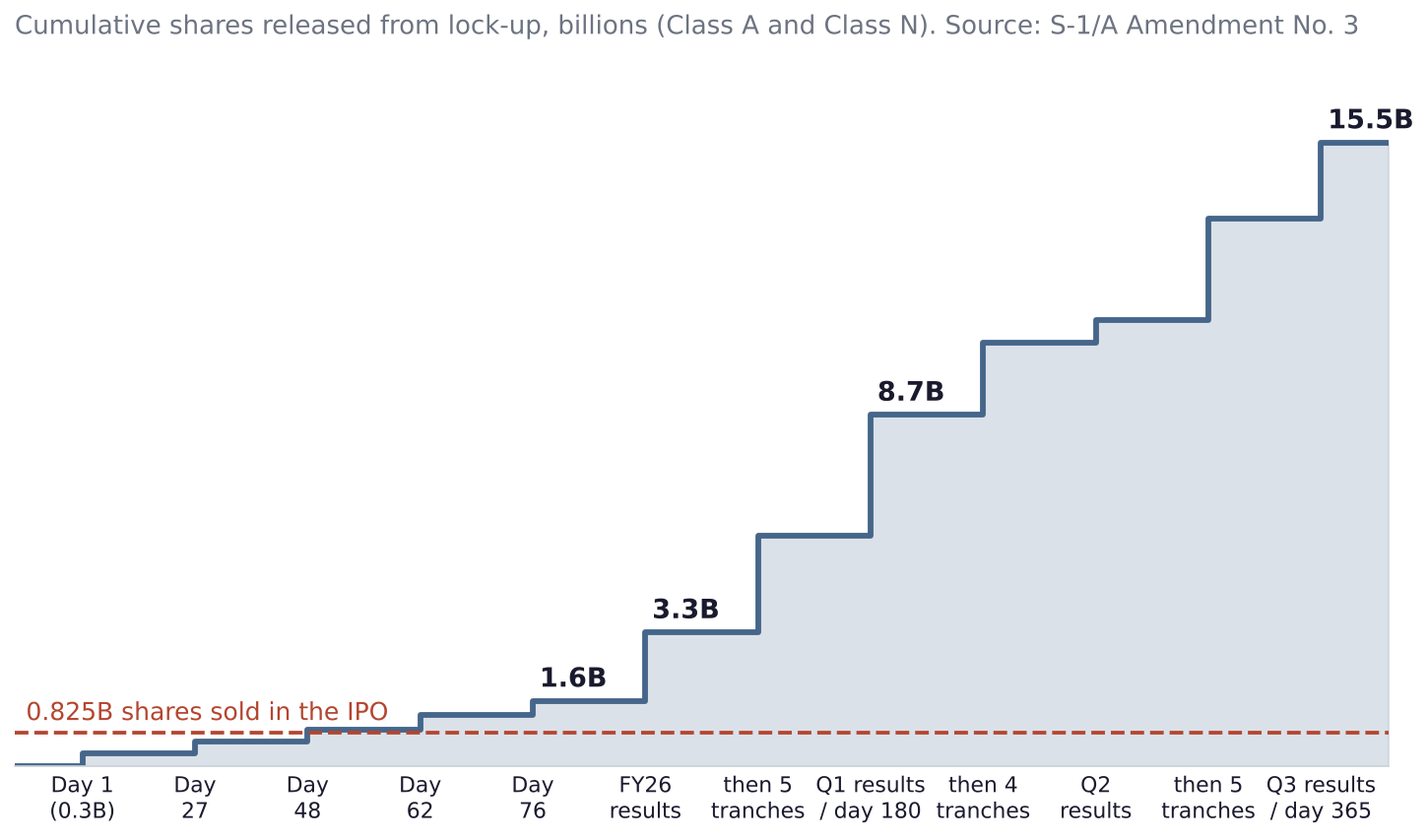
- GapStaff selling plans: none disclosed. The filing lets holders set up selling plans during the lock-up, but shares can only be sold under them once released.
3.4Orders cover the shares on offer about seven times
Demand supports the price on day one and says little about value. Investors who expect to be cut back order more than they want, so a book seven times covered overstates real appetite.
Supportive Confidence: medium. These are press reports.
- Bloomberg, 12 Nov: orders about six times the shares on offer. By Sunday 15 Nov: close to seven times. Seven times is about 5.8 billion shares, or about $450B at $78.
- Bloomberg, 17 Nov: investors told to expect the top of the range or above. CNBC reports a price above the range is likely. Several orders are $10B or more.
- Books closed at 4pm New York time on 17 November. Pricing is expected on the 18th and first trading on the 19th. Prices above $80 are being discussed, and the FT reports bankers weighing a value of $1.5T or more. None of this is confirmed by the company.
- Forced buyers: Intropic estimates index funds will need about 28% of the shares on offer, about $19B, once the stock joins their indices (Reuters; Bloomberg reports 29%).
- The range itself has not changed. Amendment No. 3, filed on 17 November, still says $70 to $78.
- Jay Ritter's data, via CNBC: the average first-day gain for US IPOs from 1980 to 2025 was 19%.
- CFRA warns that raising as much as $100B could be at risk if investors' appetite for AI stocks fades.
- Partly answeredEarly trading in a weak AI market: unknown until 19 November.
- The nearest precedent is SpaceX in June: priced at $135, it closed its first day at $160.95, up 19%, traded below the IPO price within two months and was $123.62 on 5 November.
- This is precedent, not a forecast.
- GapLong-term money in the book: no source says. Bloomberg reports several orders of $10B or more.
4Dates to watch
Open questions and reference findings
First the five answers we most want from management. Then the findings we checked that do not move the view.
- Partly answeredRevenue by product: no split from the company or any broker.
- Outside estimates: Claude Code $12B to $19B a year, about a fifth of revenue; coding in all forms above 65%; consumer plans about 5%.
- Nothing on Cowork or seats.
- Partly answeredRevenue lost to churn: businesses: between an eighth and two-fifths of customers leave within a year, depending on the panel, and far less by revenue.
- Consumers: about half of monthly subscribers leave within a year.
- No figure in dollars.
- Partly answeredThe compute bill to 2030: two markers from the filing ($70.7B in the next twelve months, $451.6B by 2030) and two broker estimates for 2027 ($88B and $114B).
- How much of the $186.2B gets cancelled is unknown.
- Partly answeredThe clouds' cut: About 34% on William Blair's estimate, twice the 2025 rate.
- Direct sales were 53% of revenue in 2025 and 56% in the nine months.
- Partly answeredRevenue tied to US government contractors: the company's own range from March: hundreds of millions of dollars a year on a narrow reading of the label, multiple billions on a broad one.
- One outside estimate for 2027 is $1B to $7B.
- Direct government contracts are under 2%.
- Partly answeredCloud revenue by provider: no split is disclosed.
- AWS is the largest channel on every outside reading.
- YipitData's spend panel has most Anthropic spend going through AWS, with Google Cloud growing faster this year.
- Wolfe estimates Anthropic is about 85% of the revenue of Amazon's Bedrock service, which it puts near $20B in 2026.
- Seaport's checks say more than two-thirds of Amazon's AI revenue runs through Anthropic.
- Microsoft's contract only began in November 2026.
- GapConsumers versus small businesses: no source splits them.
- Sensor Tower counts about 245 million monthly Claude users, and press reports of its data say about 13% pay, though one report limits that to iPhone users, so the two figures should not be multiplied.
- SemiAnalysis, as summarised by others, puts consumer plans at about 5% of revenue.
- Card data gives a feel for the consumer side: Anthropic took about 28% of US consumer spending on AI subscriptions in October, down from a peak of 31.5% in June, and the $100 and $200 plans made up about half of what its consumers paid.
- GapCompanies in each spend band: no source has a count.
- The best anchor is still the filing's: Claude spend is under 0.1% of costs at the average Fortune 500 customer and under 1% at the ten largest.
- GapAI start-ups among the 11,900: no count and no revenue share.
- William Blair names Shopify, Salesforce, SAP, Cursor and Legora as builders, and notes that only the builder counts as the customer, not the builder's own users.
- Cleveland Research says open models are gaining because the buyer mix is shifting towards AI-native firms and software vendors.
- The filing warns that venture-funded customers may cut spending.
- GapThe market outside the US: no source sizes it.
- International revenue was 29.4% of the nine-month total, up from 26.7% in 2025, and the filing gives no country split.
- Pointers from company statements in the press: run-rate in Europe, the Middle East and Africa up more than nine times in a year (as of November 2025), India the second-largest market for the Claude app, Asia-Pacific run-rate up more than ten times.
- CFRA puts the main non-US rivals at between $0.5B and $2B of run-rate, without giving a source.
- Partly answeredCustomers that cap spend per engineer: no count.
- Named examples now include Uber, Tesla, Apple, Accenture, Goldman Sachs, Microsoft and Paramount Skydance (see 1.2).
- All are press reports.
- Jefferies also notes reports of Chinese technology companies limiting staff use.
- Partly answeredCompute spent on free users: no source breaks it out, but the filing caps it.
- Free-user compute sits inside a $1.1B block of sales and marketing cost for the nine months, alongside staff and overheads.
- So it is under 6% of the compute bill.
- GapServing cost by model: no data by model.
- William Blair estimates the Opus 4 family earned a 69% margin before its training cost and 48% after, and believes the small Haiku models are cheap to train.
- Partly answeredTraining versus serving by quarter: the company does not report it and says it plans compute as one pool.
- Brokers derive it from the accounts.
- Water Tower: about $7.4B of Q3's $9.9B compute bill, 75%, was not for serving customers, nearly six times the figure a year earlier.
- William Blair: if all compute is counted as a cost of sales, gross margin was 52% in Q2 and 42% in Q3.
- Partly answeredTraining spend that repeats each generation: William Blair's estimates: a major model generation every 12 to 15 months; a training cost of $2.4B for the Opus 4 family, $3.2B for Opus 5 and nearly $7B for Fable 5; and about 90% of a family's revenue arriving in its first 12 to 15 months.
- On those numbers each generation costs more than the last and has about a year to earn it back.
- Partly answeredDiscounts for the largest customers: Anthropic's price page says it agrees volume discounts case by case.
- The filing says a growing number of large customers commit to a minimum spend for a fixed price list.
- Expert calls put committed-volume discounts at 10% to 25%.
- No source gives a figure for the top five customers.
- GapMargin by model class: the filing gives one figure for all models together: 85.5 cents of each revenue dollar in the nine months.
- No outside estimate splits it by model.
- The number of tokens a task takes differs so much between models that list prices tell us little.
- GapTraining, research and own use: the filing gives one line for all three.
- The only clue is that Anthropic's own use of Claude, valued at list prices, grew more than 250 times between January and September and passed its monthly cash pay bill in April.
- Partly answeredCost of training a flagship: the filing gives no figure.
- William Blair estimates $2.4B for the Opus 4 family, $3.2B for Opus 5 and $6.9B for Fable and Mythos 5.
- Against that, research and development cost $9.5B in Q3 alone, so most of the line pays for research, experiments and Anthropic's own use of Claude.
- GapRetention in earlier quarters: only the September reading of about 900% exists.
- It compares Q3 2026 with Q3 2025 for business customers who were already paying, and leaves out Pro, Max and Ultra subscribers.
- Our estimate above stands: last year's business customers explain about 60% to 70% of Q3 revenue, and the rest came from customers won within the year or from consumer plans.
- PitchBook expects the figure to fall sharply as last year's base grows.
- Partly answeredWork already moved to open models: a lot by volume, less by money.
- Gateway data collected by Capgemini: open models carry 56% of production tokens on Vercel and 72% on OpenRouter, but only 14% to 27% of spend.
- Named cases: AT&T (about 40% of employee queries today, aiming for 60% to 70%), Revolut (about 2,000 engineers moved to a self-hosted model), Carrier (some internal uses, 60% to 80% cheaper, in some cases with no loss of quality) and Dell (about 25% of inference volume).
- Nobody splits the moved work by type in dollars.
- Section 2.7 takes this further.
- Partly answeredThe top five's contracts: names and terms are not disclosed; section 1.1 lists the likely names from press leaks.
- The filing says many top customers have no long-term contract, and some have flexible terms on spending commitments and on ending the contract.
- Their weight is falling: about 36% of revenue in Q1, 21% in Q3.
- Partly answeredRunning cost versus equipment: only one piece is clear.
- The Broadcom equipment leases, $161.2B of rent before interest, will be recorded as equipment and debt.
- Greenwich puts the interest on them at $5.2B in 2027 and $8.8B in 2028.
- No broker has sorted the rest.
- GapReselling unused capacity: no data.
- The filing only warns that it may end up with capacity it cannot use.
- The nearest evidence is from the lenders' side: StoneX says re-leasing the equipment to someone else is one of the protections built into the Broadcom financing, which implies lenders expect a market for it.
- GapHow much of the $186.2B Anthropic would end: no forecast.
- One real case exists: a $34.9B agreement with Lambda became terminable when Lambda missed a deadline to secure its site.
- Greenwich notes the terminable total was $213.8B in an earlier version of the filing and that the fall is not explained.
- GapSupplier terms if a supplier sells its stake: we found no clause tying supply or sales terms to a shareholding.
- The filing says terms are renegotiated at renewal and that a provider could raise prices or end a contract.
- One link runs the other way: Amazon's note facility ends if certain commercial agreements with Amazon end.
- Partly answeredSafety delays to releases: it has happened, and brokers treat it as a live risk, but none puts a cost on it.
- The filing says releases have been delayed or limited before, and that export restrictions took the top models offline in June until they were lifted.
- The revenue lost was not disclosed.
- William Blair estimates about 90% of a model family's revenue arrives in its first 12 to 15 months, so a delay of a few months is costly.
- Partly answeredA US blacklist of Chinese labs: officials have drafted such measures since 2025 and shelved them each time, on Axios's reporting.
- In July the Treasury Secretary said sanctions and blacklisting are on the table for labs that copy US models.
- Four bills sit in committee.
- No rule binds private companies today.
- GapDefences against copying: Anthropic says it disrupted five campaigns between December and August.
- The filing expects revenue from rule-breaking customers, 5% to 7% of the nine-month total, to fall after the enforcement of August and September.
- The scores of the next Chinese releases will show whether the lead widens.
- GapFinal price and deal size: not set as we write.
- Books closed at 4pm New York time on 17 November.
- CNBC and Bloomberg report a price at the top of the range or above.
- Prices over $80 and a value of $1.5T or more have been reported.
- The $85 row in the tables above shows what that would require.
- GapA larger deal above the range: no report says so.
- The banks hold the usual option to sell up to 123.75 million extra shares.
- GapStaff selling plans: none disclosed.
- The filing lets holders set up selling plans during the lock-up, but shares can only be sold under them once released.
- Business Insider reports that most staff will need such a plan to sell.
- The filing's limits are up to 10% from day one and up to a further 35% after the 2026 results.
- Two known facts on insiders: the seven co-founders are selling 23.6 million shares between them in the IPO, and directors have indicated interest in buying up to $303M.
- Partly answeredDate of the 2026 results: no date is set.
- The annual report is due by 31 March 2027 at the latest, on a press reading of the filing rules, so the 1.7 billion-share release falls in the first quarter of 2027.
- GapEarly releases by the banks: unknown.
- The filing confirms Goldman Sachs and Morgan Stanley can release shares early if both agree.
- It also adds one more route to selling pressure: from day 195, certain holders may hedge up to 20% of their still-locked shares, about 719 million in total, which fixes a price without a sale.
- For scale, SpaceX's lock-up releases this year came with moves of between about −9% and +6% on the day, and the −9% day was also a weak one for the wider market.
- GapFinal price and deal size: see 3.1 and 3.2.
- Pricing is expected on 18 November.
- GapLong-term money in the book: no source says.
- Bloomberg reports several orders of $10B or more.
- ION Analytics warns that hedge funds may take profits quickly after a weak October.
Not investment advice. For information and discussion only. It is not a personal recommendation, offer or solicitation. There is no public market in the shares yet, and the terms may change before pricing. The case values are arithmetic on our assumptions, not forecasts or price targets. Capital is at risk. Do your own work and consult a licensed adviser before acting.
Disclosure. We wrote this note with Claude, an AI model made by Anthropic, the company it covers. We checked filing figures against the SEC text. Where the note compares Claude with rival models, the scores come from independent testers and rivals' wins are listed beside Claude's. We have no position in Anthropic at the date of publication.
Sources. Anthropic Form S-1/A, Amendment No. 3, 17 Nov 2026, and its roadshow presentation. Broker research and expert calls: Greenwich Research, Huatai, Seaport, Cleveland Research, William Blair, ICBC International, UBS, CFRA, Evercore ISI, Rosenblatt, D.A. Davidson, Wolfe, Water Tower Research, Jefferies, Canaccord, KeyBanc, StoneX, HSBC, Shenton Research, Danske Bank, ETR, Morningstar, Consumer Edge and Capgemini. Spend and card data: Consumer Edge, YipitData, Ramp AI Index. Other sources read directly: CBS News, DCD, Blank Rome, StreetSignal, TokenPost, FutureSearch, PYMNTS, Reuters and TechCrunch. Market data: Menlo Ventures, 2026: The State of Enterprise AI; SlashData; Eurostat; US Small Business Administration. Order book and timing: Bloomberg as reported by StockAnalysis, Gulf News and The Next Web. OpenAI figures: press reports of internal documents via Value Add Pulse. Models, prices, training and open models (sections 1.6, 1.7, 2.7): Anthropic's price list; Menlo Ventures; Simon Willison, The Decoder and Village on Ramp's data; routers.vantage.sh and OpenRouter; Artificial Analysis; Vals AI; Epoch AI, its 17 November test, and its data as compiled by speedrunningai.com and llmbenchmark.ai; Stanford AI Index; Ars Technica on Mozilla; METR; Garicano and Imas; Gundlach and others; Morningstar; Tom's Hardware; The Register on Revolut; Firetiger; Lindy; Congressional Research Service; CISA advisory AA26-251A; CNBC on Anthropic's September report; Axios, 20 July and 24 July; House Homeland Security Committee; Plotly.
© 2026 chokepoints.ai · Issue 012 · Anthropic All issues