CoreWeave
CoreWeave rents Nvidia's AI chips to Microsoft, Meta and OpenAI. Its lenders charge by the customer behind each loan, and in October its own 2031 bonds fell to about 78 cents on the dollar.

- The business. CoreWeave buys Nvidia chips, installs them in rented data centres and rents them out on contracts of several years. Microsoft, Meta and OpenAI are the main customers.
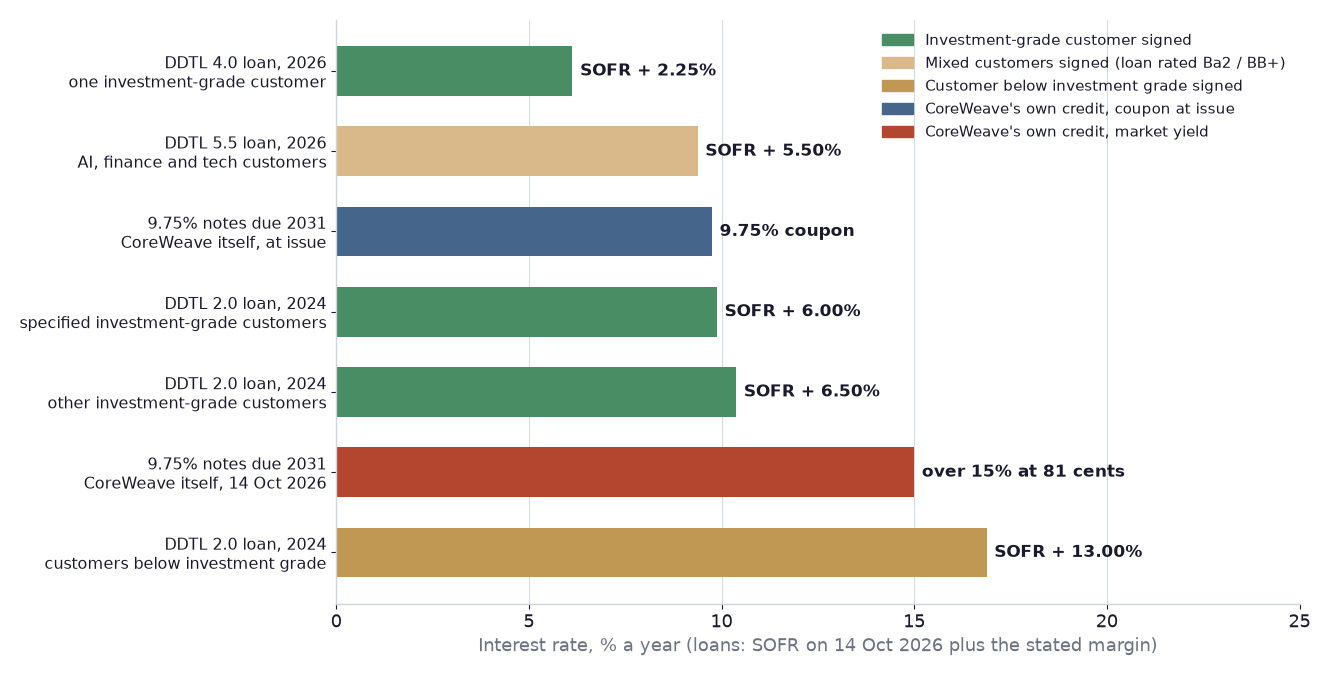
- Funding. CoreWeave borrows most of the money, against each customer contract. Lenders charge SOFR plus 2.25% when Meta is the customer and up to SOFR plus 13% when the customer is below investment grade.
- October. CoreWeave's own unsecured bonds fell to about 78 cents and its default swaps hit a record. Swap buyers now put the chance of default within five years at about 60%.
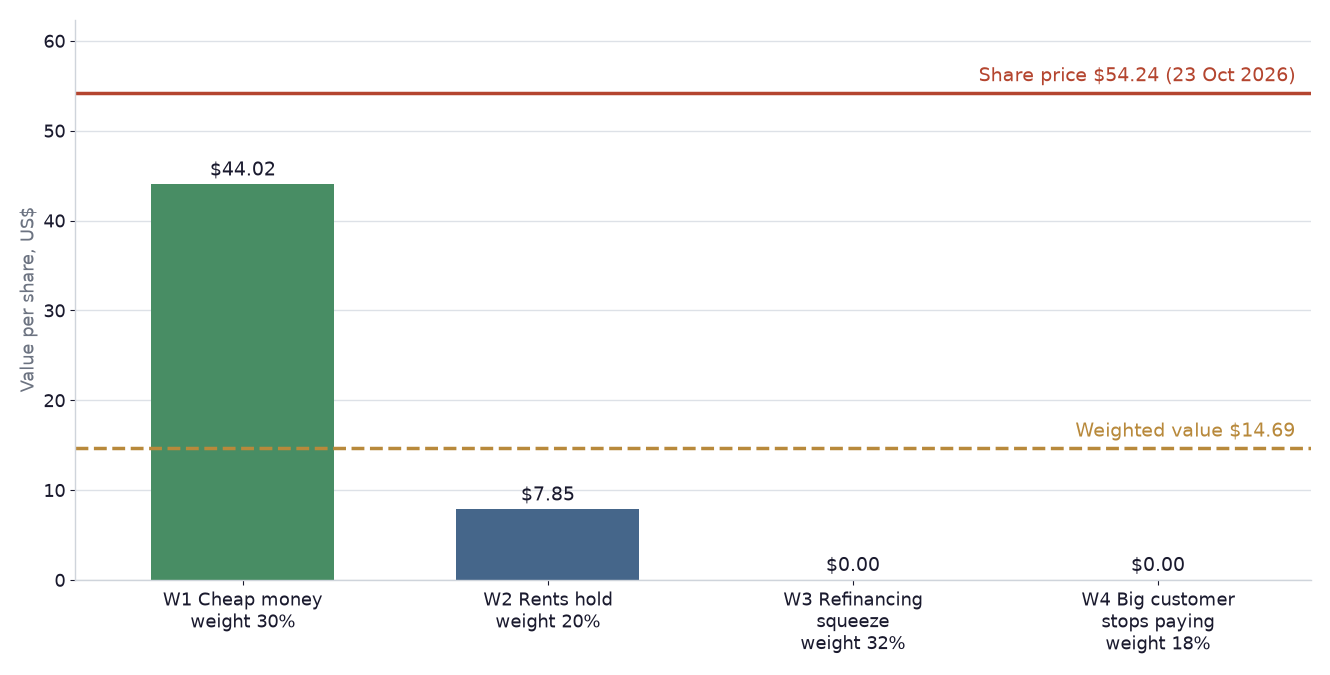
- Our value. $14.69 a share. Our best case, in which money gets cheaper and growth continues, is worth $44.02. The shares closed at $54.24 on 23 Oct 2026.
- The call. SELL. Holders sell; new money stays out until $15 or below. We do not recommend shorting it (section 09).
- Against Nebius. Nebius, the other listed GPU cloud, has a third of CoreWeave's contracts and a higher market value. It pays for growth with customer prepayments and convertible bonds, so its shareholders face dilution more than default (section 08).
Weighted value: $14.69 · Close, 23 Oct 2026: $54.24 · Entry zone: $8 to $15 · Value vs price: −73%
New money: don't buy. Holders: sell. Shorts: we do not recommend it.
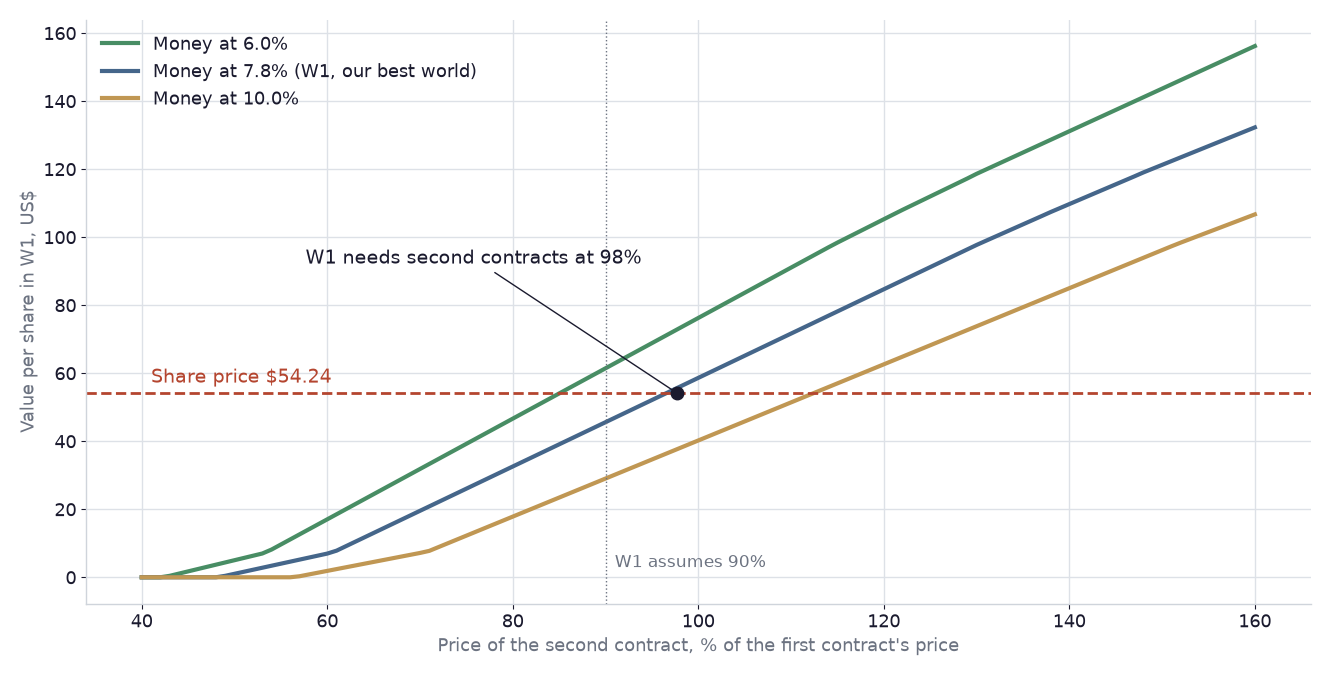
- The buyer's bet at $54.24: A market value of $29.9bn on top of $39.8bn of debt. To be worth that, CoreWeave needs our best world, with cheaper money, to come true, and then either second contracts at about 98% of the first contract's price or about $37bn a year of new clusters to 2030. Our best world assumes second contracts at 90% of the first price and $25bn a year of new clusters.
- Entry zone: $8 to $15: from our rents-hold world ($7.85) to the weighted value ($14.69).
- Move to HOLD: A price within 15% of our value, which today means $17 or below. Or evidence that lifts the value: second contracts signed at or above the first price, or a larger share of new loans raised on investment-grade terms than 2026's 59.9%.
- Against a short: The shares move 94% a year, Nvidia owns about 9% of all shares and its chief executive said on 15 October that CoreWeave needs no backstop, and the case for a short rests on second-contract prices, which nobody can see yet.
| World | Assumptions | Value a share | Weight |
|---|---|---|---|
| W1 Cheap money | Investment-grade loans spread; money costs 7.8%; second contracts at 90% of the first price; chips earn for 8 years; $25bn a year of new clusters to 2030 | $44.02 | 29.8% |
| W2 Rents hold | Money costs 8.8%; second contracts at 80%; 7-year life; no new clusters | $7.85 | 20.0% |
| W3 Refinancing squeeze | Unsecured market stays shut; money costs 11.0%; 35m new shares sold at $40; second contracts at 40%; 6-year life | $0 (debt exceeds assets by $9.05 a share) | 32.1% |
| W4 Big customer stops paying | 20% of contracted revenue stops from mid-2027; those chips re-rent at 50%; CoreWeave bears the loss on the loans it guarantees; money costs 11.9% | $0 (debt exceeds assets by $20.40 a share) | 18.1% |
| Weighted | $14.69 | 100% |
Basis: CoreWeave's 10-K (2 Mar 2026), 10-Qs (8 May and 12 Aug 2026), 8-Ks and loan agreements; Nvidia and Lenovo technical documents; Nebius's Q2 2026 6-K and releases; dated press reports for share, bond and swap prices. Our valuation model, re-run 26 Oct 2026. Prices to 23 Oct 2026.
01 The business
CoreWeave buys Nvidia's AI chips, installs them in rented data centres and rents them to a small number of large AI buyers, most of them on contracts of several years.
The chip is the GPU, or graphics processing unit: a processor that runs thousands of small calculations at once, which is the work of training and running an AI model.
- Server. Eight GPUs sit in one server.
- Rack. Racks hold the servers: steel cabinets that feed them power and carry their heat away.
- Cluster. Cables and network switches join thousands of GPUs so they work on one model as a single machine.
- Hall. The hall takes longest to build. CoreWeave's data-centre partners take 12 to 18 months to secure land, put up the building, connect the grid and fit cooling. CoreWeave then takes 1 to 2 months to install the GPUs (CoreWeave investor presentation, 17 Sep 2026). Renting lets a customer skip a wait of more than a year.
CoreWeave started in 2017 and earned most of its early revenue from mining cryptocurrency, a business it has since closed. Revenue went from $229m in 2023 to $5.1bn in 2025. It listed its shares in March 2025 at $40.00 (CoreWeave 10-K, 2 Mar 2026).
Customers
- Microsoft was about 67% of 2025 revenue (CoreWeave 10-K).
- The top three customers paid 36%, 26% and 10% of revenue in April to June 2026; CoreWeave does not name them in the filing (CoreWeave 10-Q, 12 Aug 2026).
- Meta has two contracts: up to about $14.2bn through December 2031 (8-K, 25 Sep 2025) and about $21bn through December 2032 (8-K, 9 Apr 2026).
- OpenAI has three contracts worth about $22.4bn in all, the latest running to May 2031 (CoreWeave releases, Mar to Sep 2025).
- Nvidia sells CoreWeave its chips, owns about 47m of its shares after a $2bn purchase in January 2026, about 9% of all shares, and will buy capacity customers leave unused until 13 April 2032, from an initial $6.3bn order (8-K, 9 Sep 2025; CoreWeave release, 26 Jan 2026).
| Measure, 30 June 2026 | Figure |
|---|---|
| Data centres in use | 51 |
| Power in use / under contract | about 1.5 GW / 3.7 GW |
| Contracted revenue not yet billed | $103.7bn |
| Revenue, April to June 2026 | $2,575m |
| Adjusted EBITDA (profit before interest, tax and write-offs), April to June | $1,510m |
| Net interest expense, April to June | $640m |
| Net loss, April to June | $626m |
| Debt (principal) / cash | $35.6bn / $5.5bn |
| 2026 guidance: revenue / capex | $12.4bn to $13.2bn / $35bn to $39bn |
| Shares outstanding (31 Jul) | 551.5m |
Source: CoreWeave 10-Q and Q2 2026 results, 11 to 12 Aug 2026; investor presentation, 17 Sep 2026, slide 6 for the data-centre count. A gigawatt (GW) is a thousand megawatts. Capex is the money spent on chips, servers and networks. The release gave $104.2bn of backlog; the 10-Q gives $103.7bn, which we use.
CoreWeave pays for its chips when it installs them and is paid over the years of each contract. Two things decide whether that makes money: how many years a chip keeps earning, and what the money that bought it costs.
02 The life of a GPU
So far, a GPU has earned for longer than its first contract. A customer rents A100s, a chip Nvidia launched in 2020, from CoreWeave under a contract that runs into 2029. Part of the reason is that Nvidia's newest chips need halls that the older ones do not.
An Nvidia server with eight H100 chips draws up to 10.2 kilowatts (kW), and in a hall cooled by air Nvidia says two such servers per rack is the practical maximum (Nvidia DGX H100 user guide; DGX SuperPOD FAQ). The Uptime Institute, an industry research body, found that above 20 to 25 kW a rack, air cooling stops being the cheapest choice (Uptime Institute Journal, 7 Dec 2020).
| Nvidia generation | Launched | Power | Cooling |
|---|---|---|---|
| Ampere (A100) | 2020 | 6.5 kW per eight-GPU server | Air |
| Hopper (H100) | 2022 | More than 40 kW per four-server rack | Air holds two servers a rack unless the hall is built for more |
| Blackwell (GB200 NVL72) | 2024 | About 120 kW per 72-GPU rack | Liquid plates on the chips |
| Blackwell Ultra (GB300 NVL72) | 2025 | 135 kW, up to 155 kW at peak | About 90% of heat to liquid |
| Vera Rubin NVL72 | 2026 | About 120 to 130 kW (press estimate) | Liquid at 45°C |
Source: Nvidia datasheets and user guides, Mar 2022 to May 2026; Lenovo Press LP2357. Vera Rubin rack power is a press estimate and not from Nvidia.
A hall built for air-cooled racks cannot take a 120 kW liquid-cooled rack without new power supply and pipework. CoreWeave puts new chips in new halls and leaves older chips in the halls they already fill.
Renewals
- A100s. An "AI-native scientific discovery company" renewed for three years into 2029, at a price CoreWeave says was in line with typical one-year contracts.
- H200s. A "leading early-stage research lab" renewed for three years at a premium to its original contract (CoreWeave investor presentation, slide 10).
- Prices. CoreWeave raised prices by about 25% across its chip types in July 2026 (Q2 call, 11 Aug 2026).
Outside price indices, which cover the whole market, point in different directions:
- Rental index. A one-year H100 rental fell to $1.70 an hour in October 2025 and rose to $2.35 by March 2026, on the index of SemiAnalysis, a chip research firm (2 Apr 2026). Silicon Data, which publishes a daily GPU rental index, had the H100 at $2.81 on 15 October 2026.
- Used-chip index. An index of used-GPU sale prices fell 22.1% in the year to October 2026 (American Compute Rack Report, Oct 2026; single source).
A renter pays for a chip with power, cooling and a place in a cluster. A buyer of a used card gets one card and must supply the rest, which is why the two prices can move apart. CME Group and Silicon Data have announced futures on H100 and B200 rental prices; the US futures regulator, the CFTC, has them under review until 9 November 2026.
Contracts run shorter than the accounts
CoreWeave writes servers off over six years, up from five in 2023 (CoreWeave 10-K). Of the $103.7bn of contracted revenue at 30 June, 41% is due within two years, 39% in years three and four and the rest by year six and a half (CoreWeave 10-Q). The first contract therefore has to pay for most of the chip, so the cost of the money that bought it matters as much as the rent after that contract ends.
03 One GPU, five prices of money
Lenders charge CoreWeave according to who signed the customer contract behind each loan, even when the chips behind two loans are the same.
A GPU loan, step by step
- The contract. A customer signs a take-or-pay contract for several years: it pays for the capacity whether it uses it or not.
- The vehicle. CoreWeave puts the GPUs and the contract into a separate company. For the DDTL 4.0 loan, the lenders' security is that company's assets, and CoreWeave is liable only for specified "bad acts" (CoreWeave 8-K, 31 Mar 2026).
- The loan. Lenders advance a share of the GPUs' cost through a delayed-draw term loan (DDTL), which CoreWeave draws in stages as it buys chips. CoreWeave pays the rest.
- The repayment. The customer's payments pay the loan down, "typically" in full by the time the contract ends, CoreWeave says.
SOFR, the base rate in these loans, is the US benchmark for overnight borrowing backed by Treasury bonds. It was 3.88% on 14 October. Investment grade means the upper band of credit ratings from Moody's and S&P.
DDTL 2.0, signed in May 2024 for up to $7.6bn, sets the rate by customer. It charges SOFR plus 6.00% on GPUs rented to specified investment-grade customers, plus 6.50% for other investment-grade customers and plus 13.00% for customers below investment grade (CoreWeave 10-Q, 13 Nov 2025). Lenders also advance more against the stronger customer: 90% of the GPUs' depreciated cost for an investment-grade contract and 60% for the rest (DDTL 2.0 amendment, 29 Sep 2025).
Changes in 2026
- The first investment-grade GPU loan. DDTL 4.0, $8.5bn signed in March at SOFR plus 2.25%, earned an A3 rating from Moody's because its one customer is investment grade (CoreWeave release, 31 Mar 2026). The filings call the customer a "leading AI enterprise"; the Financial Times reported it is Meta.
- Lower advances for weaker customers. Lenders advanced 71.42% on DDTL 5.0, at SOFR plus 4.50% for "two large, non-investment grade customers", and 70% on DDTL 5.5 (loan agreements, 15 May and 7 Aug 2026).
- A five-year loan on three-year contracts. DDTL 5.5 runs five years against contracts that average about three, so its lenders take the risk that customers do not renew (CoreWeave release, 10 Aug 2026).
- CoreWeave guarantees the newer loans. DDTL 5.0 and 5.5 are fully guaranteed by CoreWeave. If a customer behind them stops paying, the loss reaches CoreWeave's shareholders (8-Ks, 18 May and 10 Aug 2026).
CoreWeave's average borrowing rate fell from 14.9% in 2023 to 8.3% in the three months to June 2026 (investor presentation, slide 27). Then its unsecured 9.75% notes due 2031 traded at 81 cents on the dollar on 14 October, a yield above 15%, and at about 78 cents on 15 October, a yield above 16% (Yahoo Finance; Reuters, 15 Oct 2026).
The money for a new cluster costs CoreWeave a blend: the loan rate on the share lenders advance, plus the return its own investors want on the rest, averaged across strong and weak customers, which we estimate at 10.7% today.
04 Bond and share prices
Credit default swaps (CDS) pay out if a borrower defaults. Their yearly price, in basis points (hundredths of a percentage point) of the sum insured, rises with the risk.
- The swaps. CoreWeave's five-year CDS stood at 452 basis points in June and about 855 in late July. It passed 1,000 early on 15 October and touched a record 1,194.5 that day (ICE Data Services via The Next Web, 15 Oct 2026). Press reports put it at about 1,115 around 22 October (Benzinga; Startup Fortune, 25 Oct 2026).
- Implied odds. At 1,115 basis points and a 40% recovery on defaulted debt, swap buyers are pricing a 60.5% chance of default within five years. S&P Global Market Intelligence read it as about 63% on 15 October.
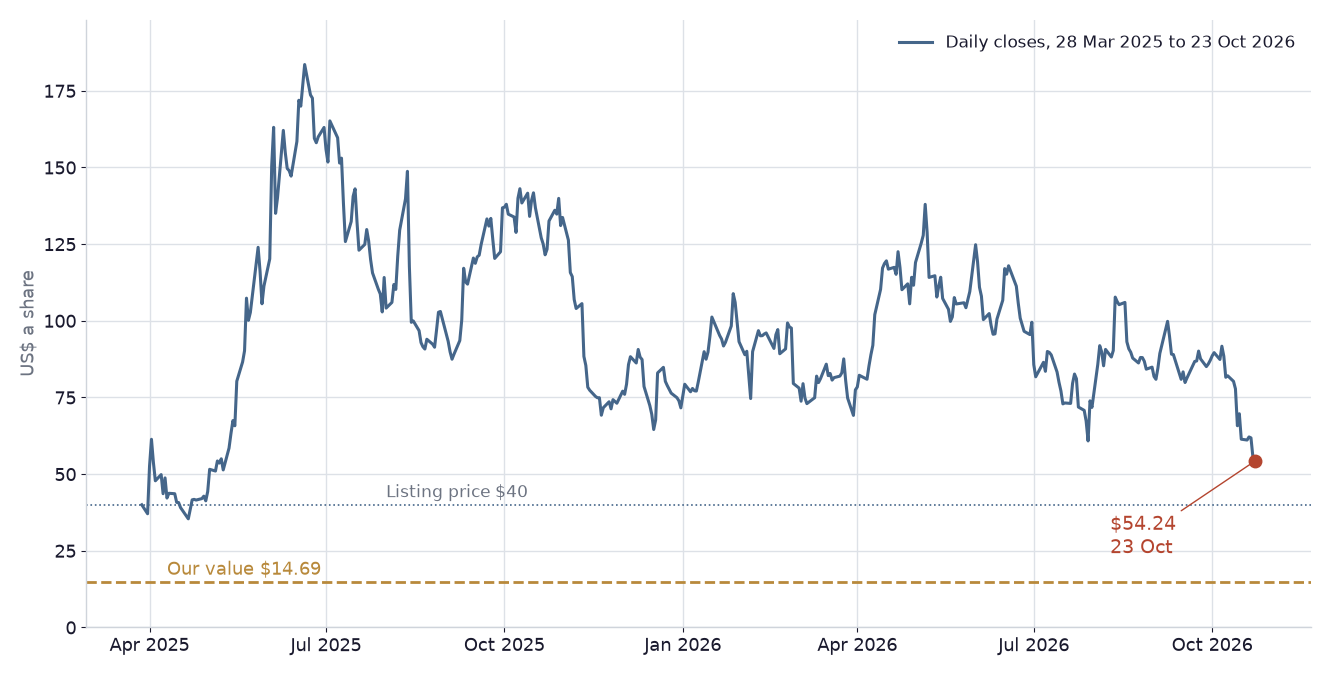
- The shares. They listed at $40 in March 2025, reached a closing high of $183.58 on 20 June 2025 and closed at $54.24 on 23 October 2026, down 37.7% in October. At that price the shares are worth $29.9bn.
Dated events
- 8 October 2026. The shares fell 7.77% to $81.58 after reports that OpenAI had told investors its yearly revenue was close to $50bn at the end of September, below a reported figure of nearly $70bn (Yahoo Finance, 8 Oct 2026).
- 14 October 2026. The shares fell 15.5% to $65.78. Chief executive Michael Intrator told staff that markets can "misunderstand and act irrationally" (Reuters, 15 Oct 2026). Nebius fell 10.1% the same day.
- 15 October 2026. The shares fell below $60 during the day, the lowest since May 2025, then closed at $69.69 after Jensen Huang, Nvidia's chief executive, said CoreWeave's "strength is improving every day" and that Nvidia does not need to backstop it (Bloomberg via The Next Web, 15 Oct 2026).
- 16 October 2026. The shares fell 11.9% to $61.39 and Nebius fell 12.2%. Reuters linked the fall to inflation data that raised bets on interest-rate rises, as CoreWeave's bonds also fell (Reuters, 16 Oct 2026). Cantor Fitzgerald and JPMorgan repeated their ratings (StockAnalysis, 16 Oct 2026).
- 19 October 2026. Goldman Sachs upgraded the shares to Buy, with a $106 target (StockAnalysis, 23 Oct 2026).
- 22 and 23 October 2026. The shares fell 10.1% to $55.60 on 22 October after Bernstein cut its target from $74 to $51, with an Underperform rating, and chip stocks fell after Lam Research's results; Nebius fell 7.2% (Yahoo Finance, 22 Oct 2026). On 23 October the shares closed at $54.24, the price we use, after UBS and Morgan Stanley cut their targets (StockAnalysis, 23 Oct 2026).
05 Our valuation: four worlds
We value CoreWeave at $14.69 a share. We split its cash into three parts:
- Contracted cash. The $103.7bn of signed revenue, on the timing CoreWeave files, less site costs, overheads and stock pay. That leaves 61% of revenue as cash.
- Capex still to spend. About $27bn more to build the clusters behind those contracts, which we take off.
- Second contracts and new clusters. The chips' earnings after the first contract ends, and the value new clusters add if they earn more than their money costs.
We then take off $39.8bn of debt (principal), which includes $4.2bn of convertible bonds sold in September, add $9.2bn of cash and divide by 551.5m shares.
A cluster that costs $100 brings in $34 a year over a five-year first contract, $170 in all. After site costs, overheads and stock pay, $104 of that is cash. In W2 a cluster returns about 9% a year over its life on money that costs 8.8%, so at today's rents a new cluster about breaks even. So the value of the shares comes from cheaper money and second contracts.
The weights
- Default odds. Swap buyers are pricing 60.5%. Swap prices run above the defaults that follow, and John Hull, a finance professor at the University of Toronto, measured that gap for single-B borrowers (Hull, 2005). Using his gap we cut 60.5% to about 50%, split between W3 (32.1%) and W4 (18.1%).
- The surviving 50%. We split it between W1 and W2 by the share of CoreWeave's 2026 secured loans raised on investment-grade terms, 59.9%.
Default risk counted once
The first draft of this note discounted W1 and W2 at rates that already carried CoreWeave's own default premium, then weighted them by the odds of no default, which counted default twice. We now discount W1 at 7.8% and W2 at 8.8%, the cost of money for a CoreWeave that survives. The old method gives $11.86, against $14.69 now.
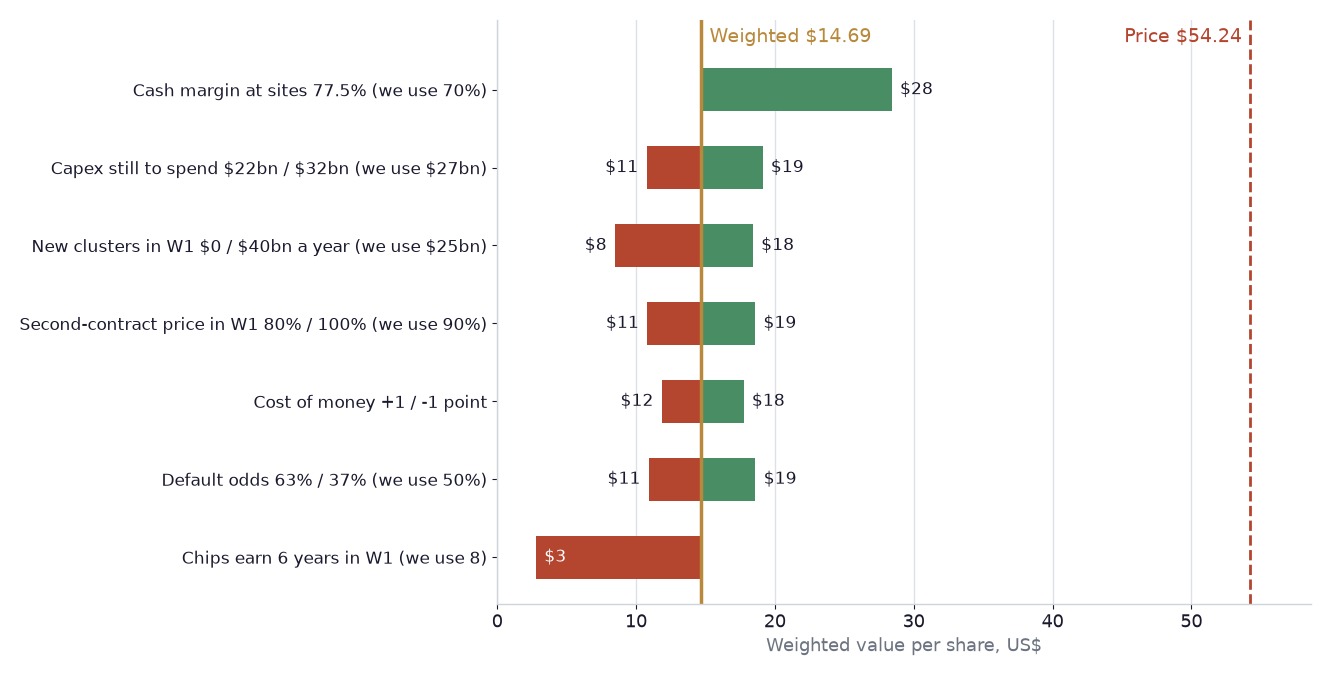
The site cash margin moves the value most: at 77.5% of revenue, against the 70% we use, the weighted value is $28. No single change we can defend gets it higher. Chip life is the biggest risk the other way: if they earn for six years in W1 rather than eight, W1 falls to about $4 and the weighted value to about $3.
06 Assumptions in the share price
At $54.24 a buyer is paying for more than our best world. Two routes get W1 to the price:
- Second contracts near the first. At W1's 7.8% cost of money, second contracts at 98% of the first contract's price. At 8.8% they need 105%.
- Much more growth. About $37bn a year of new clusters to 2030, each earning W1's returns, against the $25bn we assume.
Both routes also need the 50% chance that CoreWeave avoids default to become a certainty. A buyer today is assuming CoreWeave never gets into trouble, borrows at lower rates than it ever has, and either re-rents old chips at about their launch price or builds much more than we assume.
07 The case for and against
- $103.7bn of signed revenue at 30 June, and more than $25bn of new commitments early in the third quarter (CoreWeave Q2 release).
- Adjusted EBITDA of $1,510m in the second quarter.
- Meta's contract earned the first investment-grade rating on a GPU loan. More rated loans would open insurers' money, which co-founder Brannin McBee called "unlimited" (FT via Yahoo Finance, 14 Oct 2026). Lambda, a smaller GPU cloud, raised a $1bn investment-grade loan backed by two investment-grade customers (Lambda, 1 Oct 2026).
- Old chips have renewed at or near their first price: two of the three disclosed renewals at or above it, one within 5% (sections 02 and 09). CoreWeave raised prices 25% in July.
- Nvidia owns about 9% of all shares, sells it chips, and backs unused capacity to April 2032.
- Brokers are far above us: the 42 analysts tracked by S&P Global average $135.82; Cantor Fitzgerald has $176 and Deutsche Bank $150, while Mizuho cut to $88 and Bernstein rates it Underperform at $51 (StockAnalysis, 23 Oct 2026; Yahoo Finance, 22 Oct 2026).
- Net loss of $626m and net interest of $640m in the second quarter, a quarter of revenue. CoreWeave guides third-quarter interest to $860m to $940m.
- Three customers paid 72% of second-quarter revenue. OpenAI's reported revenue miss hit the shares on 8 October.
- CoreWeave guarantees the newer loans, so a customer loss reaches shareholders.
- Its unsecured bonds yield about 15 to 16%. At that rate, most new clusters CoreWeave builds with unsecured debt would lose money.
- CoreWeave may sell up to 35 million new shares at market prices from mid-October.
- Used-GPU prices fell 22.1% in a year. If chips earn for six years rather than eight, our best world is worth little.
08 CoreWeave and Nebius
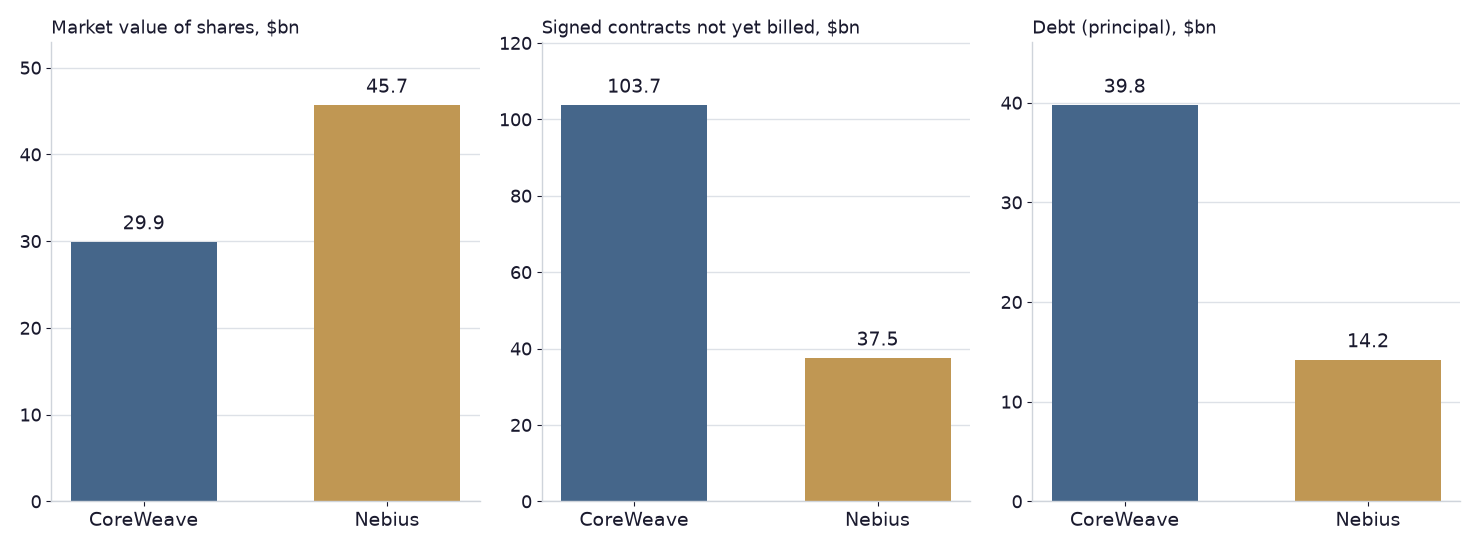
Nebius Group (Nasdaq: NBIS) is the other large listed GPU cloud. It is Amsterdam-based and grew out of Yandex's international businesses. It rents Nvidia chips to Microsoft, Meta and AI labs from data centres in Finland, Iceland, the US and elsewhere.
| CoreWeave | Nebius | |
|---|---|---|
| Share price, 23 Oct | $54.24 | $158.74 |
| Change in October to 23 Oct | −37.7% | −32.7% |
| Market value of shares | $29.9bn | about $45.7bn |
| Signed contracts not yet billed, 30 Jun | $103.7bn | $37.5bn |
| Market value ÷ signed contracts | 0.29x | 1.22x |
| Revenue, April to June 2026 | $2,575m | $582m |
| 2026 revenue guidance | $12.4bn to $13.2bn | $3.0bn to $3.4bn |
| 2026 capex guidance | $35bn to $39bn | $20bn to $25bn |
| Debt (principal) | $39.8bn, including $4.2bn of convertibles sold in September | about $14.2bn, most of it convertible |
| Cash | about $9.2bn after the September raise | about $14.5bn after the August raise |
| Typical interest rate on debt | 8.3% average; unsecured bonds about 16% | 0.5% to 4.5% on convertibles; secured loan SOFR + 2.50% |
| Top three customers, share of Q2 revenue | 72% | 59% |
| Server write-off period | 6 years | 5 years (4 until January 2026) |
Source: CoreWeave 10-Q, 12 Aug 2026; Nebius Q2 2026 6-K and shareholder letter, 12 Aug 2026; Nebius releases, 17 Jul and 24 Aug 2026; Nebius 6-K, 22 Oct 2026; share prices from StockAnalysis. Nebius debt and rates leave out a $3.5bn Citi facility signed in October, at SOFR + 2.75% rising to at most 3.50%. Nebius market value uses 287.7m shares (30 Jun count plus 15.8m issued on 24 Aug); with Nvidia's 21.1m pre-funded warrants it is about $49bn. Nebius guidance figures are from press summaries of the Q2 call, not a filing.
The differences
- Funding. CoreWeave borrows against each contract, at rates set by the customer, and guarantees the newer loans. Nebius has raised about $14bn of convertible bonds, which pay 0.5% to 4.5% and turn into shares above about $51 to $325, plus $2.8bn of new shares in the first half and $2bn from Nvidia. Customers also prepay: Nebius says prepayments cover 50 to 60% of the capex behind its newest contracts and expects more than $9bn of them in 2026.
- Main risk. CoreWeave's swap buyers price about a 60% chance of default. Nebius shareholders face dilution: each convertible becomes shares if the price rises, and Nebius sells new shares to fill the gap if it does not. Nebius has no credit rating and no traded bonds, so nobody prices its default risk.
- Price against contracts. CoreWeave's market value is 0.29 times its signed contracts, against 1.22 times for Nebius. Most of what a Nebius buyer pays for is contracts not yet signed, and Nebius plans $20bn to $25bn of capex this year against $3.0bn to $3.4bn of revenue, on press reports of its Q2 call.
Our 2025 case for Nebius over CoreWeave rested on a shorter write-off period and a net-cash balance sheet. Nebius moved from four years to five in January 2026, and its debt is now about $14.2bn, matched by about $14.5bn of cash after the August raise. It still borrows at far lower rates than CoreWeave and carries less default risk. We have not published a valuation of Nebius. On the method in this note, its signed contracts bring in about as much cash ($22.9bn) as the chips behind them cost (about $22bn), so almost all of its value rests on contracts it has not yet signed. We plan a full Nebius issue.
09 The case against a short
- Volatility. The shares move about 94% a year. On 15 October they rose from below $60 to $69.69 in one session on a few sentences from Nvidia's chief executive.
- Nvidia's stake and backstop. Nvidia owns about 9% of all shares, sells CoreWeave its chips and will buy unused capacity until April 2032. A rescue, or a deeper Nvidia commitment, would move the shares up fast.
- Second-contract prices. They decide most of the value, and CoreWeave has disclosed only three: two at or above the first price and one H100 contract re-signed within 5% of it. We are least sure of this input, so we do not bet against the shares on it.
- Cheaper money. If CoreWeave sold one more investment-grade GPU loan to insurers, W1's weight would rise overnight.
10 The call, what would change it, and the dates
- Verdict: SELL at $54.24 against our $14.69. New money: don't buy. Holders: sell. Shorts: no.
- Entry zone: $8 to $15, from W2 ($7.85) to the weighted value ($14.69).
- The number we track: 10.7%, CoreWeave's marginal cost of money today, against 7.8% in W1.
▲ What moves us to HOLD or a buy
- $17 or below. The price within 15% of our value: HOLD. At $15 or below, new money can open.
- Second contracts at or above the first price, disclosed for more than two customers. At 100% of the first price, W1 is worth about $57 and the weighted value about $19.
- More investment-grade loans. If CoreWeave raises more than 2026's 59.9% of new secured loans on investment-grade terms, we move weight from W2 to W1.
- Site cash margin of 77.5% or more, against the 70% we use: the weighted value rises to $28.
▼ What moves us to a lower value
- Default odds of 63%, S&P Global Market Intelligence's reading: $10.92.
- Unsecured refinancing near 16%, where the 2031 notes yielded on 15 October: we move weight to W3.
- Chips that earn for six years rather than eight in W1: about $3.
Dates to watch
- Since 17 Oct 2026: CoreWeave could sell up to 35 million new shares at market prices; the agreement barred sales until 30 days after 17 September (8-K, 17 Sep 2026). No sales were disclosed to 26 October.
- 9 Nov 2026: The CFTC's review of GPU rental futures ends; that sets no listing date.
- Mid-Nov 2026: Third-quarter results, the first full quarter after the July price rise. CoreWeave has not set a date; TipRanks estimates 16 November. Guidance: revenue $3.45bn to $3.6bn, interest $860m to $940m.
- Nov 2026: DDTL 5.0 starts repaying in monthly instalments (10-Q, 12 Aug 2026).
- Nov 2026: Nebius third-quarter results; no date announced yet (Q3 2025 results came on 11 Nov 2025).
- 31 Dec 2026: The DDTL 5.5 draw window closes; its test that cash covers debt payments at least 1.35 times applies from the next full month (8-K, 10 Aug 2026).
11 Scorecard
12 Workings register
Every input in our model, so you can change one and trace the effect.
| Ref | Input | Value | Source or reason |
|---|---|---|---|
| W01 | Signed revenue not yet billed | $103.7bn | 10-Q, 30 Jun 2026 |
| W02 | Billing timing | 41% years 1 to 2; 39% years 3 to 4; 20% years 5 to 7 | 10-Q |
| W03 | Revenue per $1 of cluster cost, per year | $0.34 | CoreWeave's accounts show $0.29 to $0.39 |
| W04 | First contract | 5 years | Contract mix in the 10-Q |
| W05 | Site cash margin | 70% of revenue | Our estimate from Q2 costs |
| W06 | Overheads and stock pay | 9% of revenue, leaving 61% as cash | Q2 2026 accounts |
| W07 | Capex still to spend on signed contracts | $27.25bn | 2026 guidance less H1 spending, plus 2027 builds; set so the model matches our first draft's W1 and W2 at its rates |
| W08 | Debt / cash | $39.75bn / $9.16bn | Principal in the 10-Q at 30 Jun 2026 plus the $4.2bn 2.875% convertible due 2033 (closed 22 Sep); cash is the 10-Q's $5.5bn plus $4,137.0m of net proceeds less $498.8m for the base capped call, so at most $9.16bn |
| W09 | Data-centre leases | Treated as site costs, not debt | $16.3bn of lease liabilities; counting them as debt as well would count the rent twice |
| W10 | Shares | 551.5m | 10-Q cover, 31 Jul 2026 |
| W11 | Cost of money | W1 7.8%; W2 8.8%; W3 11.0%; W4 11.9% | Survival worlds without a default premium (section 05) |
| W12 | Extra return on second-contract cash | +3 points | Uncontracted cash is riskier |
| W13 | Second-contract price, % of first | W1 90%; W2 80%; W3 40%; W4 50% | Two filed renewals at or above 100%; used-GPU prices down 22% |
| W14 | Chip life | W1 8; W2 7; W3 6; W4 7 years | A100s rented into 2029 (9 years) |
| W15 | New clusters in W1 | $25bn a year, 2027 to 2030 | Below the 2026 capex guidance |
| W16 | New shares in W3 | 35m at $40 | Share-sale agreement, 17 Sep 2026 |
| W17 | Customer loss in W4 | 20% of signed revenue from year 2 | Size of a large customer that relies on raising money |
| W18 | Default odds | 50% | CDS-implied 60.5% (1,115bp, about 22 Oct), cut using Hull's gap for single-B borrowers |
| W19 | W1 / W2 split of the rest | 59.9% / 40.1% | Investment-grade share of 2026 secured loans |
| W20 | Valuation date | Balance sheet at 30 Jun 2026; price at 23 Oct 2026 | Q3 accounts not yet out |
Go deeper
- CoreWeave 10-Q for the quarter to 30 June 2026. Backlog timing, customer shares, debt and the share count.
- CoreWeave investor presentation, 17 Sep 2026. Renewals of old chips, its cost of debt by year, and how its asset-level loans repay.
- CoreWeave 8-K on the DDTL 4.0 facility, 31 Mar 2026. Terms of the first investment-grade GPU loan.
- Nebius Q2 2026 financial statements. Convertible notes, lease commitments, customer shares and the depreciation change.
- SemiAnalysis GPU Rental Price Index and Silicon Data H100 Rental Price Index. Rental prices by chip and contract length.
- Nvidia DGX GB200 user guide. The contents of one 72-GPU rack, its cooling and its power draw.
- Wing Venture Capital, "How the GPU Became Collateral", Sep 2026. The case that lenders read the customer contract rather than the chip.
Disclosure. We have no position in CoreWeave, Inc. (Nasdaq: CRWV) at the date of publication.
Not investment advice. This note is for information and education. It is not investment advice, a personal recommendation or an offer to buy or sell any security. Figures are from public filings and reports as dated in the text; estimates are ours and can be wrong. Do your own research.
© 2026 chokepoints.ai · Issue 011 · CoreWeave rents Nvidia's AI chips to Microsoft, Meta and OpenAI. Its lenders charge by the customer behind each loan, and in October its own 2031 bonds fell to about 78 cents on the dollar. All issues