Tungsten West
Tungsten West has restarted the Devon tungsten mine that failed in 2018. At 43.70p the share price is a bet that China’s export wall holds.
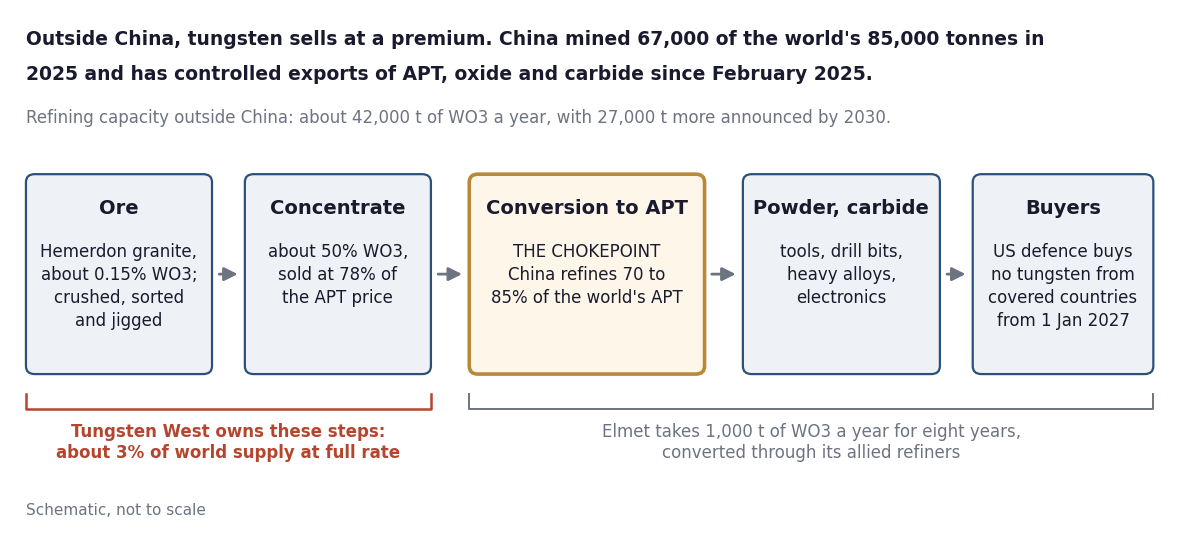
What Tungsten West does. It owns one mine: Hemerdon, an open pit near Plymouth, with a processing plant beside it. The rock is granite holding about 0.15 percent tungsten oxide. The plant crushes it, pulls out a tungsten concentrate and sells that to refiners. The mine failed under its last owner, Wolf Minerals, in 2018. On 15 September 2026 Tungsten West announced it was back in production.
Why it matters now.
- China mined 79 percent of the world’s tungsten in 2025 and has required a licence for exports of refined tungsten since February 2025. Its exports of APT, the refined form the metal is priced in, have been zero this year.
- From 1 January 2027 US defence contractors may not use tungsten mined or refined in China.
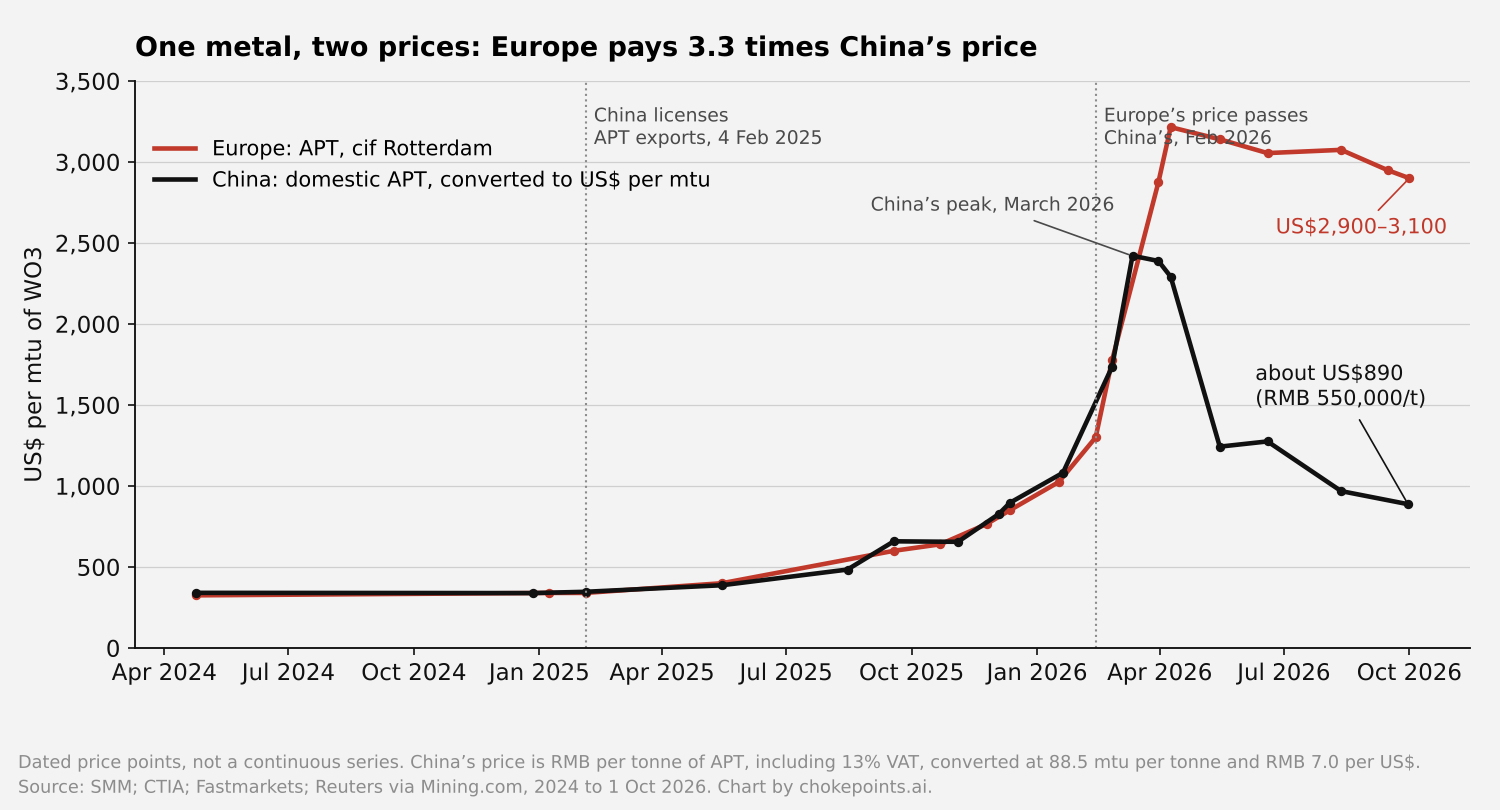
- So there are two prices. In Europe APT fetches ◆ US$2,900 to 3,100 per metric tonne unit (mtu, ten kilograms of oxide). In China it fetches about US$890. Hemerdon sells at the European price.
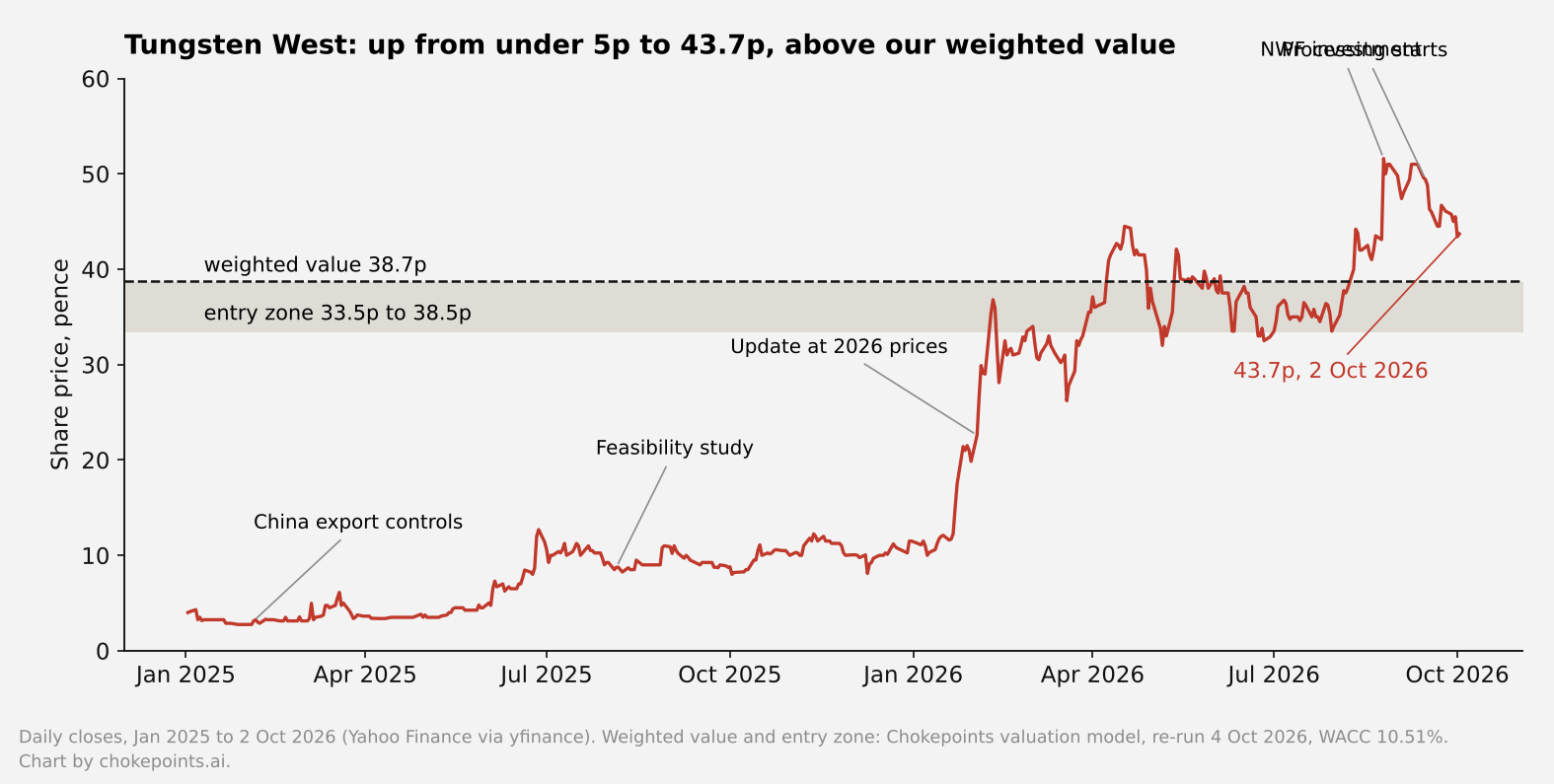
- The shares have risen from under 5p in early 2025 to ◆ 43.70p, a market value of about £705m.
Four things set the value
- China controls the metal, and the West is paying to get round it. The UK’s National Wealth Fund bought into Hemerdon in August 2026 and Elmet, a US tungsten processor that supplies the Pentagon, signed for its concentrate a month later.
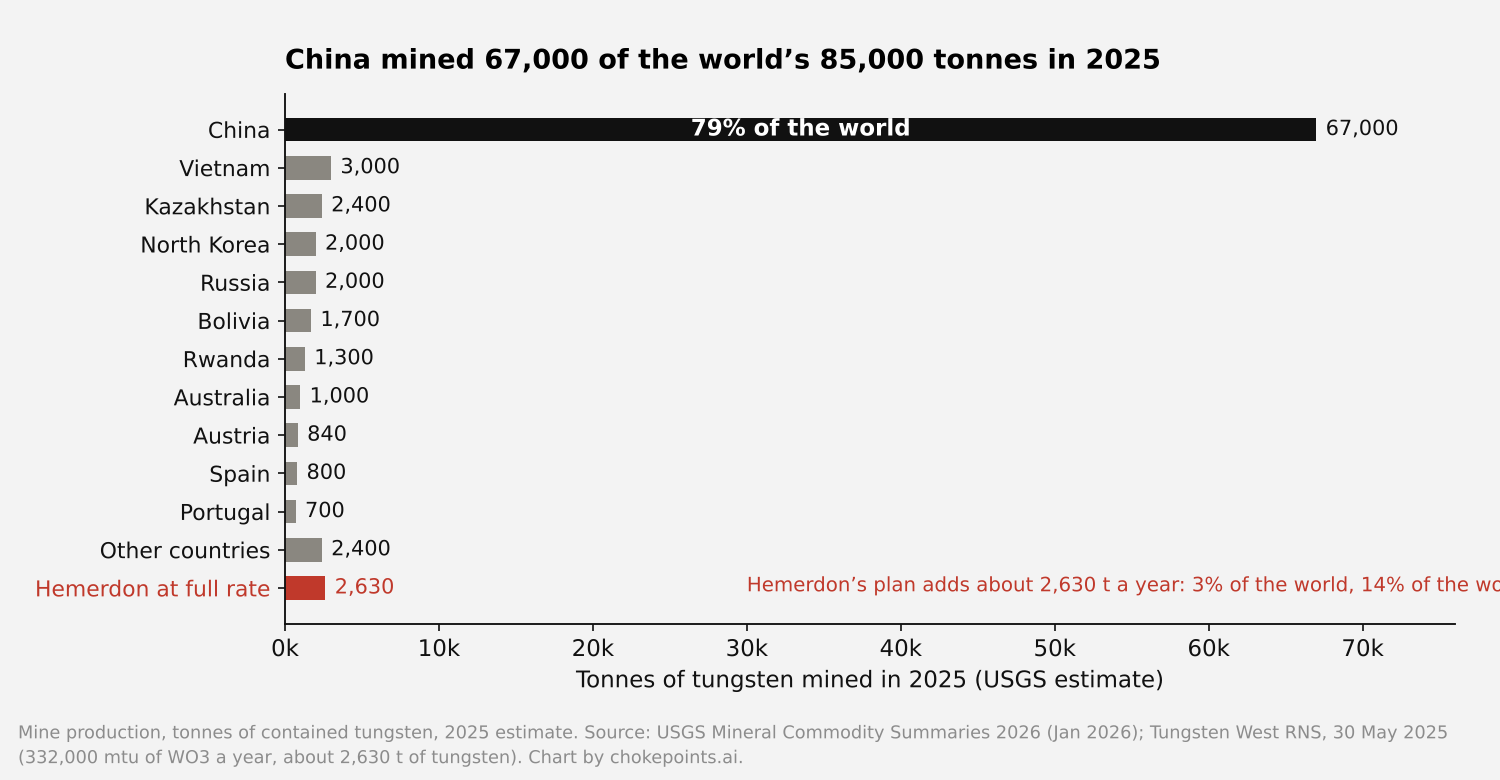
- Hemerdon is a real mine but a small one. At full rate it adds about 2,630 tonnes of tungsten metal a year: 3 percent of the world, 14 percent of the world outside China.
- The price needs Europe’s premium to last. Held flat after inflation, APT must average US$1,211 per mtu to return 43.70p on our weights: three times its 2010 to 2024 average of US$395, and 1.7 times the US$700 we expect if the gap closes.
- This plant has failed once. Wolf Minerals never reached its target recoveries here, and a repeat of that slow ramp carries 33 percent of our weight across the two price worlds.
At 43.70p the company is worth about £705m, and for that you get one mine selling tungsten concentrate at the European price. Our weighted value is 38.7p, 11 percent below the price. The gap between the two is one question: is Europe’s tungsten price, 3.3 times China’s today, still far above China’s in 2031? We give that 27 percent; the price implies 37 percent. On top of that, a plant that failed once has yet to prove it can run. We would buy at 33.5p to 38.5p.
- The chokepoint: partial. China mines about four-fifths of the world’s tungsten and refines most of its ammonium paratungstate (APT), the refined form tungsten is priced in; Hemerdon at full rate would add about 3 percent of world supply.
- The gap: our 38.7p weighted value sits 11% below the 43.70p price. The price implies 37% odds on Europe’s premium holding to 2031; we give 27%. Across the standard specifications, 40% to 41% of model paths finish above spot.
- The entry: 33.5p to 38.5p, our weighted value with and without the planning permission running past June 2036. New money: wait for the zone. Holders: hold, and exit at the tripwire.
- Why not short: a signed UK Government offtake for up to half the output could reprice the shares in one session, one model path in ten ends above 100p, and if the premium holds with the plant on plan the shares are worth 84.0p. On the APT price forecasts (price decks) others published this year, US$1,000 to 1,973 per mtu, our own model gives 34p to 81p.
Five futures, each changing one driver, valued at a 10.51 percent WACC against the 2 Oct 2026 close:
| Future | Value | vs spot (43.7p) | Weight |
|---|---|---|---|
| Wall holds, on plan: APT settles at US$1,509 | 84.0p | +92% | 16% |
| Wall holds, Wolf repeat | 49.9p | +14% | 10% |
| Wall falls, on plan (reference): APT settles at US$700 | 41.4p | −5% | 40% |
| Wall falls, Wolf repeat | 16.8p | −62% | 23% |
| Insolvency | 3.0p | −93% | 12% |
| Probability-weighted | 38.7p | −11% | 100% |
Basis: Tungsten West’s RNS announcements, annual accounts and August 2025 feasibility study, read against their text; a public fact register in which 46 load-bearing claims were re-checked against second sources: 28 confirmed, 2 disputed, 8 refuted, 6 outdated, 2 unverifiable; we corrected or dropped the refuted and outdated ones before drafting. A share-price event study against the FTSE AIM All-Share, and a mine valuation across two price worlds and two ramps, with an insolvency model and a Monte Carlo. The register was checked in the last week of September 2026, the valuation rebuilt on 4 October 2026, and the price worlds and their odds revised on 4 October after a second pass over China’s export record. Values marked ◆ like this change over time and move our view; each has a row in the Watch variables appendix.
01 The question
On 15 September 2026 Tungsten West announced that Hemerdon, near Plymouth in Devon, had entered production, with ore going through the plant. The same deposit ran from 2015 to 2018 under Wolf Minerals, which by Tungsten West’s count put more than US$300m into the site before it went into administration (Tungsten West website, accessed 29 Sep 2026). Tungsten West bought the mine in December 2019 and trades on AIM as TUN. At ◆ 43.70p its 1,356.0m ordinary shares, after an option exercise on 1 October, and 257.1m non-voting B shares are worth about £704.9m (Tungsten West RNS, 1 Oct 2026). Hemerdon sells tungsten concentrate and nothing else, so the share price is a bet on the tungsten price and on the plant.
This note answers one question: does Europe’s tungsten premium last long enough, and does the plant run well enough, to pay for what the shares assume?
02 What tungsten is
Tungsten is a grey metal, nearly twice as dense as lead, with the highest melting point of any metal. Its value is that it stays hard when hot. A steel tool edge softens as friction heats it and the cut drifts; a tungsten carbide tip holds its edge at the same heat and keeps cutting.
Where it is used:
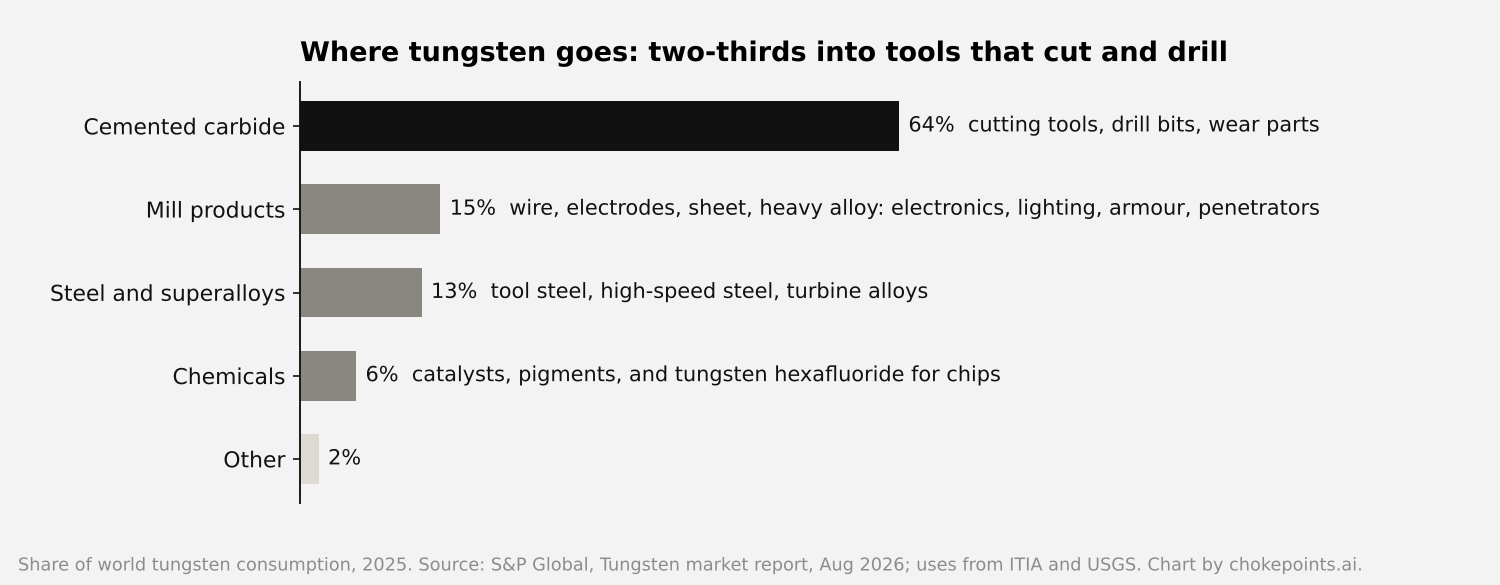
- Cutting and drilling, 64 percent of demand. Cemented carbide is tungsten carbide grains fired together in a cobalt binder. It is used for the cutting tools that machine steel, drill bits, mining picks and wear parts.
- Electronics and lighting, part of the 15 percent that goes into mill products. In electronics tungsten is used for wire, electrodes and heat sinks, and for the contacts and wiring inside chips: it is laid down as tungsten hexafluoride gas in every logic chip and 3D memory chip. Two Japanese makers of that gas halted output in July 2026 and its price is up about five times this year (Global Semi Research, 29 Jun 2026; Korea Times, 22 Aug 2026).
- Defence, also inside mill products. In weapons tungsten heavy alloy is used for armour, armour-piercing penetrators, shaped-charge liners and counterweights. Elmet says its tungsten goes into more than 100 US defence programmes, including the F-35 and the PAC-3 missile (Manufacturing Dive, 15 Sep 2026).
- Steel and superalloys, 13 percent. In steelmaking it is used for tool steel, high-speed steel and turbine alloys.
- Chemicals, 6 percent. In chemicals it is used for catalysts and pigments.
In the ground the metal sits in heavy minerals scattered through ordinary rock, and the grade is thin. Hemerdon’s Ore Reserve grades about 0.15 percent WO3 (Tungsten West RNS, 30 May 2025), WO3 being tungsten trioxide, the oxide form the trade counts metal in. Behind that grade stand 70.7 million tonnes of rock carrying 10.3 million metric tonne units of contained oxide, one mtu being ten kilograms of WO3. Almost everything the mine moves leaves the site as waste.
Getting from granite to a sellable product takes three physical steps: crush and sort, jig, then grind and separate (Exhibit A). The sorter reads each piece of rock on a belt and air jets throw the barren ones out before they reach the mills. It is designed to cut the rock going on to the plant by about 70 percent, and a set of pressure jigs, which separate by weight, cuts what is left by a further 75 percent (Tungsten West RNS, 16 Feb 2026). Out comes a concentrate of about 50 percent WO3 (Tungsten West feasibility study, 4 Aug 2025).
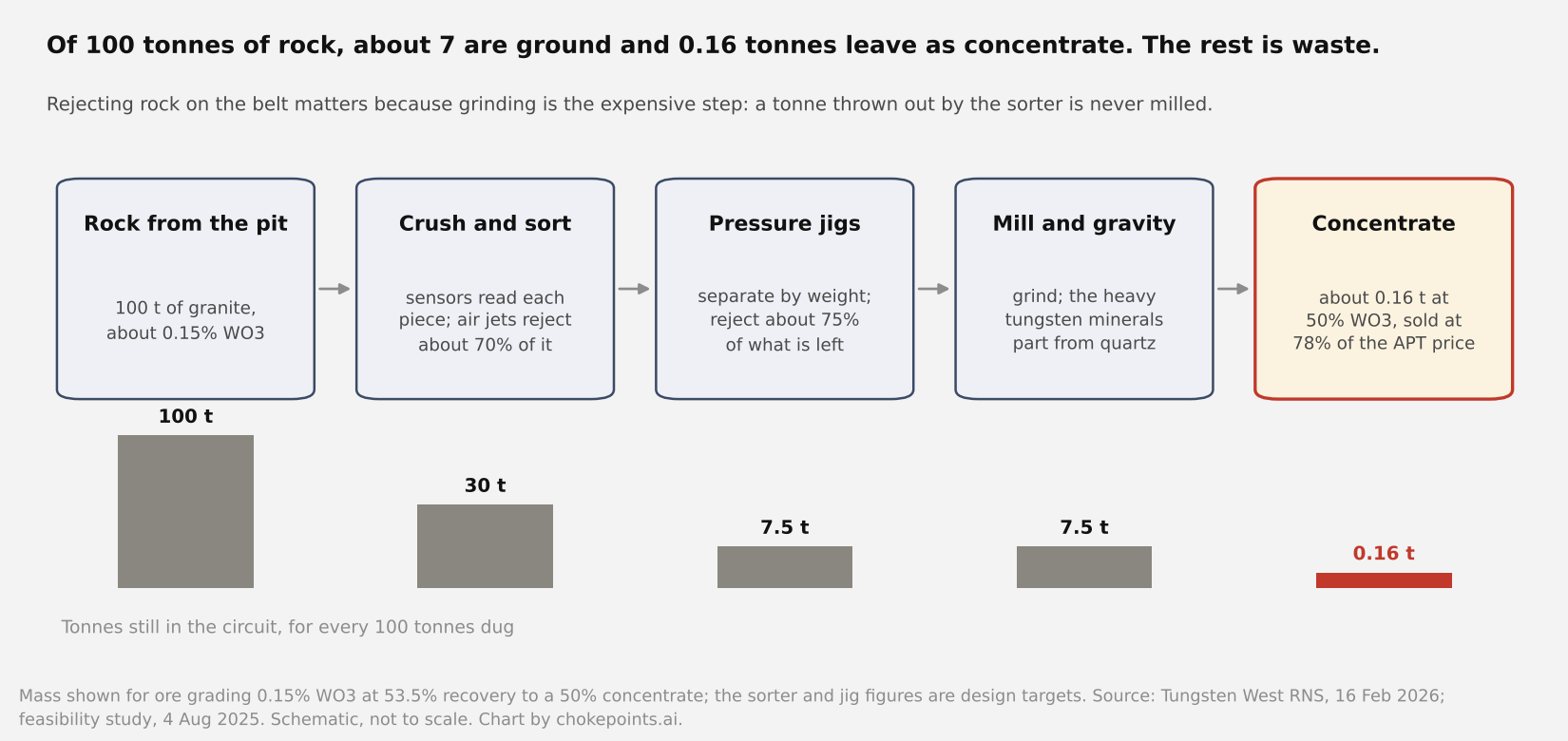
The mine sells the concentrate. A refiner buys it, dissolves it and purifies it into ammonium paratungstate, or APT, a white powder that is the first clean product in the chain; the carbide powders, oxides and chemicals made downstream all begin from it. Prices are quoted in US dollars per mtu of WO3 contained in the APT, and a mine selling concentrate receives a share of that price called payability: 78 percent in Hemerdon’s terms (Tungsten West feasibility study, 4 Aug 2025).
Ore can be found, financed and dug in many countries. Refining is harder: the plants that turn concentrate into APT are few, slow to build and mostly Chinese. Hemerdon’s concentrate has to pass through that step, and the next two sections follow it there.
03 Tungsten West in brief
Tungsten West is a single-mine company. It owns Hemerdon, a tungsten and tin deposit in Devon, and exists to restart a mine that failed under its previous owner.
Wolf Minerals ran the mine from 2015 and went into administration in October 2018. The feasibility study puts the failure down to poor ore feed, unreliable plant and metallurgical problems, on top of low tungsten prices (Tungsten West feasibility study, 4 Aug 2025). The other problem Wolf left was noise: low-frequency noise at nearby homes was the most significant issue the previous operator left, and the restart budget carries US$10.6m to deal with it (Tungsten West feasibility study, 4 Aug 2025).
Sources: Tungsten West RNS announcements and feasibility study, 4 Aug 2025; National Wealth Fund, 25 Aug 2026. Chokepoints analysis.
The mine: one open pit with eleven years of ore.
- Ore Reserve: 70.7 Mt at 0.15 percent WO3 and 0.03 percent tin, 10.3 Mmtu of contained oxide, inside a Mineral Resource of 327 Mt holding 39.7 Mmtu (Tungsten West RNS, 30 May 2025).
- The plan runs 3.5 million tonnes of ore a year at steady state, grading 0.17 to 0.20 percent WO3, above the reserve average.
- It pays for 332,000 mtu of WO3 a year: about 3,320 tonnes of oxide, or 2,630 tonnes of tungsten metal, plus 462 tonnes of tin.
- Eleven years of primary ore come first, then four years of stockpile reclaim and twelve of aggregate sales.
The money: £77m of new equity and a £25m state loan.
- Two funders paid for the restart: the market, with £41.4m raised at 18p in February 2026, and the National Wealth Fund, the UK Government’s investment fund, which bought £36m of equity at 36p in August 2026, took 7.42 percent of the votes and lent a further £25m (Tungsten West RNS, 25 Aug 2026).
- The non-voting B shares carry the same economic rights as the ordinary shares and convert one for one while their holders stay below the 30 percent takeover threshold. They were created to settle convertible loan notes the takeover code barred from converting.
- Cash stood at £25.49m on 31 March 2026.
The permit: planning permission to June 2036.
- Planning permission for extraction, processing and waste disposal runs to ◆ 5 June 2036, and the mineral lease to 2044 (Tungsten West feasibility study, 4 Aug 2025). The feasibility study plans inside that permission and treats anything later as future potential.
- The Environment Agency granted the processing plant its environmental permit on 12 June 2024, the last of the key permits (Tungsten West RNS, 12 Jun 2024).
- The financial year ends on 31 March.
People and owners: a new board for production, and a state shareholder.
- Jeff Court is chief executive, Phil Povey chief financial officer and Ron Day, hired in April, chief operating officer; Stephen Harrison chairs the board (Tungsten West AGM notice, 3 Sep 2026; Tungsten West RNS, 8 Apr 2026).
- Two non-executive directors, Adrian Bougourd and Martin Wood, stepped down at the AGM on 29 September. Katherine Callaghan, formerly group HR director at Rotork, joined on 1 October to chair the remuneration committee (Tungsten West RNS, 29 Sep and 1 Oct 2026). The National Wealth Fund may nominate one non-executive director.
- Gregory Coffey, the hedge fund manager, was the largest holder on record at 14.4 percent on 1 April 2026. He lent the company money through an entity he controls; the loan was repaid on 28 August 2026 when the fund’s package landed.
- The company had recruited over 100 employees by July and targets 350 by early 2027 (Tungsten West RNS, 8 Jul 2026).
The fund’s board nominee, and the further board changes the company says will follow.
04 Where the supply chokes
China mines four-fifths of the metal and refines most of it. China mined 67,000 of the world’s 85,000 tonnes of tungsten in 2025 (USGS, Mineral Commodity Summaries 2026) and refines about 85 percent of the world’s APT (S&P Global, Aug 2026). Since February 2025 its export controls have covered APT, tungsten oxide, carbide and solid tungsten (MOFCOM, 4 Feb 2025). European APT fetched US$2,900 to 3,100 per mtu on 1 October 2026, against about US$890 inside China (SMM, 30 Sep and 1 Oct 2026).
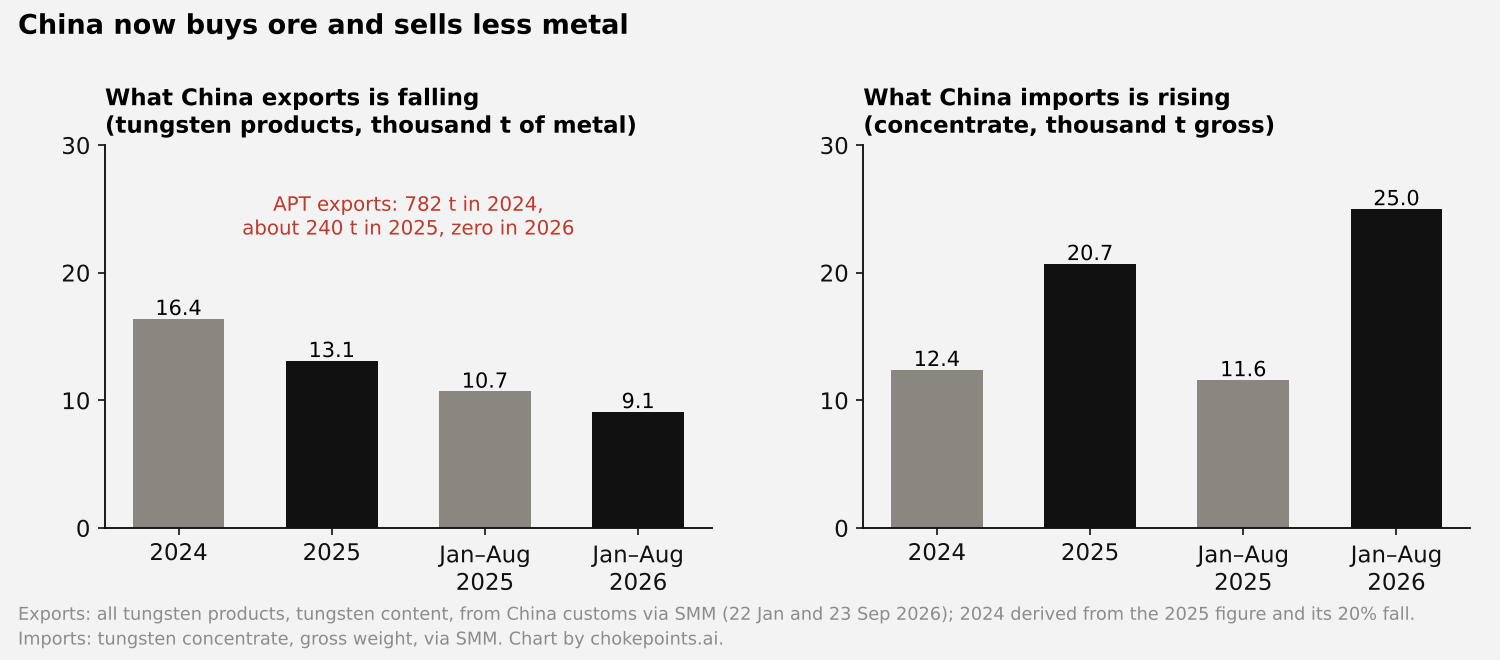
China now buys ore and sells less metal. Its APT exports were 782 tonnes in 2024, about 240 tonnes in 2025 and zero so far in 2026. Exports of all tungsten products fell 20 percent in 2025 and a further 16 percent in the first eight months of 2026. Over the same months its imports of concentrate more than doubled (SMM, 22 Jan and 23 Sep 2026). Its mining quota is flat, its ore grades have fallen from 0.42 percent in 2004 to 0.28 percent in 2024 (CTIA, 19 Aug 2025), and its concentrate output fell 17 percent in the first four months of 2026 (SMM, 9 May 2026). Even without the licensing, China has little raw tungsten to spare.
Washington has built a second wall.
- Section 301 tariffs of 25 percent on certain Chinese tungsten products from 1 January 2025 (USTR, 11 Dec 2024).
- From ◆ 1 January 2027, a DFARS rule bars tungsten mined, refined or produced in China, Russia, North Korea or Iran from US defence supply (DFARS Case 2021-D015, final rule, Federal Register, 30 May 2024). A July 2026 executive order tightened the waivers.
- In September 2026 the Defense Logistics Agency gave Elmet a US$2bn, five-year contract to supply tungsten for the national stockpile, and the Pentagon put US$450m of equity into Elmet (Manufacturing Dive, 15 Sep 2026).
- From 27 August 2026 US sellers of tungsten scrap must sell it to US buyers for a year (BIS, 91 FR 50,701).
Hemerdon is a large Western mine and a small world one. At steady state the plan pays for 332,000 mtu of WO3 a year (Tungsten West RNS, 30 May 2025), about 2,630 tonnes of contained tungsten: about 3 percent of world supply, about 14 percent of what was mined outside China in 2025, and about 18 percent of the pool DFARS leaves open once Russia and North Korea, at about 2,000 tonnes each, are barred. The company quotes about 20 percent of primary supply outside China (Tungsten West website, strategy page, accessed 29 Sep 2026). Its figure counts every primary producer beyond China’s borders; ours counts 2025 output, then only the tonnes a US defence buyer may take. The company’s figure is the flattering one.
That share will shrink. Eleven announced projects could add ◆ about 20,000 tonnes of WO3 mine capacity a year outside China by 2030 (The Oregon Group, 28 Aug 2026), about a quarter of today’s world output. Almonty’s Sangdong mine in Korea reached commercial production in September 2026 (Almonty, 21 Sep 2026), Kazakhstan’s Boguty mine produced 2,400 tonnes in its first year, and a US-backed venture in Kazakhstan is planning 12,000 tonnes a year with a US$900m EXIM letter of interest (Business Wire, 6 Nov 2025). If the pipeline lands, Hemerdon’s share of supply outside China falls toward 8 to 10 percent.
The tighter step is refining, and Tungsten West owns none. Refining capacity outside China runs at about 42,000 tonnes of WO3 a year, with 27,000 tonnes more announced by 2030 (The Oregon Group, 28 Aug 2026). The American end of it is still under construction: Elmet’s Springer conversion plant in Nevada is due to start only in 2028 (sustainabilityhq.com, 14 Sep 2026). Hemerdon’s concentrate will be converted “through ELMT’s allied refining network” (Elmet, 22 Sep 2026).
Which refiners will convert Hemerdon’s concentrate, and at what charge. Elmet names only an “allied refining network”, and no source we found names the plants.
The Western premium narrows when the new mines and refineries start, or if China eases its licensing, whichever comes first. Section 06 puts odds on both.
05 How Hemerdon makes money
Hemerdon sells concentrate, and its price is set by formula: the European APT price, times payability, less a royalty of 2.5 percent of net smelter return, the sales value left after the refiner’s charges (Tungsten West corporate presentation, 28 Jan 2026). Recovery decides how much of the tungsten in the rock reaches the concentrate: 53.5 percent from fresh granite, 51.1 percent from transitional granite, 47.6 percent from killas, the altered rock around the granite, and 45.5 percent from soft oxidised granite (Tungsten West feasibility study, 4 Aug 2025). The blend fed each day sets output as much as the grade does.
| Line | Figure | Note |
|---|---|---|
| Ore Reserve grade | 0.15% WO3, 0.03% Sn | 70.7 Mt, 10.3 Mmtu contained WO3 |
| Recovery to concentrate | 53.5% fresh granite | 47.6% on killas |
| Payability | 78% of APT | used in the pit-shell work; the Elmet terms imply about the same |
| Royalty | 2.5% of net smelter return | the pit-shell work used 2.25% |
| AISC, feasibility study, steady state | US$144/mtu | US$167 across the project |
| AISC, our model, life of mine | US$181.6/mtu | on plan, the wall falling |
| AISC, our model, life of mine | US$247.8/mtu | Wolf repeat, the wall falling |
| Fixed share of cash cost | 53% | our model |
| Payable production | 332,000 mtu WO3 a year, 462 t tin | average of years two to eleven |
Sources: Tungsten West RNS, 30 May 2025, and feasibility study, 4 Aug 2025; Chokepoints valuation model, 4 Oct 2026. AISC is all-in sustaining cost: cash cost plus the capital that keeps the mine producing. The pit shell is the study’s outline of the open pit worth mining at its prices.
Payability is the term we can check least. The offtake announcement gives none, so we carry the pit-shell figure of 78 percent. At 85 percent our weighted value would be 43.7p; at 70 percent, 33.1p; at 65 percent, 29.6p.
More than half of the cash cost is fixed, so a plant running below rate still pays most of its bills while it sells less.
One contract covers most of the output. Elmet (Nasdaq: ELMT) takes 1,000 tonnes of contained WO3 a year for eight years at variable prices referenced to European APT, an indicative £1.4bn nominal over the term, not guaranteed (Tungsten West RNS, 23 Sep 2026). That is a little under a third of planned output. At US$2,950 APT and 78 percent payability it comes to about US$230m a year, the figure Elmet quotes (Elmet, 22 Sep 2026). Elmet will use commercially reasonable endeavours to take a further 500 tonnes a year (Tungsten West RNS, 23 Sep 2026), and the production is unhedged (Tungsten West corporate presentation, 28 Jan 2026). The UK Government has a limited period to agree an offtake of up to 50 percent of the feasibility study’s tungsten output; no agreement had been announced by 2 October (Tungsten West RNS, 25 Aug 2026).
The price does most of the work. The feasibility study ran on US$400 per mtu and US$32,500 a tonne of tin and returned a post-tax NPV of US$190m at a 7.5 percent discount rate, with an IRR of 29 percent (Tungsten West feasibility study, 4 Aug 2025). Re-run at January 2026 prices, the company reported an IRR of 197 percent (Tungsten West RNS, 2 Feb 2026).
The money behind the restart
The restart was funded by the National Wealth Fund and two creditors. The fund lent £25m for 366 days at SONIA plus 5.5 percent, the margin stepping up one percentage point a quarter, with a £10m accordion uncommitted behind it, and bought £36m of new equity at 36p on the same day (Tungsten West RNS, 25 Aug 2026). McHale Komatsu financed £22.3m of mining equipment (Tungsten West RNS, 8 Apr 2026), and Hargreaves Services, the Durham engineering group that sold Tungsten West the mine, is owed £7.0m for the ending of its mining contract, due by 15 May 2027 (Tungsten West RNS, 8 Apr 2026). Within a year the state loan has to be repaid or refinanced, on terms the fund will have a say in.
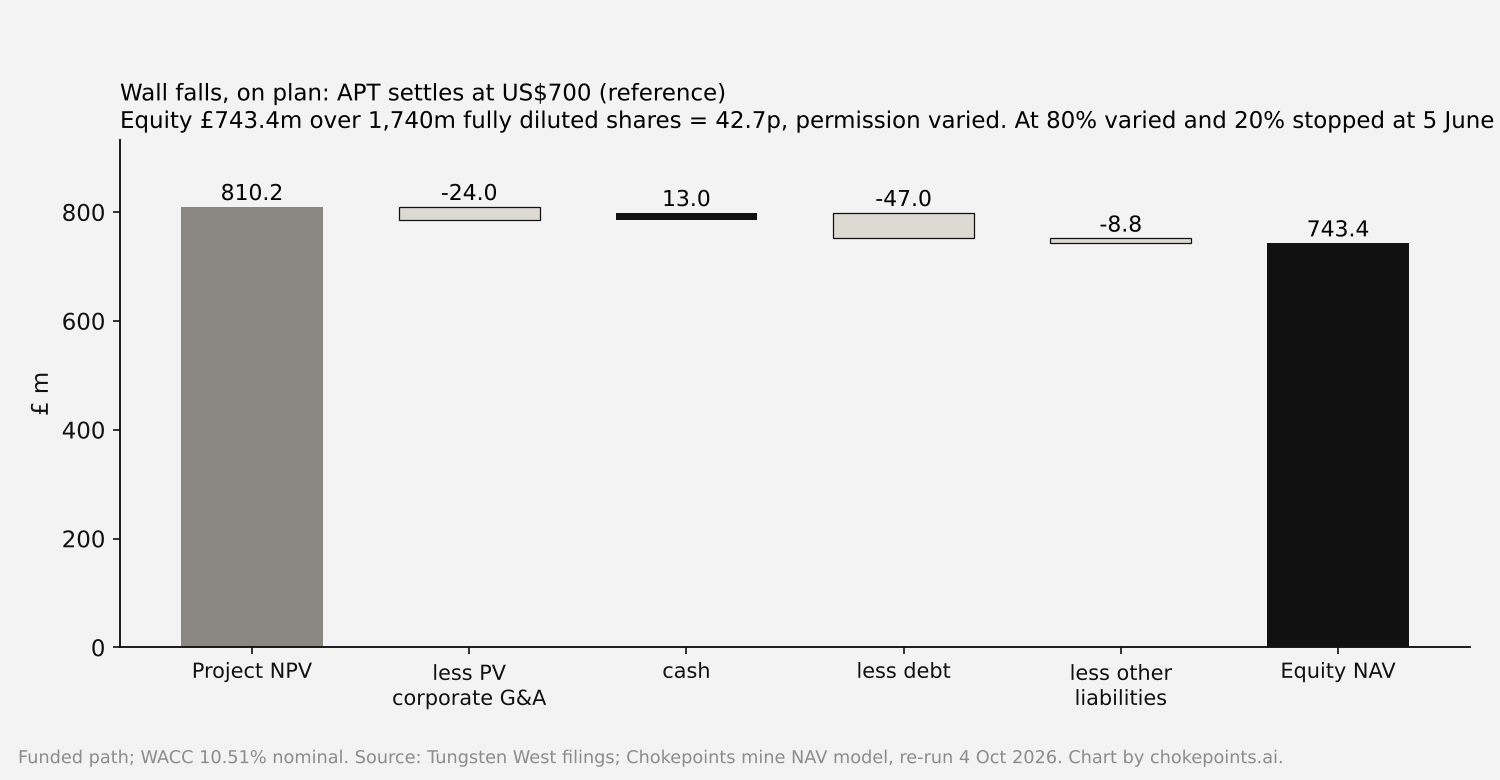
The bridge from project value to a share is short (Exhibit 1). In the reference future, with the permission varied past 2036, the project is worth £810.2m; overheads take £24.0m, cash adds £13.0m, debt and other liabilities take £47.0m and £8.8m, and equity is worth £743.4m, 42.7p per fully diluted share. The same future at our blend of permit outcomes, 80 percent varied, is worth 41.4p.
The share count divides that value (Exhibit 2). On the 24 September count, the 1,352.6m ordinary shares become 1,609.7m when the B shares convert, and 1,740.0m once options in the money are counted on the treasury method, which nets off the cash their exercise would raise. The funded path raises nothing more. The Wolf repeat does: it opens a £20.0m funding gap, met by a £23.8m raise in 2028, and takes the count to 2,233.1m.
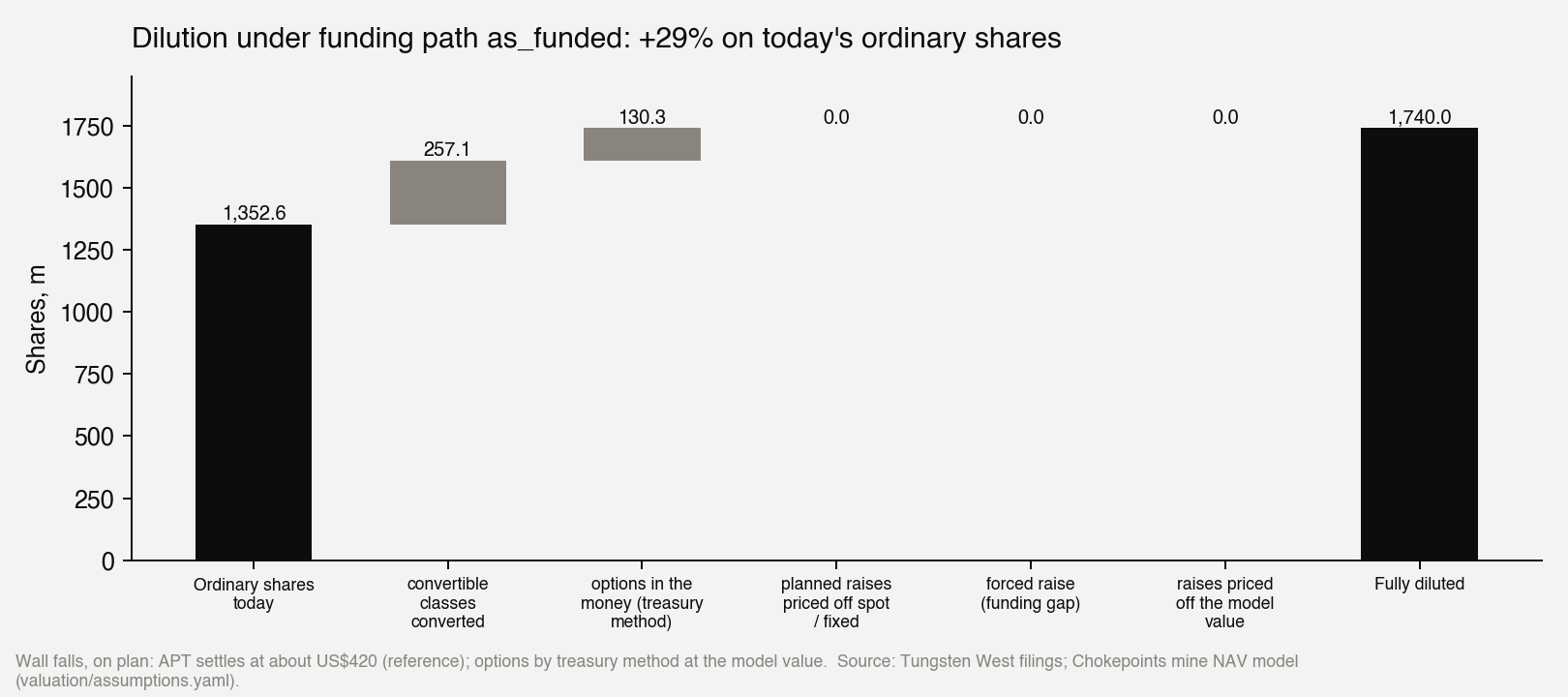
A restart that slips into a second raise hands more of the mine to new shareholders, so for today’s holders the timing of the ramp matters as much as the tungsten price.
06 What the price assumes
The shares need two things at once: a tungsten price far above its long-run level, held for years, and a plant that failed once running to plan. This section puts a number on each.
Two price worlds
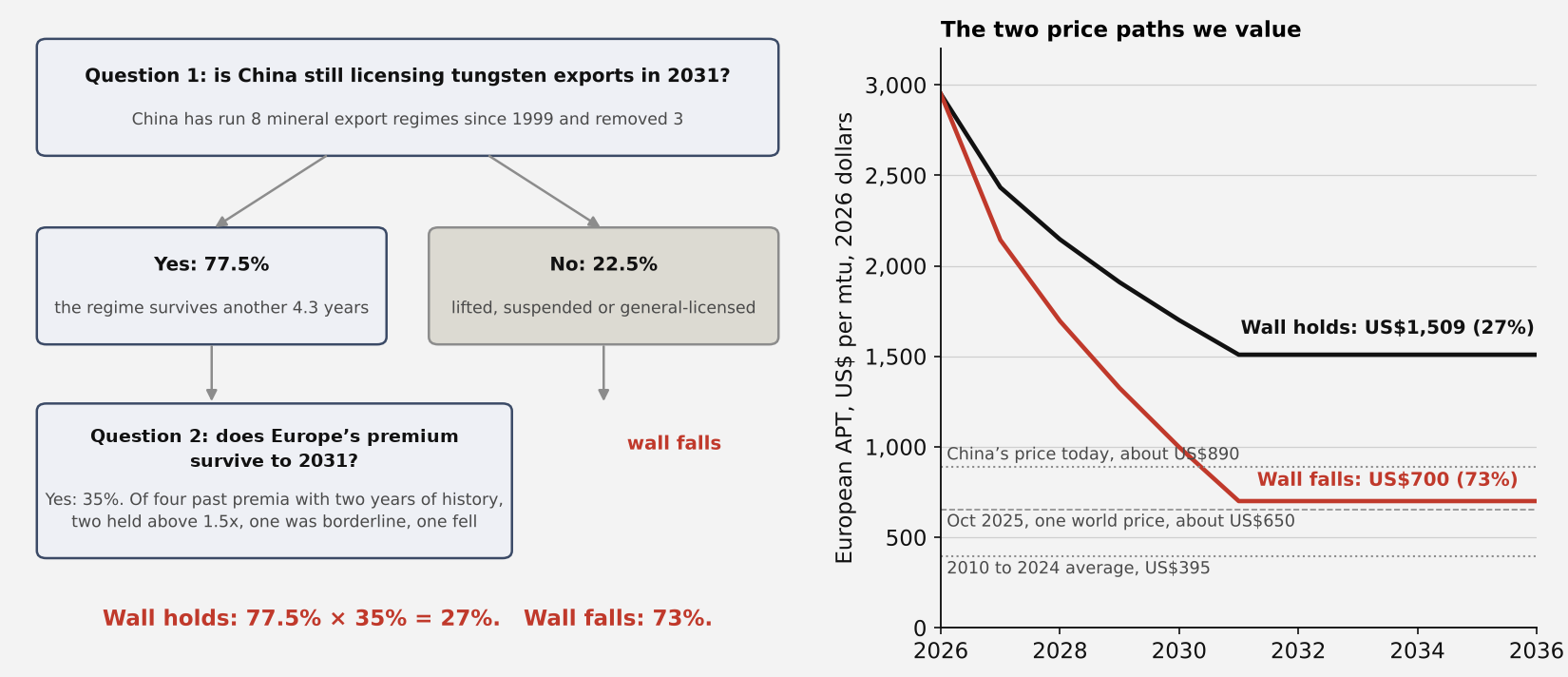
We split the future into two price worlds, value the mine in each, and weight them by their odds (Exhibit C).
- Wall holds: APT settles at ◆ US$1,509 per mtu. China keeps licensing exports and buyers outside China keep paying up. US$1,509 is the life-of-mine average Fastmarkets, the price-reporting agency, set in August 2026 for a new mine in Western Australia. The price eases from today’s US$2,950 to that level by 2031 and holds there after inflation.
- Wall falls: APT settles at US$700 per mtu. The gap between Europe and China closes and the world goes back to one price. The metal averaged US$395 from 2010 to 2024 (USGS Minerals Yearbook, in 2026 dollars). We put the settle at US$700, above that average, for three reasons. In October 2025, with the controls in force but the gap not yet open, the one world price was already US$600 to 680 (Fastmarkets, 29 Oct 2025). China’s own price today is about US$890 with no exports at all, so the floor under a reunited market sits above the old average. And S&P puts the price that pays for every announced mine outside China at US$900 (S&P Global, Aug 2026). US$700 sits between the last single price and that incentive price.
Two questions set the odds
Question 1: is China still licensing tungsten exports in 2031? Our answer: 77.5 percent yes.
- China has run eight export restrictions on minerals since 1999 and removed three: two after WTO rulings, and one in November 2025 for a trade truce that left tungsten’s licensing in force (MOFCOM, 7 Nov 2025). At that rate a regime survives the next 4.3 years 77.5 percent of the time.
- Since then Beijing has tightened. In December 2025 Beijing named the 15 companies allowed to export tungsten in 2026 and 2027 (Reuters, 30 Dec 2025). In January 2026 it banned dual-use exports, APT and carbide among them, to Japanese military users (Fastmarkets, 9 Jan 2026). Licences take about four months to clear (SMM, 12 Dec 2025).
- Through 2027 we would put it above 90 percent. The 77.5 percent is for 2031, four years further out, with a WTO case or a wider trade deal as the ways it ends.
Question 2: if the licensing lasts, does Europe’s premium? Our answer: 35 percent yes.
- China has restricted exports of other metals before, and the premium outside China has a record. Four of those premia have two years of history. Gallium’s (licensed from August 2023) is 5 to 9 times China’s price today and still widening. Germanium’s (the same date) peaked at 3 to 5 times and is 1.5 to 1.9 times today. Antimony’s (September 2024) peaked at 2.3 times and is 1.5 times today, on the line. The rare-earth premium of 2011 was gone within two years, as buyers found substitutes and smugglers found routes (sources in the appendix).
- Two held, one is on the line, one fell: about 60 percent survive two years. Only the rare-earth case is old enough to test five years, and it failed. Carrying the two-year rate forward at the same rate of decay gives about 28 percent at 2031.
- We lift that to 35 percent for the Western wall. The US DFARS bar is law, and the closest analogue, US anti-dumping duties on Chinese magnesium, has held a US premium above 1.5 times for more than fifteen years (USGS; USITC, 2022).
Together: 77.5 percent times 35 percent gives a 27 percent chance the wall holds to 2031, and 73 percent that it falls. Our September draft gave 13 percent, from two episodes rather than four and a settle price of US$420. The price today implies about 37 percent.
What closes the gap, and what keeps it open
- Closes it: new mines. Sangdong’s second phase doubles its output to about 460,000 mtu a year from 2027 (Almonty, 16 Mar 2026). Eleven mine projects and 27,000 tonnes of new refining capacity outside China arrive by 2030 (The Oregon Group, 28 Aug 2026). Fastmarkets’ sources expect a two- to three-year gap before output outside China catches up (Fastmarkets, 29 Oct 2025).
- Closes it: buyers at US$3,000. European APT averaged US$431 in 2011 and US$227 four years later, US$311 in 2018 and US$218 two years later (USGS). At today’s price toolmakers thrift, recycle and substitute. SMM reports no spot deals in Europe at the end of September, only low offers (SMM, 1 Oct 2026).
- Closes it: China’s own price is already falling. It peaked in March 2026 and closed September 63 percent lower (CTIA, 30 Sep 2026). Europe’s has not followed yet.
- Keeps it open: China has no spare ore. It imports concentrate and exports no APT (section 04), so lifting the licence would not by itself send tonnes west.
- Keeps it open: the US wall is statute. DFARS from 1 January 2027, a US$2bn stockpile contract to Elmet, and a scrap export ban. Defence is a small share of tungsten demand, but Hemerdon is a small mine and its buyer supplies the Pentagon.
- Keeps it open: chips. Demand for tungsten hexafluoride, the gas that lays tungsten into logic and memory chips, is set to pass 11,000 tonnes in 2026 against capacity of about 12,000 (Global Semi Research, 29 Jun 2026). Tungsten is a small part of a chip’s cost, so chipmakers keep buying when its price rises.
Two ramps
The second requirement is the plant. At 43.70p Hemerdon has to run to its feasibility plan, and the tungsten mines that started or restarted since 2010 mostly did not (Exhibit D). Hemerdon’s first operator was among the failures, and the tungsten price was rising when it failed.
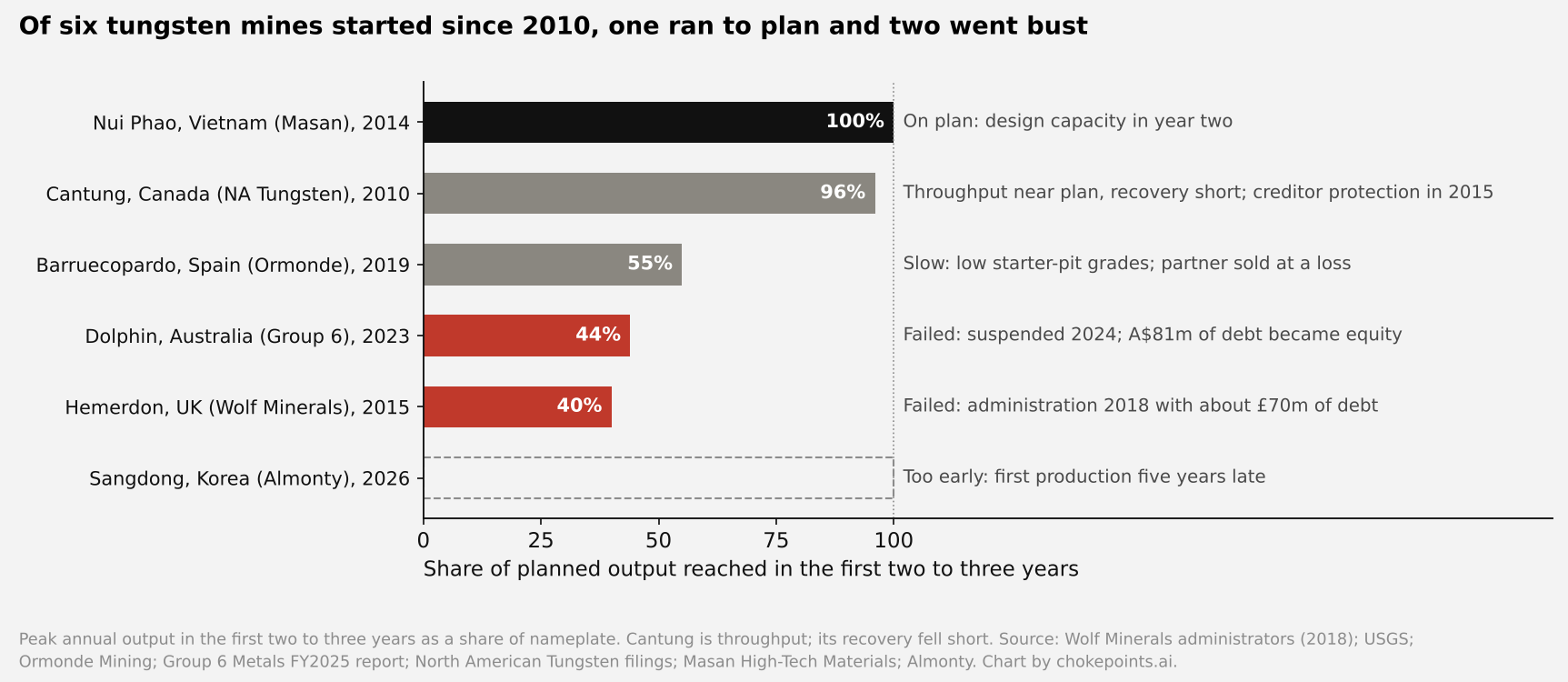
- On that record we give the restart 58 percent on plan and 42 percent slow, after blending the tungsten cases with the wider mining record, in which about half of new mines run to plan (McNulty; Hatch, 2026).
- “Slow” means a Wolf repeat: output short of plan for three years, costs a third higher per unit, and a £23.8m share issue in 2028 to cover the gap.
- Insolvency is modelled separately, from how restarts fail (section 09). It comes out at about 12 percent.
The premium survives at its two-year rate. If 60 percent of premia that last two years also last five, the wall’s chance is 46.5 percent and the weighted value is 46.2p, above the price. With the wall certain to hold and Wolf’s history still in the weights, the value is 66.9p. The disagreement between us and the market is one number: whether the premium decays between year two and year five. We say it does, because every past spike in tungsten has, and because the new mines that would close it have announced start dates.
The price deck behind the two analysts’ targets, 60.5p and 79p. Neither publishes revenue, earnings or production estimates, and the higher, Zeus Capital, became the company’s joint broker on 18 September (Tungsten West RNS, 18 Sep 2026). Nor can the operating half be observed yet: no recovery results exist to test the ramp against.
07 What would prove us wrong
One risk breaks the call in each direction. Upward: the wall outlasts the new supply and Hemerdon ramps to plan. The mine then collects today’s spread for years, and with the wall certain to hold our value is 66.9p. Downward: the gap closes to the old average. If every future’s price glides to US$395 by 2031, the value is 14.9p.
Three signs would show the upward case happening:
- US$1,500: European APT holding above US$1,500 per mtu while the new mines land. It is about US$2,950 today. In our wall-falls path it drops through US$1,500 in 2028.
- Q1 2027: full commissioning on the company’s own date (Tungsten West RNS, 3 Sep 2026), with the plant reaching its 500 tonnes an hour nameplate through 2027 (Tungsten West RNS, 21 May 2026) at the 53.5 percent recovery on fresh granite that section 05 uses. Wolf’s shortfall arrived at this stage.
- 5 June 2036: a variation of the planning permission past that date. It takes the weighted value to 40.0p, against 33.6p if production stops there.
A lower discount rate does not change the call. At a WACC of 0.01 percent the weighted value is 70.5p; at the 5 percent real rate mining analysts use for gold it is 44.3p, about the price. On plan with the wall holding, the value stays above the price up to a WACC of 25 percent.
Whether the ramp repeats Wolf’s recovery shortfall. Recovery is a behaviour of a plant under load, and only tonnes running at rate will show it.
08 What 43.70p already demands
A reverse DCF turns the question round. Instead of asking what the shares are worth, it asks what tungsten price would make them worth exactly ◆ 43.70p. We hold the price flat after inflation for the rest of the mine’s life and solve for it. A mine with a fixed life has no value beyond its last tonne, so the answer depends on two things: the price and the discount rate.
In plain terms: a buyer at 43.70p is assuming the mine sells its tungsten at about US$1,200 per mtu, three times the 2010 to 2024 average, for the next fifteen years. Or, if today’s price is allowed to run for the next four years as in our futures, at about US$1,100 after that.
| At 43.70p, a buyer needs | Implied | Our reference settle | Long-run real average |
|---|---|---|---|
| Flat real APT, weighted value | US$1,211/mtu | US$700/mtu | US$395/mtu |
| Flat real APT, reference future | US$985/mtu | US$700/mtu | US$395/mtu |
| Deck kept to FY2031, then flat, weighted value | US$1,101/mtu | US$700/mtu | US$395/mtu |
| Deck kept to FY2031, then flat, reference future | US$760/mtu | US$700/mtu | US$395/mtu |
| Flat real APT, weighted value, at an 8.50% WACC | US$1,110/mtu | US$700/mtu | US$395/mtu |
| Flat real APT, weighted value, at a 12.00% WACC | US$1,290/mtu | US$700/mtu | US$395/mtu |
Source: Chokepoints valuation model, re-run 4 Oct 2026; WACC 10.51% nominal, 7.55% on real cash flows. Each implied price returns 43.70p.
On the weighted rows a buyer at 43.70p needs about 1.7 times the US$700 at which our reference future settles. On the reference future with the deck kept to 2031, the buyer needs US$760, close to our settle: run the plant to plan and keep today’s price for four years, and 43.70p is about right.
The same price on the industry’s yardsticks
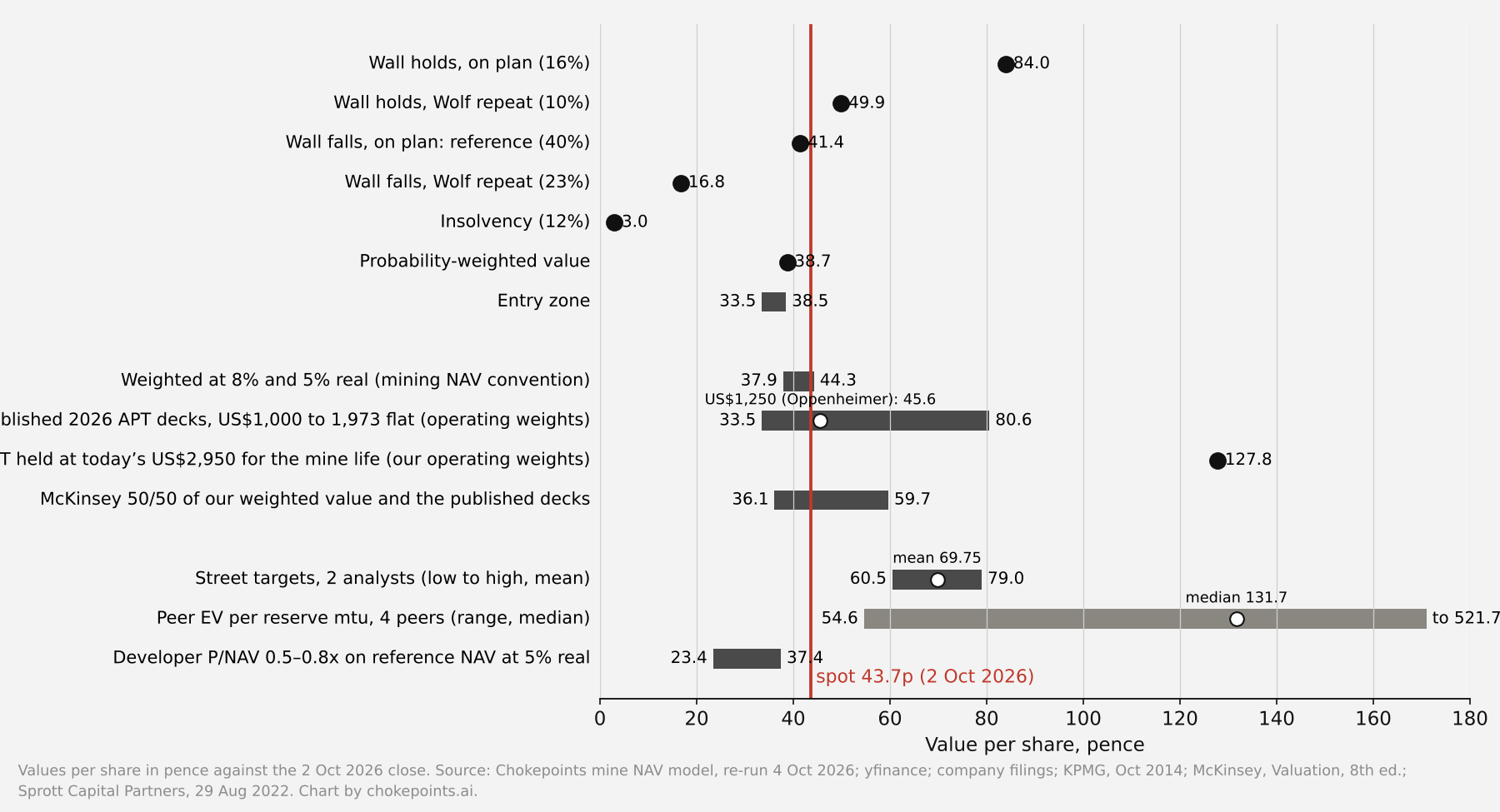
Mining analysts value a mine another way. They discount the mine plan at a fixed real rate, “5 percent for gold properties and 8 percent for most base metals”, rates “seldom adjusted” for market conditions (KPMG, Oct 2014), and take development risk through a multiple of that value. Our 7.55 percent real sits between the two. At 5 percent real the weighted value is 44.3p; at 8 percent, 37.9p. 43.70p sits between them.
The price deck moves the answer far more than the rate. Our reference future settles at US$700, and every deck published this year sits above it: Oppenheimer’s for Almonty uses US$1,250 for 2026 to 2028 (Investing.com, 19 Mar 2026), Group 6 Metals tests its Dolphin mine at US$1,000 to 1,800 in the long run (Group 6 Metals, FY2026 accounts), Fastmarkets puts US$1,509 under a new Western Australian mine (Aug 2026), and Guardian Metal’s pre-feasibility study uses US$1,973 (Guardian Metal, 30 Jun 2026). Each was set after China’s controls began. Run flat through our futures with our operating weights, those decks give:
| Flat real APT, per mtu | Whose deck | Our operating weights | Restart on plan | vs spot |
|---|---|---|---|---|
| US$700 | Our wall-falls settle | 18.9p | 26.0p | -57% |
| US$900 | China’s domestic price, September 2026 | 28.6p | 38.4p | -35% |
| US$1,000 | Group 6 Metals, long-run low | 33.5p | 44.6p | -23% |
| US$1,250 | Oppenheimer, 2026 to 2028 | 45.6p | 60.2p | +4% |
| US$1,509 | Fastmarkets, Mt Mulgine life of mine | 58.1p | 76.3p | +33% |
| US$1,800 | Group 6 Metals, long-run high | 72.2p | 94.4p | +65% |
| US$1,973 | Guardian Metal, pre-feasibility study | 80.6p | 105.1p | +84% |
| US$2,950 | Today’s European price, held for the mine’s life | 127.8p | 165.7p | +192% |
Source: Chokepoints valuation model, re-run 4 Oct 2026, every future at the flat price shown, weighted by our operating priors (restart on plan 55.2%, Wolf repeat 33.0%, insolvency 11.7%); Investing.com, 19 Mar 2026; Group 6 Metals FY2026 accounts; Fastmarkets via Tungsten Mining, Aug 2026; Guardian Metal, 30 Jun 2026. “vs spot” is the operating-weights value against 43.70p.
Our model returns 43.70p at a flat US$1,211, US$39 below the only broker deck we could read. McKinsey’s method for cyclical companies values a “new trend line”, which it equates with the consensus forecast, next to the cycle, and finds the market follows a blend “much closer to the 50/50 path” (McKinsey, Valuation, 8th edition). Blended 50/50 with our weighted value, the published decks give 36.1p to 59.7p, a range that straddles the price; today’s price held for the mine’s life gives 83.3p, and a 6 percent weight on it returns 43.70p.
The industry’s two multiples point opposite ways, and the inputs explain why. One broker values gold mines still in construction at 0.5 to 0.8 times their value at a 5 percent real rate (Sprott Capital Partners, 29 Aug 2022); at 43.70p Tungsten West trades at 0.93 times our reference value at 5 percent, above that band, for a plant weeks into production. Per mtu of reserve the shares look cheap: the enterprise value is US$94.8, against a median of US$276.8 for four listed peers, and at that median the shares would be worth 131.7p (Exhibit 3). A Hemerdon reserve mtu yields less than its face value: at 53.5 percent recovery, about half of it reaches the concentrate. Three of the four peers already sell concentrate, and their study decks run from US$450 to US$1,973. Our value also puts 45 percent of its weight on a slow ramp or insolvency, risk a sell-side value takes through its multiple instead.
09 Two price worlds, two ramps
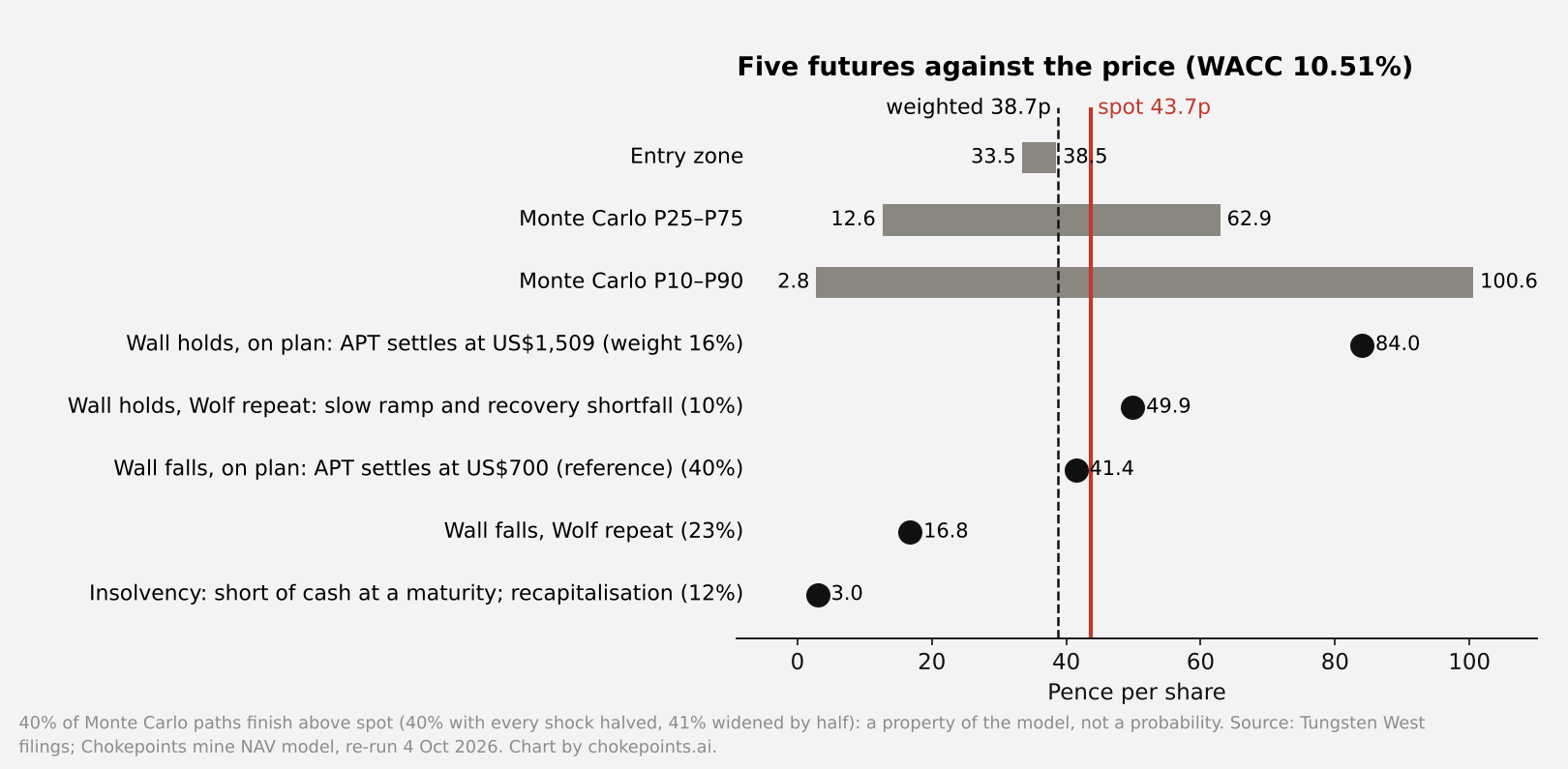
Each future sets two drivers, the price world and the ramp, and runs the rest of the mine on the feasibility plan. Together they give 38.7p against ◆ 43.70p at spot.
| Future | What it assumes | Value, p | vs spot | Weight |
|---|---|---|---|---|
| Wall holds, on plan | China’s licensing stands and the premium survives: APT eases from US$2,950 to US$1,509 by 2031 | 84.0 | +92% | 15.6% |
| Wall holds, Wolf repeat | The same prices; ramp and recovery come in short of plan | 49.9 | +14% | 10.1% |
| Wall falls, on plan (reference) | The premium closes: APT settles at US$700 by 2031 | 41.4 | -5% | 39.7% |
| Wall falls, Wolf repeat | The same prices, with the slow ramp | 16.8 | -62% | 23.0% |
| Insolvency | Short of cash at a maturity; recapitalisation | 3.0 | -93% | 11.7% |
| Probability-weighted | 38.7 | -11% |
Source: Chokepoints valuation model, re-run 4 Oct 2026; WACC 10.51%. Each weight is the chance of its price world (section 06) times the share of its ramp, times its survival in our insolvency model.
Insolvency comes from how tungsten restarts fail. In our precedents every failure ran one chain: output short of plan, cash burning, a payment falling due, and an equity too small to raise the gap. Tungsten West sits on that chain’s calendar: £7.0m falls due to Hargreaves by 15 May 2027 and the £25m state loan about 29 August 2027, one and two quarters after full commissioning. We run 20,000 paths of price and plant quarter by quarter against those dates and let the company raise up to 16.0 percent of its market value a year, the median of its four raises since 2023. Insolvency comes out at about 12 percent: under 1 percent on plan with the wall holding, about 25 percent in a Wolf repeat with the wall falling. No regulator stopped any of the six tungsten starts since 2010, so a permit stop carries no weight of its own; it sits on the watch list.
The Monte Carlo varies price, recovery, throughput, grade, costs, the pound and the discount rate inside each future. In our central set-up 40% of its paths end above the price, 40% with every shock halved and 41% with every shock widened by half; the median path is worth 34.5p and the 90th percentile 100.6p (Exhibit 4).
The discount rate, and what moves the value
The discount rate is one subtraction and one sum. The ten-year gilt yields 5.332 percent and the UK’s Aa3 rating carries a 0.509 percent default spread in Damodaran’s January 2026 data, leaving a risk-free rate of 4.823 percent. A 5.006 percent equity risk premium at a beta of 1.19, the global metals and mining beta, gives a cost of equity of 10.78 percent. With debt at 6.92 percent after tax on a 7.1 percent weight, the WACC is ◆ 10.51%, or 7.55 percent on real cash flows. The share’s own two-year regression beta is 1.33, but with an R-squared of 2 percent it carries no information (Bank of England, 25 Sep 2026; Damodaran, Jan 2026).
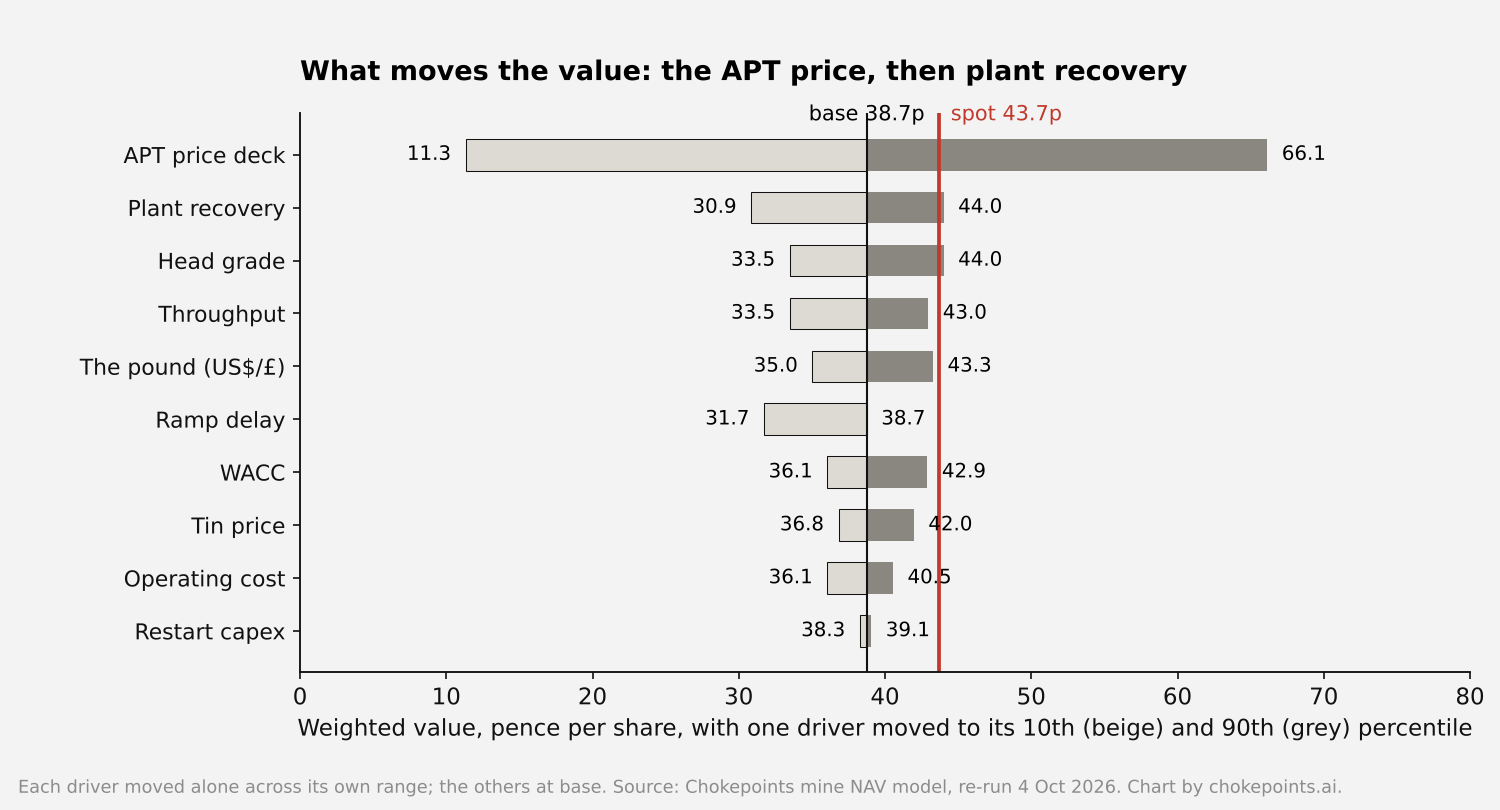
The APT price moves the value most. Taken one at a time to the 10th and 90th percentile of its own range, APT swings the weighted value from 11.3p to 66.1p; plant recovery, second, from 30.9p to 44.0p; the discount rate from 36.1p to 42.9p (Exhibit 5). APT, recovery and grade at their 90th percentiles each clear the price.
| APT deck, x | 8.50% WACC | 10.51% WACC | 12.00% WACC |
|---|---|---|---|
| 0.50 | 12.6p | 11.3p | 10.5p |
| 1.00 | 42.9p | 38.7p | 36.1p |
| 1.50 | 73.2p | 66.1p | 61.6p |
Weighted value with every future’s APT deck scaled, by discount rate. Source: Chokepoints valuation model, re-run 4 Oct 2026.
The grade matters less than the price and more than the discount rate: at the planned price deck, a head grade at 85% of plan gives 30.9p and at 115% gives 46.6p (Exhibit 6).
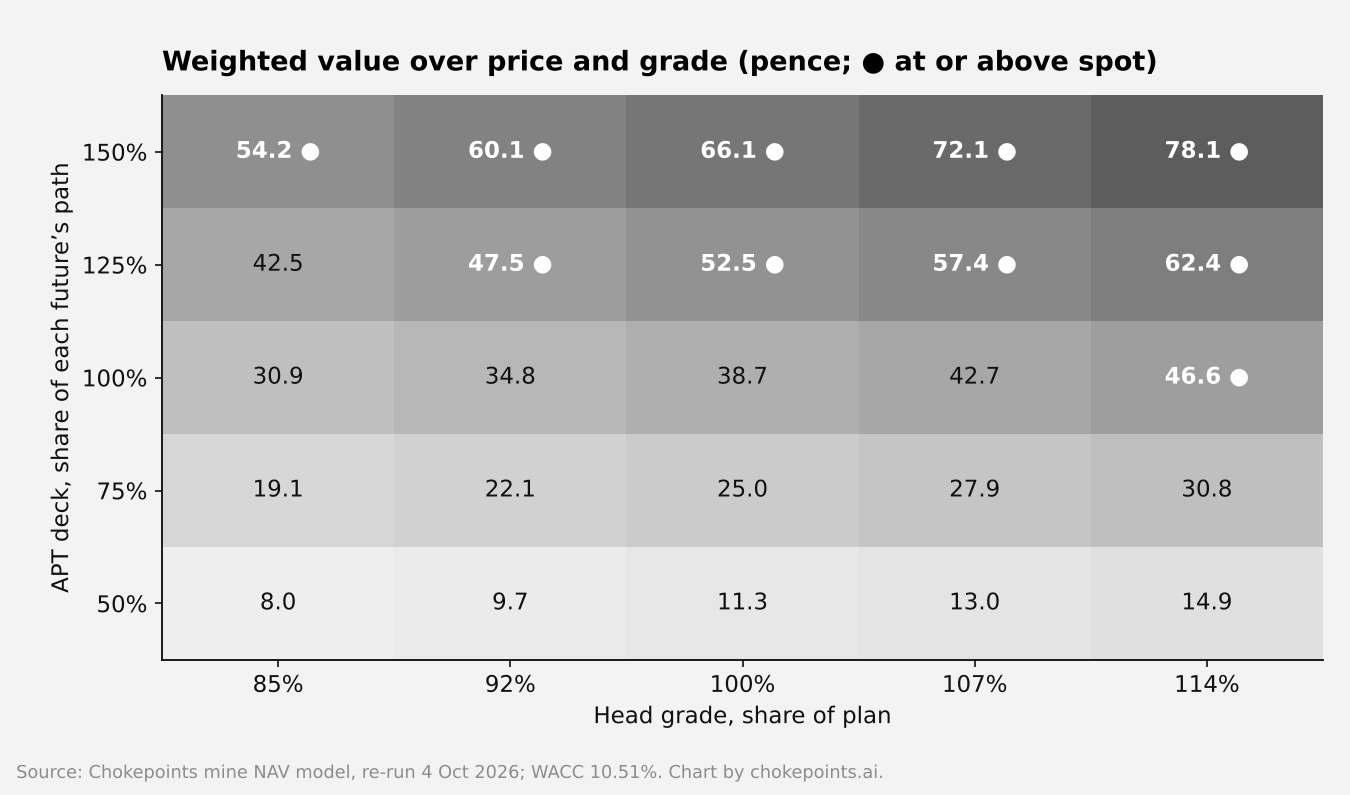
Three checks sit behind the entry zone. If every future’s APT deck glides to the long-run US$395 by 2031, the weighted value is 14.9p, the harshest case we ran. If the wall-falls settle is US$600 rather than US$700, the value is 35.5p; at US$900, China’s price today, 45.5p. The planning permission ends on 5 June 2036 and the reference mine runs six years past it; we put an 80 percent weight on a variation, which gives 40.0p if varied and 33.6p if production stops. The weight rests on history: the permission has been extended twice, to 2021 and then to 2036, and Devon’s minerals plan supports completing the approved development (Devon County Council). The entry zone runs from the stopped case to the 80 percent blend, 38.7p, each rounded down to the half penny.
10 The share price and the news
The shares have moved on the tungsten price, on policy and on money; the start of production barely moved them. The shares closed at 3.625p at the end of March 2025, 51.0p at the end of August 2026 and ◆ 43.70p on 2 October 2026 (Exhibit 7).
The stock market explains almost none of it. Against the FTSE AIM All-Share the shares have an R-squared of 2.6 percent, and the index accounts for 3 percent of the rise since January 2025, a gain of 2.39 in log terms as the shares multiplied about elevenfold. Listed tungsten producers and developers account for 36 percent: the shares carry a beta of 0.45 to them. The rest came on news days. In 2026 the move in listed tungsten shares and five days of reports of a surging APT price carried 52 percent of the rise, financing news 21 percent and company operations 19 percent; offtake news, unexplained days and fund flows net to the other 8 percent (Exhibit 8).
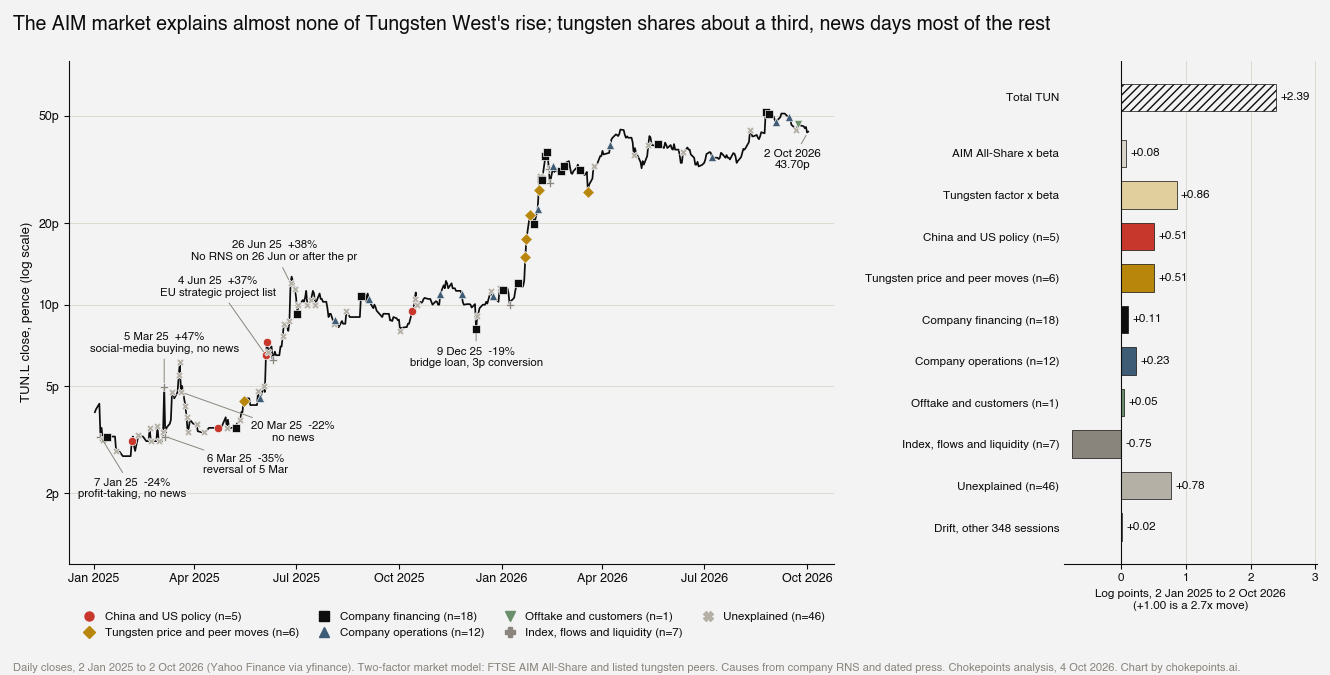
| Date | Event | Move on the day | Abnormal (t) | What it means |
|---|---|---|---|---|
| 4 Feb 2025 | China puts APT and other tungsten items under export licensing (MOFCOM) | +13.6% | +11.5% (1.1) | Price lever: the Western quote starts to split from China’s |
| 5 and 6 Mar 2025 | No announcement; social-media buying, then its reversal (Armchair Trader) | +47.3%, then -34.6% | +37.4% (3.8), then -43.2% (-4.3) | None: a 3p stock on a wide spread |
| 4 Jun 2025 | The European Commission lists Hemerdon as a Critical Raw Materials Act strategic project, during London trading | +36.8% | +29.3% (3.2) | Policy lever: the mine joins Europe’s list before any financing lands |
| 26 Jun 2025 | No announcement found | +38.2% | +31.7% (3.5) | Unexplained |
| 28 Aug 2025 | US EXIM letter of interest for up to US$95m, non-binding | +20.0% | +18.7% (2.1) | Funding lever: a US backstop that needs offtake to US buyers |
| 9 Dec 2025 | Bridge loan at 15 percent; notes to convert at 3p | -19.4% | -23.7% (-2.8) | Funding lever: dilution from a company that needed cash |
| 22 to 26 Jan 2026 | Reports of China’s APT price up 17.2 to 18.7 percent in the year to date; no announcement | +22.4%, +16.7%, +22.3% | +17.8% (2.2), +10.7% (1.3), +14.8% (1.8) | Price lever: the shares trade on the tungsten price |
| 2 Feb 2026 | Project update at end-January prices | +13.9% | +12.0% (1.5) | Price lever: the spot quote enters the plan |
| 16 Feb 2026 | Contracts for the plant upgrade and the pressure jigs signed | +15.7% | +14.7% (1.8) | Ramp lever: the restart becomes buildable |
| 25 Aug 2026 | National Wealth Fund: £36m of equity at 36p, a loan, and a period for the UK Government to agree offtake of up to 50% of study production | +19.7% | +16.7% (3.9) | Funding and offtake levers in one announcement |
| 15 Sep 2026 | Production announced | -0.4% | -0.8% (-0.2) | Ramp lever: ore through the plant, and the shares did not move |
| 23 Sep 2026 | Elmet offtake agreement | +4.9% | +5.0% (1.2) | Offtake lever: the contract from section 05 lands inside the noise |
Moves are close to close. An abnormal return strips out the move the two-factor model expected that day from the AIM market and the tungsten basket, estimated on the prior year with news days removed; a t-statistic above 2 in either direction is unlikely to be noise. Source: Yahoo Finance via yfinance; company RNS; MOFCOM; European Commission; China Tungsten Industry Association; Armchair Trader. Chokepoints analysis, 4 Oct 2026.
The strongest news day of the past year was 25 August 2026. The National Wealth Fund put in £36m of equity at 36p, a loan and a limited period for the UK Government to agree to buy up to 50 percent of the study’s production, and the shares rose 19.7 percent that day, an abnormal return of 16.7 percent with a t-statistic of 3.9. That close, 51.6p, is the highest of the past year. Three weeks later the company announced it had entered production and the shares fell 0.4 percent; the Elmet offtake moved them 4.9 percent, inside the noise. Investors paid for solvency and a prospective government buyer. The plant and the customer were already in the price; the rest of the value rests on Europe’s premium.
11 The call
- Verdict: HOLD. New money: wait for the entry zone. Holders: hold, and exit at the tripwire. We hold no position.
- The number: 38.7p probability-weighted at a 10.51 percent WACC, 11 percent below the ◆ 43.70p price. The price implies 37% odds on Europe’s premium holding to 2031; we give 27%. At 40% the two meet.
- Entry zone: 33.5p to 38.5p, from the weighted value with production stopped at the permit end to the weighted value with an 80 percent weight on a variation, both at 10.51 percent and rounded down to 0.5p.
- Why not short: the wall-holds future on plan is worth 84.0p, ore is moving through the plant, the Elmet offtake is signed, and on the decks others publish our model gives 34p to 81p.
- Tripwire: European APT below US$1,500 per mtu for a quarter, or China easing its tungsten export licensing. Either takes our value to 28.3p.
- Offtake: Elmet puts the contract at more than US$230m a year at current APT prices (Elmet, 22 Sep 2026).
- State money: £36m of equity at 36p and a £25m loan from the National Wealth Fund (Tungsten West RNS, 25 Aug 2026).
- Policy: DFARS bars covered-country tungsten from US defence supply from 1 January 2027 (DFARS Case 2021-D015, final rule, Federal Register, 30 May 2024).
- Cost: a steady-state all-in sustaining cost of US$144 per mtu in the feasibility study (Tungsten West RNS, 30 May 2025).
- A failed site: Wolf’s recoveries never reached target (Tungsten West feasibility study, 4 Aug 2025), and low-frequency noise from the plant’s screens led Wolf to shut them down at weekends (Global Mining Review, 22 Aug 2017).
- New supply: Sangdong’s second phase doubles its output to about 460,000 mtu a year from 2027 (Almonty, 16 Mar 2026).
- A dated permit: the feasibility study plans inside a permission that ends in June 2036 (Tungsten West feasibility study, 4 Aug 2025).
- Short money: the state loan runs 366 days and steps up 1 percentage point a quarter (Tungsten West RNS, 25 Aug 2026).
▲ What moves us to accumulate
- 33.5p to 38.5p: the shares enter the entry zone.
- Q1 2027: full commissioning on schedule, at the feasibility study’s 53.5 percent recovery on fresh granite.
- Up to 50 percent: the UK Government’s offtake negotiation ends in a signed contract.
- 5 June 2036: Devon County Council extends the permission before that date arrives.
▼ What moves us to avoid
- 10 November 2026 or any day after: a MOFCOM notice that suspends, lifts or general-licenses tungsten under its 2025 announcement No.10. Our value falls to 28.3p; holders sell.
- US$1,500: European APT below US$1,500 per mtu for a quarter, against US$2,900 to 3,100 today: the same 28.3p; holders sell.
- 31 Jul 2027: no refinancing or extension of the state loan, with April to June 2027 output below 36,700 mtu (plan 61,600): the wall-holds case falls to 40.8p, below the price; holders sell.
- Any standstill or deferred payment, including the £7.0m due to Hargreaves on 15 May 2027: exit at once. Wolf went from standstill to administration in 72 days.
- Q1 2027: full commissioning slipping past it.
Bought in the zone, the Wolf repeat is the risk we accept at a mine that has failed once, and the wall holding is our upside. Until the price comes into the zone, we do nothing.
Scorecard
Dates to watch
| When | What | Lever |
|---|---|---|
| ◆ 10 November 2026 | China’s one-year suspension of its October 2025 export controls expires; tungsten’s licensing sits outside it (MOFCOM, 7 Nov 2025) | Policy |
| Q4 2026 | Coarse gravity circuit commissioning target, after the fines circuit’s recommissioning in Q3 2026 (Tungsten West RNS, 8 Jul 2026) | Ramp |
| ◆ 1 January 2027 | DFARS 225.7018-2 bars tungsten from covered countries in US defence supply (DFARS Case 2021-D015, final rule, Federal Register, 30 May 2024) | Policy |
| ◆ Q1 2027 | Full commissioning, and full-scale production “early next year” (Tungsten West RNS, 3 Sep 2026) | Ramp |
| 15 May 2027 | The ◆ £7.0m owed to Hargreaves falls due | Funding |
| 31 Jul 2027 | The NWF loan refinanced or extended; without it, and with output short of plan, holders sell | Funding |
| Aug 2027 | The state loan’s 366 days run out (Tungsten West RNS, 25 Aug 2026) | Funding |
| Q1 2028 | Ramp-up to full-scale production complete (Tungsten West corporate presentation, 28 Jan 2026) | Ramp |
| 2030 | The ex-China mine pipeline of section 04 lands (The Oregon Group, 28 Aug 2026) | Supply |
| ◆ 5 June 2036 | Planning permission ends | Permit |
Source: Tungsten West RNS, 8 Jul 2026, 21 May 2026, 25 Aug 2026 and 3 Sep 2026; Tungsten West corporate presentation, 28 Jan 2026; Federal Register, DFARS final rule of 30 May 2024; The Oregon Group, 28 Aug 2026; planning permission from Devon County Council. Funding dates from our funding schedule. Chokepoints analysis.
The truce date in November is the first test of China’s wall, and the refinancing date is one of our exit lines. The permit date is the only one a variation moves, and section 09 values both outcomes. The policy date is fixed by statute; the company dates are targets that a plant with two weeks of running has to earn.
Appendix Watch variables
Each variable below changes over time and moves the view. In the body its current value carries the red diamond. Thresholds are ours.
| # | Variable | Current value (as of) | Source | Cadence | Threshold | Which way |
|---|---|---|---|---|---|---|
| W01 | Share price (AIM: TUN) | ◆ 43.70p (2026-10-02) | Yahoo Finance | Daily | Enters the entry zone, 33.5p to 38.5p | Inside the zone: toward opening a position; at spot we hold none |
| W02 | European APT spot | ◆ US$2,700-3,100/mtu (2026-10-01) | SMM | Weekly | Tripwire: below US$1,500/mtu for a quarter. Reference: US$1,211/mtu is the flat real APT that returns spot on the weighted value | Below US$1,500 for a quarter: the wall-holds world goes, our value falls to 28.3p and holders sell |
| W03 | China domestic APT | ◆ RMB 540-560k/t (2026-09-30) | SMM | Weekly | A rise toward Europe’s price, or a fall below RMB 400k/t | Rising: the gap closes from China’s side and Hemerdon’s price is untouched; falling: Chinese oversupply, toward the wall-falls settle |
| W04 | LME tin | ◆ US$55,385/t (Aug 2026) (2026-08) | World Bank | Monthly | A move outside the model band of -40.1/+67.0% | Tin is 7% of steady-state revenue; the band swings the weighted value by 2.4p |
| W05 | Long-run real APT (reversion check) | ◆ US$395/mtu (2026-09-28) | USGS | Semi-annual | A revised 2010-2024 real mean above US$395/mtu | Above: the reversion check lifts from 14.9p; below: toward avoid |
| W06 | Settle prices of the two price worlds | ◆ US$1,509 wall holds; US$700 wall falls (2026-10-04) | Fastmarkets; Chokepoints valuation model | Semi-annual | Wall-falls price at the ends of our range, US$600 and US$900 | US$600: 35.5p; US$900: 45.5p, above spot |
| W07 | Commissioning schedule | ◆ coarse circuit Q4 2026; full Q1 2027 (2026-09-03) | Tungsten West RNS | Quarterly | Full commissioning slipping past Q1 2027 | A 5.1-month delay takes the weighted value to 34.5p, into the entry zone |
| W08 | Ramp-up to full-scale production | ◆ full scale Q1 2027; ramp-up done Q1 2028 (2026-09-03) | Tungsten West RNS and corporate presentation | Quarterly | Ramp-up completion slipping past Q1 2028 | A slip pushes the shares toward the Wolf-repeat future at 16.8p |
| W09 | First-year production targets | ◆ 2,500 t WO3 and 500 t Sn in concentrate (2026-01-28) | Tungsten West | Quarterly | FY2028 output below 250,000 mtu | Below: recovery and grade assumptions fail, toward the Wolf-repeat future at 16.8p |
| W10 | WO3 in concentrate per quarter | ◆ none published (2026-10-04) | Tungsten West RNS | Quarterly | Below 36,700 mtu in April to June 2027, against a plan of 61,600 | Below: a Wolf repeat; the wall-holds case falls to 45.0p, a sell only with W12 |
| W11 | Cash and equivalents | ◆ £25.49 million (2026-03-31) | Tungsten West RNS | Quarterly | On-plan minimum cash balance of £11.7m breached | Breach: toward avoid; the Wolf-repeat future needs a £23.8m raise in 2028 |
| W12 | NWF debt facility | ◆ £25m, 366 days, SONIA + 5.5% (2026-08-25) | Tungsten West RNS | Quarterly | No refinancing or extension by 31 Jul 2027 | With output below the W10 line: sell, the wall-holds case is 40.8p; with output on plan: hold |
| W13 | Gross debt stack and maturities | ◆ NWF £25m, Komatsu £22.3m, Hargreaves £7m (2026-09-28) | Chokepoints valuation model | Quarterly | Hargreaves £7.0m unpaid at 15 May 2027 | A default or worse terms: toward avoid |
| W14 | Fully diluted share count | ◆ 1,740.0m fully diluted (2026-09-28) | Chokepoints valuation model | Quarterly | 2,233.1m shares, the Wolf-repeat count after a FY2028 raise | More dilution than the plan: toward avoid |
| W15 | Planning permission, Devon CC DCC/3823/2015 | ◆ to 5 June 2036 (2026-09-29) | Devon County Council | Semi-annual | Production stopped at 5 Jun 2036 | Stopped: the weighted value is 33.6p, the bottom of the entry zone |
| W16 | Permit variation prior | ◆ 80% weight on a variation (2026-09-29) | Chokepoints valuation model | Semi-annual | A variation refused, or a fresh EA consultation round on a new application | Refused: the weighted value sits at the stopped case of 33.6p; granted: at the varied case of 40.0p |
| W17 | Mineral Processing Facility environmental permit (EA) | ◆ granted (2024-06-12) | Tungsten West RNS | Quarterly | Enforcement action, or a limit on plant operating hours | A limit on hours: toward the Wolf-repeat future at 16.8p; enforcement that stops the plant: toward insolvency at 3.0p |
| W18 | Elmet offtake | ◆ 1,000 t WO3 a year for 8 years (2026-09-23) | Tungsten West RNS | Quarterly | The extra 500 t WO3/yr taken, or a second offtake concluded | More contracted volume: toward the wall-holds future on plan at 84.0p |
| W19 | UK Government offtake negotiation | ◆ up to 50% of FS production (2026-08-25) | Tungsten West RNS | Quarterly | A concluded government offtake, or the negotiation period lapsing | Concluded: toward the wall-holds future on plan at 84.0p; lapsed: toward the wall-falls future on plan at 41.4p |
| W20 | US DFARS 225.7018-2 | ◆ effective 1 January 2027 (2027-01-01) | Federal Register, DFARS Case 2021-D015 | On event | Covered-country tungsten barred from DoD supply on schedule | On time: toward the wall holding, 84.0p on plan; waived or slipped: toward the wall falling, 41.4p on plan |
| W21 | China tungsten export controls | ◆ 25 rare metal products and technologies (2025-02-04) | MOFCOM | On event | Any notice that suspends, lifts or general-licenses tungsten under 2025 No.10 | Eased: the wall-holds world goes, our value falls to 28.3p and holders sell; extended to concentrates: toward the wall holding |
| W22 | Ex-China mine pipeline | ◆ about 20,000 t WO3 by 2030 (2026-08-28) | The Oregon Group | Semi-annual | Hemerdon’s share of ex-China supply falling toward 8-10% as the pipeline lands | Pipeline landing: toward the wall-falls future on plan at 41.4p |
| W23 | Almonty Sangdong Phase 2 | ◆ ~4,600 tonnes per year (~460,000 MTU) (2026-03) | Almonty | Quarterly | Phase 2 commissioning in 2027 | Doubling Sangdong output: toward the wall-falls future on plan at 41.4p |
| W24 | Discount rate (WACC) | ◆ 10.51% (7.55% real) (2026-09-28) | Chokepoints valuation model | Monthly | A 5% real rate (gold convention) gives 44.3p, 8% real gives 37.9p | Lower rates lift every future; at 5% real the weighted value passes spot |
| W25 | Probability-weighted value | ◆ 38.7p (2026-10-04) | Chokepoints valuation model | On event | Reaches spot, 43.70p | Above spot: re-open the call; inside the entry zone, 33.5p to 38.5p: toward opening a position |
| W26 | Premium survival in other Chinese export controls | ◆ gallium 5-9x, germanium 1.5-1.9x, antimony 1.5x, bismuth 2.7x (2026-10-04) | Fastmarkets; SMM; Argus; trade press | Quarterly | Germanium or antimony falling below 1.5x and staying there, or gallium narrowing | More premia failing at two to three years: our 35% survival odds fall, toward the wall-falls settle; premia holding: toward the wall holding |
Register as of 4 October 2026. Thresholds are ours. Sources for W26: Fastmarkets, 22 Jul 2024, 7 Jan 2026 and 27 Apr 2026; CSIS, 11 May 2026; Benchmark, 25 Sep 2026; Materials Dispatch, 16 Aug 2026; Mining.com, 19 Mar 2025; USITC working paper, Apr 2022.
Disclosure. At the date of publication, Chokepoints and its author hold no position in Tungsten West PLC (AIM: TUN).
Not investment advice. This note is for information and education. It is not investment advice, a personal recommendation or an offer to buy or sell any security. Figures are from public filings and reports as dated in the text; estimates are ours and can be wrong. Do your own research.
All figures come from Tungsten West’s filings and announcements, other companies’ disclosures, government and industry sources, share-price data and the publisher’s own valuation model, each dated where it is used. No broker or expert-network research is reproduced. © 2026 chokepoints.ai · Issue 009 · Tungsten West has restarted the Devon tungsten mine that failed in 2018, and at 43.70p the share price is a bet that China’s export wall holds. All issues